

Rug Placement Under a Sofa: The Sizing Rules That Work
Put a rug under a sofa when it’s large enough to hold either the sofa’s front legs or all four legs. Never buy a rug that leaves the sofa floating in the middle of open floor with no visual anchor. There are three correct methods, and picking the right one depends mostly on room size:
- All legs on rug: the sofa and every seating piece sit fully on the rug. Best for larger living rooms.
- Front legs only: the front legs rest on the rug, back legs stay on bare floor. The most common compromise in mid-size rooms.
- Floating in front: the rug sits only under the coffee table, not touching the sofa at all. Works only in small rooms or as a secondary layer.
The numeric rule that ties it together: let the rug extend at least 6 to 8 inches beyond the sofa’s sides in tighter rooms, and 18 to 24 inches in larger ones. That maps cleanly onto standard sizes like 6×9, 8×10, 9×12, and 10×14.
Key Takeaways
Rug placement under a sofa works when the rug is sized to the seating group first and the pattern second, with margins that scale to the room.
| Point | Details |
|---|---|
| Choose a placement method | Use all legs on rug for large rooms, front legs only for medium rooms, floating only for small spaces. |
| Follow the margin rule | Extend the rug 6 to 8 inches past the sofa in tight rooms and 18 to 24 inches in larger ones. |
| Always use a rug pad | Cut the pad 1 inch smaller than the rug on every side to stop sliding and protect flooring. |
| Test before buying | Tape out the rug footprint on the floor and live with it for a day or two before ordering. |
| Size sectionals generously | Measure the full sectional footprint including the chaise and use a 9×12 minimum, sizing up for larger pieces. |
| Noble Abode’s fit | The Ornate Room Rug offers sizes and medium pile suited to the sofa-length rules covered above. |
Table of Contents
- Rug Placement Under Sofa: Three Methods and When to Use Them
- What Rug Size Fits Your Sofa and Room?
- How Should You Size a Rug for a Sectional or Chaise?
- How Do You Measure and Test Before You Buy?
- Which Rug Material and Pile Height Work Best Under a Sofa?
- What Are the Most Common Rug Placement Mistakes?
- Noble Abode and Stephane: How We Recommend Sizing Rugs
- A Stylist’s Take on Trade-Offs Worth Making
- Find the Right Rug Size for Your Sofa
- Sources
- FAQ
Rug Placement Under Sofa: Three Methods and When to Use Them
Rug placement under a sofa isn’t a matter of taste so much as arithmetic. Room dimensions, sofa length, and traffic patterns dictate which of the three standard placements actually works, and each method suits a different room size and traffic pattern.
All legs on rug is the gold standard. The sofa, chairs, and any side tables sit entirely on the rug, which anchors the whole seating group as one visual unit. Designers consistently favor this configuration because it reads as the most intentional and grounded look, while a rug that floats under just the coffee table tends to break the room’s cohesion. This method needs the most floor space and the biggest rug, but it also does the most to make a small room feel bigger, since larger rugs make rooms feel more intentional and spacious rather than chopped into pieces.
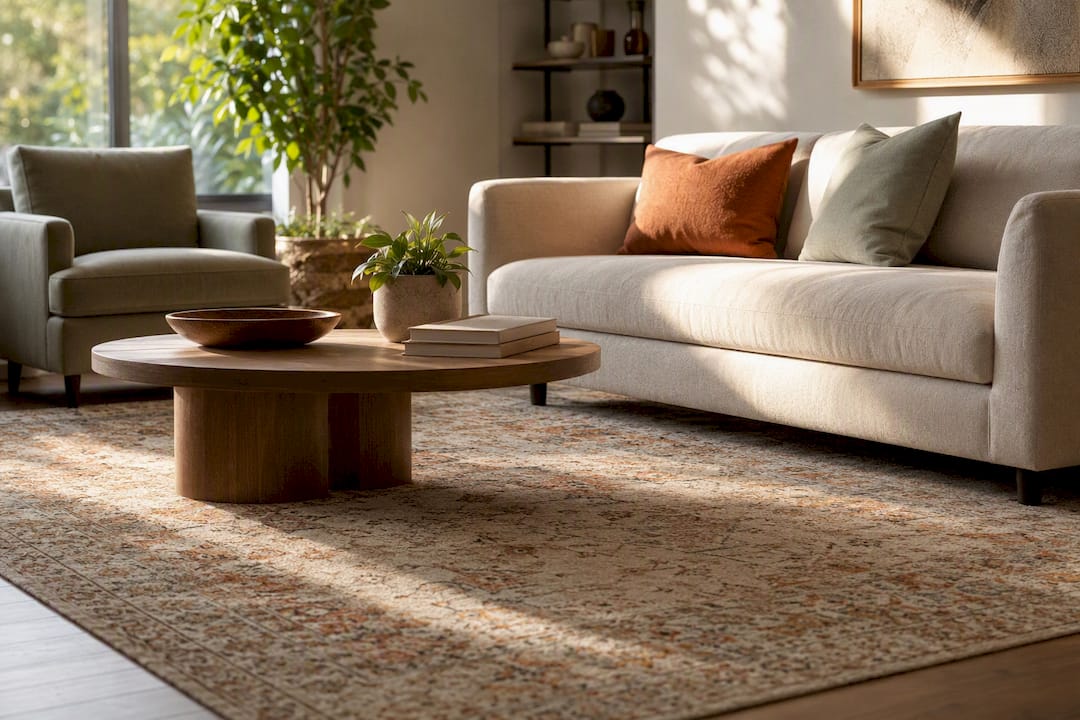
Front legs only is the practical middle ground. The front two legs of the sofa (and any accompanying chairs) touch the rug, while the back legs stay on bare floor. This works well in living rooms where a rug sized for “all legs on” would run wall-to-wall, or where budget rules out a 10×14. It still visually connects the seating to the rug, which is the part that matters. You lose a little of the grounded feeling of full coverage, but you gain flexibility in size and price.
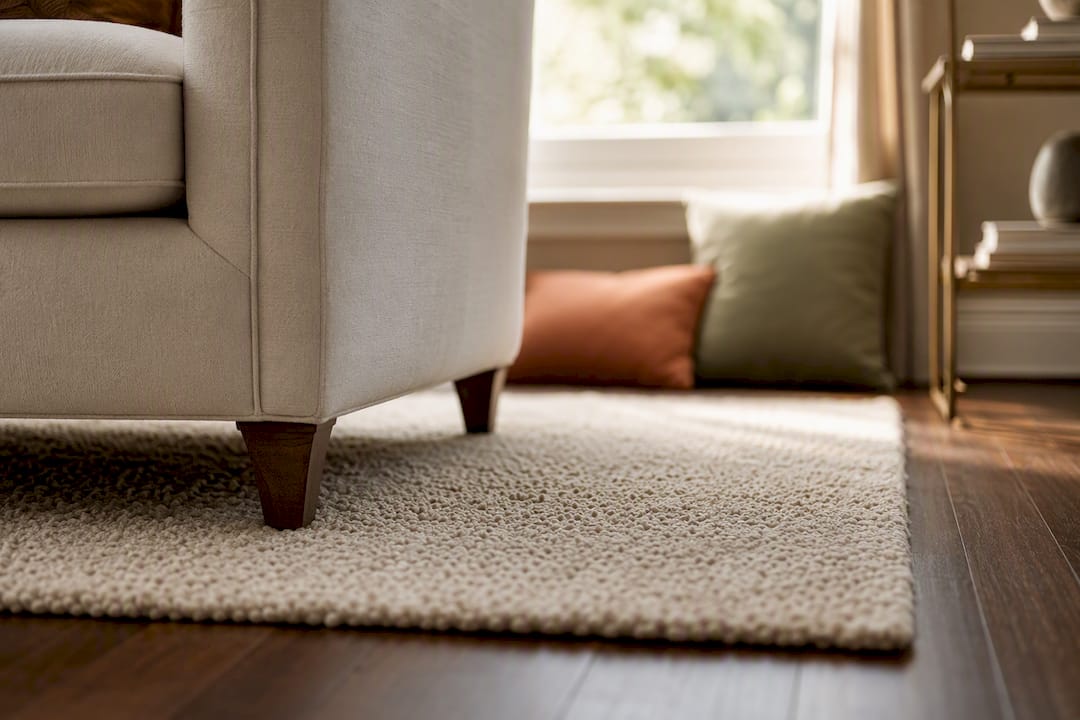
Floating in front means the rug sits entirely in front of the sofa, usually just under the coffee table, with no part of the sofa touching it. This is the weakest of the three options for a main living room because it visually separates the seating from the rug rather than uniting it. It works, though, in small apartments where a bigger rug simply won’t fit, in rooms where the sofa backs against a wall with almost no clearance, or as a secondary rug layered in front of a larger one.
Here’s how sofa length lines up with workable rug sizes for each method:
- Sofa under 72 inches, all legs on: minimum 8×10, ideally 9×12.
- Sofa 72 to 96 inches, all legs on: 9×12 minimum, 10×14 for breathing room.
- Any sofa length, front legs only: 6×9 or 8×10 can work if the room is tight.
- Small rooms, floating: 5×8 or 6×9 under the coffee table alone.
Pro Tip: If you’re torn between two sizes, go with the bigger one. A rug that’s too large can always be styled with furniture pulled slightly inward, but a rug that’s too small can’t be fixed without buying again.
What Rug Size Fits Your Sofa and Room?
The math behind rug placement under sofa setups comes down to two numbers: how long your sofa is, and how much clearance you have on either side. Once you know those, the size chart practically writes itself.
- Sofa 72 to 80 inches: 8×10 works in a tighter room; 9×12 is the better fit if you have the floor space.
- Sofa 84 to 96 inches: 9×12 is the baseline; 10×14 gives more margin in open-plan rooms.
- Sofa 96 inches or longer: 10×14 or larger, especially if a loveseat or accent chairs share the same rug.
The edge rules scale with the room. In a compact apartment living room, 6 to 8 inches of rug beyond each side of the sofa reads as generous without eating into walking space. In a larger, open-concept room, that margin should stretch to 12 to 18 inches, and sometimes 18 to 24 inches, because a rug that only barely peeks past the sofa in a big room looks stingy rather than intentional. Bigger margins let a rug visually anchor a wider seating group, which is exactly why designers scale up the border as the room grows rather than keeping it fixed.
Before you buy anything, test it. Painter’s tape is the cheapest sizing tool you’ll ever use: mark the exact rug footprint on your floor with blue tape and live with it for a day or two. Walk the path you normally take to the kitchen or hallway. Sit on the sofa and see how the proportions feel from that angle, not just standing in the doorway. If the taped rectangle looks smaller than you expected once furniture is around it, that’s usually a sign to size up, not down.
The most common sizing mistake, and it’s not close: buying a rug that’s too small for the seating group is the single error that shows up more than any other in living room layouts. A rug that stops several inches short of the sofa on every side looks like a bath mat under a piece of furniture built for a much bigger space. When you’re stuck between two sizes, the safer bet is nearly always the larger one.
How Should You Size a Rug for a Sectional or Chaise?
Sectionals break the simple sofa-length formula because the chaise adds depth that a straight rug measurement misses. Measure the sectional’s full footprint, chaise included, not just the back cushion length.
Once you have that footprint, add at least 18 to 24 inches beyond each exposed side where the room allows it. That extension is what keeps a large sectional from looking like it’s sliding off the rug on one end while the other end floats over bare floor.
- Standard three-piece sectional: 9×12 is usually the minimum workable size.
- Oversized or U-shaped sectional: step up to 10×14 or larger to keep every seat grounded.
- Sectional with chaise: measure chaise depth separately; a rug that fits the main sofa run but stops short of the chaise looks unfinished.
Alignment matters as much as size. Run the rug parallel to the sectional’s longest side, and make sure the coffee table sits fully on the rug rather than half on, half off. A coffee table straddling the rug’s edge is one of the fastest ways to make an otherwise well-sized rug look miscalculated.
In open-plan rooms where a sectional also has to define a walking path to a kitchen or entry, rug placement under the sofa doubles as traffic control. A rug that runs too far into a walkway invites furniture to be pushed back to avoid tripping over the edge, which throws off every other measurement you just calculated. For unusually large or irregular sectional footprints, layering a big neutral rug with a smaller patterned one on top can define separate zones (a reading corner versus the main seating area) without paying for a custom-cut rug. It’s a workaround worth knowing before you assume a nonstandard shape means a nonstandard budget.
How Do You Measure and Test Before You Buy?
Getting rug placement under a sofa right on the first try comes down to five steps you can do in an afternoon, with nothing more than a tape measure and a roll of painter’s tape.
- Measure the sofa’s width and depth, plus the full seating group if chairs or a loveseat share the rug. Note where the coffee table sits relative to the sofa.
- Calculate candidate sizes using the sofa-length mapping: shorter sofas lean toward 8×10 or 9×12, longer sofas and sectionals toward 9×12 or 10×14.
- Tape out the footprint. Use painter’s tape to outline each candidate size directly on the floor, then live with it for a day or two before committing.
- Order a rug pad sized correctly. Cut the pad about 1 inch smaller than the rug on every side so no pad edge peeks out. A quarter-inch felt-and-rubber pad is the standard recommendation because it grips hardwood without damaging the finish while still adding cushion underfoot.
- Let the rug relax for 24 to 72 hours after unboxing before final placement. Rolled rugs need time to lie flat, and pressing furniture onto a still-curling rug can leave uneven wear patterns.
Pro Tip: Do the tape-out test at the time of day you actually use the living room most. Afternoon light can make a floor look bigger than it does in the evening, and that changes how a taped rug outline reads.
Once the rug is down and settled, do one final check: sit in every seat in the group and make sure no chair leg teeters on the rug’s edge. A leg balanced right on the border is a tripping hazard waiting to happen, and it’s the kind of detail the tape-out test won’t always catch until furniture is actually in place. If your room combines a rug with a carefully styled coffee table, center the table on the rug first, then adjust the sofa around it rather than the other way around.
Which Rug Material and Pile Height Work Best Under a Sofa?
Material and pile height decide whether a well-sized rug still looks good in a year, so they deserve as much attention as the dimensions.
- Low-pile, flatweave, or kilim rugs handle heavy foot traffic and furniture weight best. They’re the right call under rolling office chairs or in high-traffic living rooms, and they’re easier to vacuum without crushing.
- Medium-pile rugs hit the best balance for most living rooms. They’re soft enough underfoot but structured enough that sofa legs don’t sink in and leave permanent dents.
- High-pile or shag rugs look luxurious in photos but tend to mat down under heavy furniture legs over time, and they trap dust and pet hair more than a flatweave does. Save shag for open floor areas rather than directly under a sofa’s full weight.
Fiber matters too. Wool holds up to years of daily use and resists staining better than most synthetics, though it costs more upfront. Synthetic blends, including many machine-washable options, trade a little bit of that longevity for lower cost and far easier cleaning, which matters if pets or kids are part of the household. Natural fibers like jute add texture but wear faster under constant furniture weight and aren’t the best pick directly beneath a sofa. If you’re deciding between hand-knotted and tufted construction, the difference in pile density and durability is worth understanding before you commit to a price point.
What Are the Most Common Rug Placement Mistakes?
Most rug problems trace back to one of four fixable errors, and you can usually spot them from across the room.
- Postage-stamp rug: the rug is dramatically smaller than the seating group. Fix it by sizing up to the next standard dimension, or layer a larger neutral rug underneath the existing one as a stopgap.
- Uneven borders or an off-center rug: measure from each wall to the rug’s edge and adjust until the margins match on opposite sides. A rug shifted two inches off-center is more noticeable than most people expect.
- Pattern and scale conflicts: a bold rug pattern fighting with a patterned sofa or heavily patterned pillows makes a room feel busy. Pick one dominant pattern per seating zone and keep everything else solid or textured.
- Rug sliding or crushing under furniture: this is almost always a pad problem. A proper rug pad, felt furniture coasters under the legs, or rug tape on hard flooring solves it without replacing the rug itself.
| Point | Details |
|---|---|
| Postage-stamp sizing | Size up to the next standard dimension rather than settling for a rug that isolates the sofa. |
| Border evenness | Measure wall-to-rug distance on opposite sides and adjust until margins match. |
| Pattern discipline | Choose one dominant pattern per seating zone to avoid visual clutter. |
| Pad prevents sliding | A rug pad with felt coasters stops shifting and crushing under sofa legs. |
Noble Abode and Stephane: How We Recommend Sizing Rugs
Noble Abode’s product selection is built around the same rules covered in this guide: rugs sized generously enough to anchor a sofa properly, in pile heights that hold up to daily use, and in materials easy enough to maintain that homeowners and renters alike can commit without worry.
The three rules that matter most when choosing a rug for a sofa: tape it out before you buy, cut the pad an inch smaller than the rug on every side, and when the size decision is close, choose the larger option rather than the smaller one.
These three habits, tape-out testing, correct pad sizing, and generous margins, come up in nearly every well-proportioned living room… Readers who’ve used this approach on their own rooms report.
Stephane’s other Noble Abode guides on best living room rugs and small living room decorating apply the same room-size-first logic to apartments and open floor plans where every inch counts.
A Stylist’s Take on Trade-Offs Worth Making
When a room forces a trade-off, size wins over pattern almost every time. A plain rug in the correct dimensions will make a living room look pulled together; a beautifully patterned rug that’s two sizes too small will not, no matter how good the pattern is on its own. The same logic applies to pile height in homes with pets or kids: durability beats plushness, because a rug that mats down or stains within a year isn’t saving anyone money by being the cheaper option upfront.
If you only take one thing from this guide, tape it out before you buy. It costs nothing but a roll of painter’s tape and an evening, and it catches sizing mistakes that photos and showroom floors never will.
Find the Right Rug Size for Your Sofa
Getting the size right matters more than the pattern, and that’s exactly where the Ornate Room Rug fits into the rules covered above. It comes in the 8×10 range that matches the sofa-length chart for most standard living rooms, with a medium pile that holds up under daily use without matting like a shag would, and a machine-washable construction that makes upkeep simple for households with pets or kids.
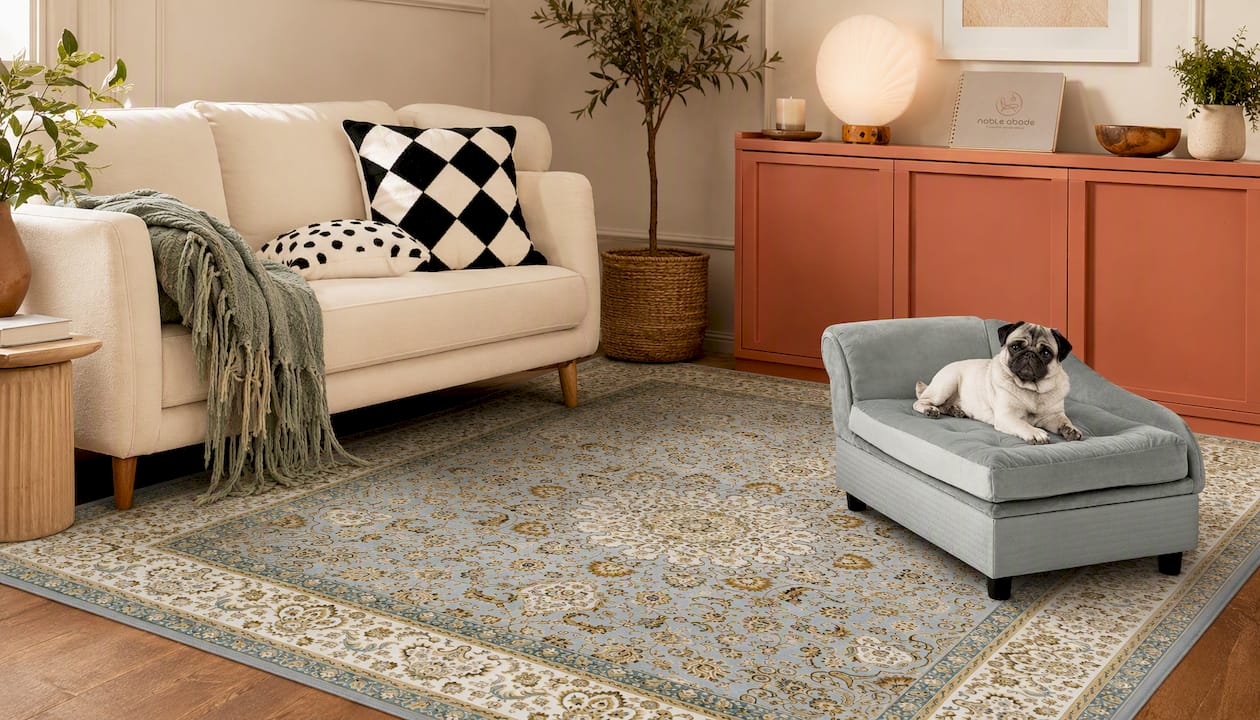
Pair it with a properly sized rug pad underneath, cut about an inch smaller on every side, and the rug will stay put instead of sliding under sofa legs. If your seating group includes a reading chair or an accent piece, the Retro Rabbit Fur Luxury Checkerboard Sofa Cushion adds texture that complements a floral rug without competing with it, and for pet owners styling the space around a sofa, the Luxury Small Dog Bed With Hidden Storage tucks into the same footprint without disrupting the rug’s lines.
Measure your sofa and room before you order. Tape out the footprint for a day, confirm it clears your traffic paths, and then check the Ornate Room Rug’s size options against your numbers before checkout.
Sources
- Rug Under Couch Rules: Complete Guide for Homeowners - D and G Flooring
- The Best Living Room Rugs (And Why Size Is the Mistake Everyone Makes) - Chris Loves Julia
- How To Choose The Right Rug Size For Your Living Room - Emily Henderson
- Stylish Rug Placement With Living Room Sectionals Made Easy
FAQ
What Is the Rug Rule for Sofas?
The core rule is that a rug should be large enough for either the front legs or all legs of the sofa to rest on it, with the rug extending 6 to 8 inches past the sofa’s sides in small rooms and 18 to 24 inches in larger ones.
Should a Rug Be Longer or Shorter Than a Couch?
A rug should generally be longer than the couch, extending past both ends and pulling the entire seating group onto it rather than leaving the sofa’s edges hanging off bare rug.
What Is the 2/3 Rule for a Sofa and Rug?
There’s no single universally defined “2/3 rule” in the sourced sizing guidance here; the more consistent principle is designers favor larger rugs that seat the whole group rather than a rug sized to roughly two thirds of the sofa’s length.
Where Should a 9×12 Rug Be Placed Under a Sectional Sofa?
A 9×12 rug should sit under the full sectional footprint, chaise included, with the rug’s edges reaching as close as possible to the 18 to 24 inch extension rule beyond exposed sides; it’s the minimum workable size for most standard three-piece sectionals.
Does a Rug Pad Really Matter Under a Sofa?
Yes. A rug pad cut about 1 inch smaller than the rug on each side prevents sliding under sofa legs, cushions the rug, and protects the floor finish underneath.