

Hallway Runner Size Guide for Homeowners
For most U.S. hallways, the right hallway runner size leaves 4–6 inches of bare floor visible on each side and stops 12–18 inches short of doorways or hall ends. Two formulas cover the majority of situations:
- Runner width = hallway width minus 8–12 inches
- Runner length = hallway length minus 12–18 inches
Quick example: a 42-inch-wide hall calls for a 30-inch runner. A 12-foot hallway works well with a 10-foot runner. Standard runner rug sizes run 2–3 feet wide and 6–14 feet long, with 2’6" and 3’ widths being the most common.
Key Takeaways
The most reliable hallway runner sizing rule is to leave 4–6 inches of bare floor on each side and stop the runner 12–18 inches short of doorways, then confirm door clearance before ordering.
| Point | Details |
|---|---|
| Length rule | Runner length = hallway length minus 12–18 inches; stop 6–12 inches from each doorway or threshold. |
| Measure first | Record narrowest wall-to-wall width, walking path length, door swing arcs, and vent positions before shopping. |
| Pile and pad | Keep total runner-plus-pad stack under 1/2 inch for doors that swing over the runner; use a 1/8-inch pad as the default. |
| Noble Abode | Clear product specs on Noble Abode listings make it straightforward to match measured dimensions to in-stock runners and decor. |
Table of Contents
- What is the right hallway runner size for your space?
- How much floor should show on each side of a runner?
- How long should a hallway runner be?
- How do you handle doors, vents, stairs, and furniture?
- Common runner sizing mistakes and how to fix them
- Which materials and pile heights work best in a hallway?
- An editorial perspective on runner sizing
- Noble Abode: curated decor to complete your hallway
- Sources
- FAQ
What is the right hallway runner size for your space?
Getting the hallway runner size right starts with one measurement session before you shop. Here is a step-by-step checklist.
Step-by-step measurement checklist
- Measure wall-to-wall width at three points: near the entry, at the midpoint, and near the far end. Use the narrowest reading for your runner width calculation.
- Measure the walking path length from where you want the runner to start to where you want it to stop. This is your working length, not the full room length.
- Check every door swing along the hall. Stand at each door, open it fully, and note where the arc ends on the floor. Your runner must clear that arc by at least 6 inches.
- Locate floor vents and radiators. A runner sitting over a vent blocks airflow. Mark those positions on your measurement sketch.
- Check thresholds. Stop the runner at least 6–12 inches before any raised threshold or transition strip to avoid a trip hazard.
- Note furniture legs. Console tables and benches in the hall look best when all four legs sit either fully on or fully off the runner. Measure leg positions relative to the wall.
Key numbers to record:
- Narrowest wall-to-wall width (inches)
- Desired start point to desired stop point (feet and inches)
- Distance from start point to nearest door threshold
- Pile clearance needed under each door (see Section 7)
A proportional cross-check: runner width should be roughly 50–70% of hallway width. For a 48-inch hall, that puts you between 24 and 34 inches, which aligns with the 4–6 inch border rule.
How much floor should show on each side of a runner?
The 4–6 inch border is the standard. Experts recommend starting with visible floor borders of roughly 4–6 inches on each side as the primary sizing rule, then adjusting width and length to match hall proportions.
Width matching table
For a standard 36-inch hallway, a 24–27 inch runner is ideal. Wider corridors in the 48–60 inch range suit a 30–36 inch runner well.
Why not wall-to-wall? Exposed floor on both sides creates a visual frame that helps the hall appear wider and more intentional. A runner that fills the full width risks resembling partial wall-to-wall carpeting.
Very narrow halls (under 30 inches): Designers recommend at least 3 inches between the rug edge and wall when space is tight. A 3-inch border is acceptable; anything less looks crowded.
Grand or wide hallways (60 inches or more): A single wide runner still works, but two parallel runners with a gap of 6–8 inches down the center can look more deliberate and are easier to source in standard widths.
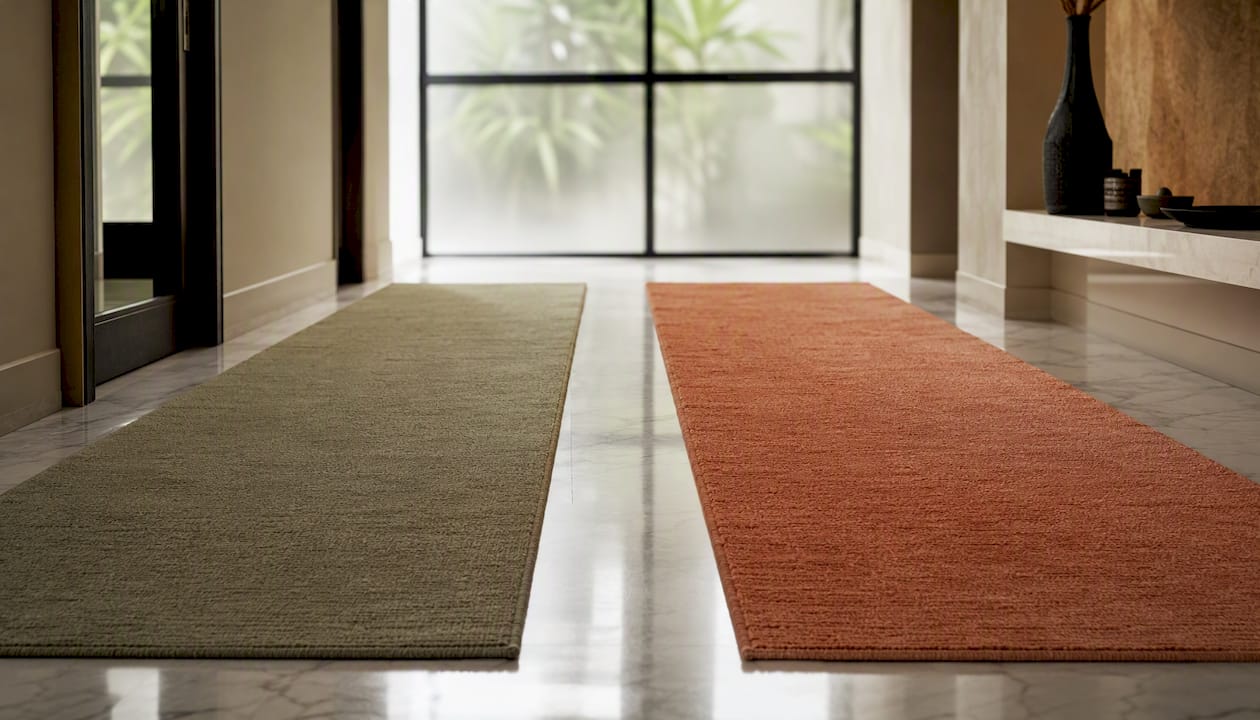
Pro Tip: When two standard widths both fall within the 4–6 inch rule, choose the slightly narrower one for high-traffic halls (easier to clean around) and the slightly wider one for formal entry halls where visual weight matters more.
How long should a hallway runner be?
Length is where most buyers go wrong. The practical formula is runner length = hallway length minus 18 inches, leaving roughly 9 inches at each end. For halls with doorways at both ends, stop the runner 12–18 inches short of each threshold.
Hallway length to runner length reference
| Hallway Length | Suggested Runner Length | Notes |
|---|---|---|
| 8 feet | 6 feet | Standard single runner |
| 10 feet | 8 feet | Standard single runner |
| 12 feet | 10 feet | Standard single runner |
| 14 feet | 12 feet or two 6’ runners | Near the limit of standard lengths |
| 18+ feet | Two runners | Gap of ~6 inches, placed away from thresholds |
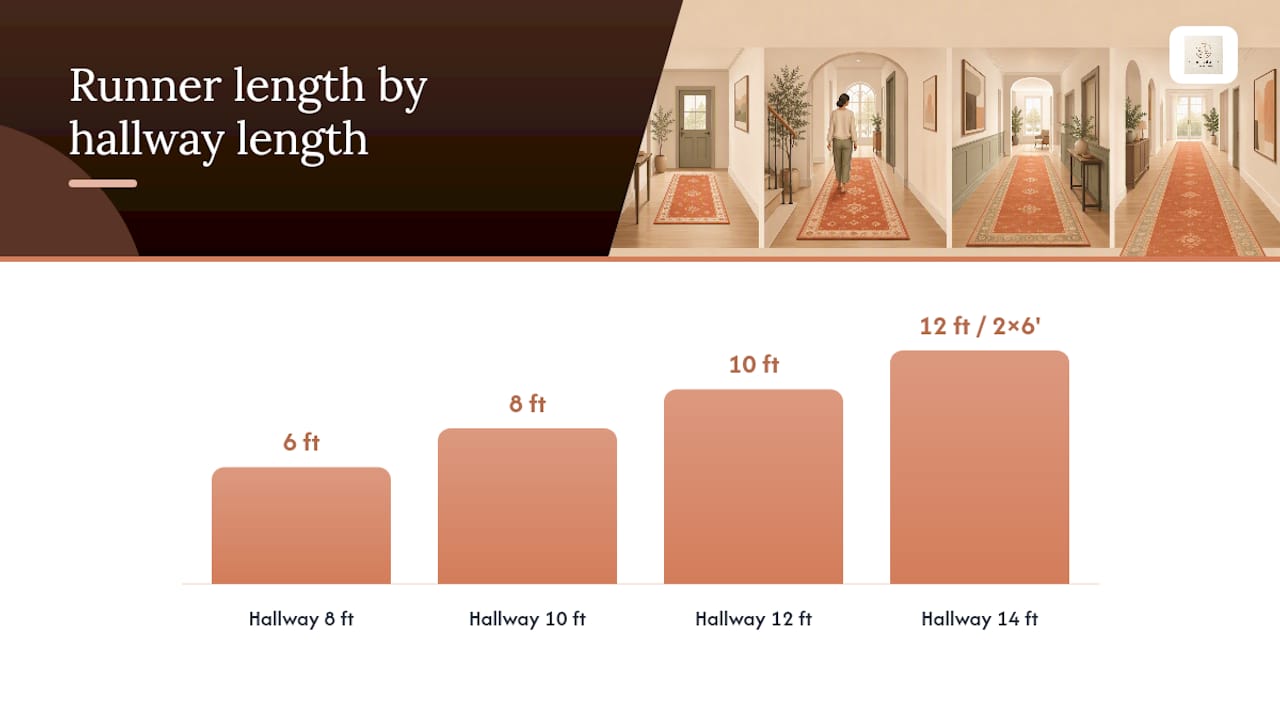
Runner rugs commonly come in lengths of 6, 8, 10, and 12 feet, so matching to these standard cuts keeps costs down and avoids custom orders.
Visual and safety notes on length:
- A runner that slides under a door threshold creates a trip hazard and wears the pile unevenly. Stop it short.
- Ending the runner at a natural visual break (a doorway, a stair nosing, a console table) looks more deliberate than ending it mid-hall.
- For very long corridors, two shorter runners work better than one awkwardly sized long piece. Place the gap between them away from door thresholds, not at them.
One runner vs. two runners:
A single runner is simpler and creates an uninterrupted line. Use two runners when the hall exceeds 14 feet, when a standard 12-foot runner would still leave an awkward gap, or when budget makes a custom length impractical. Position the gap at a neutral point, such as the midpoint between two doorways, never directly at a threshold where foot traffic concentrates.
How do you handle doors, vents, stairs, and furniture?
Placement details determine whether a runner looks intentional or like an afterthought. Work through this checklist before finalizing your order.
Before ordering, verify:
- Every door along the hall opens and closes freely over the runner (or over the rug pad plus runner stack). Test with a sample or measure door clearance precisely.
- Floor vents are fully exposed. Shift the runner start point if a vent falls within the runner’s footprint.
- Thresholds and transition strips are clear by at least 6 inches on the approach side.
- Stair nosings: if the runner leads to a staircase, stop it at least 2 inches back from the nosing edge so the transition is visible and safe.
- Console table or bench legs: decide in advance whether all legs sit on or off the runner. Legs straddling the edge pull the runner sideways over time.
Practical fixes for tight situations:
- Door clearance too tight: choose a lower-pile runner or a thinner pad (see Section 7).
- Vent in the runner’s path: shift the start point by 6–8 inches and adjust the length formula accordingly.
- Furniture legs straddle the edge: move the runner 2–3 inches toward center or choose the next standard width up.
- Stair transition awkward: use a separate stair runner rather than extending the hall runner.
Pro Tip: Use a thin, non-slip rug pad cut 1 inch smaller than the runner on all sides. In high-traffic spots, add professional-grade double-sided rug tape at the corners and along the leading edges to prevent shifting and reduce trip risk.
Common runner sizing mistakes and how to fix them
Most sizing errors fall into a short list. Recognizing them early saves a return trip.
- Runner too narrow. A 24-inch runner in a 42-inch hall leaves 9 inches of floor on each side, which looks thin and unbalanced. Fix: move up to the next standard width (30 inches).
- Runner too short. Stopping 3–4 feet short of the hall end looks unfinished. Fix: add a second runner or choose the next standard length up.
- Runner stops at the threshold. Placing the runner edge flush with a door threshold is a trip hazard and causes edge wear. Fix: pull it back 6–12 inches from the threshold.
- Door swing ignored. A runner that blocks a door from opening fully will curl, wear, and eventually tear. Fix: measure the door arc before ordering and choose a shorter runner or a lower-pile option.
- Thick high-pile runner in a narrow hall. Plush pile in a tight space makes the hall feel smaller and creates clearance problems under doors. Fix: switch to a flatweave or low-pile construction.
- Pattern running the wrong direction. A strong horizontal pattern in a narrow hall makes it feel shorter. Fix: choose a lengthwise stripe or a small-scale all-over pattern.
When none of the standard fixes work, a custom-cut runner is the right call. Flooring specialists and some rug retailers offer binding services that finish the edges of cut-to-length runners cleanly.
Which materials and pile heights work best in a hallway?
Material choice affects clearance, durability, and how often you need to clean. Hallways are high-traffic zones, so the wrong pile height or backing causes problems fast.
Material comparison:
- Wool and wool blends. Durable, naturally soil-resistant, and resilient underfoot. Higher price point, but wool runners in low-to-medium pile last years in busy halls.
- Synthetic (nylon, polypropylene). Stain-resistant, easy to clean, and available in most standard runner sizes. Nylon holds up well under heavy foot traffic; polypropylene works for lower-traffic halls and covered entryways.
- Cotton flatweave. Lightweight, washable, and low-profile. Good door clearance. Less durable than wool or nylon under constant traffic, but easy to replace.
- Jute and sisal. Natural texture, low pile. Hard underfoot and difficult to clean; better suited to low-traffic decorative halls than daily-use corridors.
Lower-pile constructions and flatweaves perform better in busy passageways than thick plush rugs because they reduce trip hazards and wear more evenly.
Pile height and door clearance:
Most interior doors have a clearance gap of 3/4 inch to 1 inch above the finished floor. A runner plus pad must stay under that gap. As a practical limit, keep total stack height (runner pile + pad) under 1/2 inch for doors that swing over the runner. Flatweaves and low-pile runners (pile height under 1/4 inch) paired with a 1/8-inch pad clear most standard doors without adjustment.
Rug pad selection:
- Use a non-slip pad cut 1 inch smaller than the runner on all sides.
- Pad thickness: 1/8 inch for low-clearance doors; up to 1/4 inch where clearance allows.
- Most interior doors require less than 1/4 inch of extra stack height before the door begins to rub.
- Felt-and-rubber combination pads grip both hard floors and the runner backing without damaging hardwood finishes.
Maintenance in high-traffic halls:
- Vacuum low-pile runners weekly; rotate reversible runners every 6 months to even out wear.
- Spot-clean synthetic runners immediately after spills; wool runners benefit from professional cleaning once a year.
- Standard-length runners are easier and cheaper to replace than custom-cut pieces when wear becomes uneven.
Pro Tip: For halls with multiple doors, choose a flatweave runner and a 1/8-inch pad as your default. You avoid clearance problems at every door without measuring each one individually.
An editorial perspective on runner sizing
Most people overthink the pattern and underthink the pile height. A beautiful runner that catches on every door swing, or one that sits 2 inches from the wall on one side and 8 inches on the other, undermines the whole effect. The 4–6 inch border rule and the length-minus-18-inches formula exist because they work across the widest range of standard U.S. hallways. Start there, confirm door clearance, and then choose the style. Getting those numbers right before you fall in love with a pattern is the order that actually saves time.
Noble Abode’s approach to soft furnishings reflects this: clear product specs, consistent sizing, and designs that hold up in daily use. For readers who want to explore complementary stylish home decor ideas beyond the runner itself, the Noble Abode blog covers practical styling for every room.
Noble Abode: curated decor to complete your hallway
Measuring first is the right move. Once you have your width and length numbers, Noble Abode’s product pages list clear dimensions, pile details, and material specs so you can confirm fit before checkout.
Quick buying checklist:
- Narrowest hall width recorded (use for runner width formula)
- Walking path length recorded (use for runner length formula)
- Door clearance confirmed (pile + pad under 1/2 inch for swinging doors)
- Pad thickness selected (1/8 inch or 1/4 inch based on clearance)
- Return policy reviewed before ordering
Browse Noble Abode’s curated selection of home accents, including abstract art sculptures and decorative statement pieces that pair well with a new runner in an entry hall or corridor. For a complete look, visit Nobleabode to find pieces that match your measured space and personal style.
Sources
- Rugsize
- Hallway Runners For Every Budget And The Rules You Should Know - Emily Henderson
- How big should a hallway runner be? Experts reveal | Ideal Home
FAQ
How big should a runner be for a hallway?
A hallway runner should leave 4–6 inches of bare floor on each side and stop 12–18 inches short of doorways. For a 36-inch-wide hall, a 24–27 inch runner is the standard recommendation.
Should a hallway runner be as long as the hallway?
No. The runner should be shorter than the hallway, typically by 12–18 inches total. Use the formula: runner length = hallway length minus 18 inches, leaving roughly 9 inches clear at each end.
Is a 3x5 rug a runner?
A 3x5 rug is generally considered a small area rug, not a runner. Standard runner rug sizes are 2–3 feet wide and 6–14 feet long; a 3x5 is too short and proportionally wide to function as a hallway runner in most spaces.
What is the size of a typical runner rug?
Typical runner rug sizes are 2’6" x 8’, 2’6" x 10’, and 3’ x 12’. Widths of 2’6" and 3’ are the most common in U.S. retail, with lengths of 6, 8, 10, and 12 feet covering the majority of standard hallway lengths.