

Coffee Table Styling Made Easy: A Stylist's Formula
The core recipe: place a tray, arrange objects in odd-numbered groupings at high, medium, and low heights, and leave a significant portion of the surface empty for drinks and remotes. That single formula covers 90% of what makes a coffee table look intentional.
Quick-start checklist — done in 10–15 minutes:
- Pick a tray sized to roughly one-third of your table’s surface
- Stack 2–3 books to build a medium-height base (roughly 3–6 inches total)
- Add one tall vase or sculptural piece (12–18 inches)
- Set one low bowl or candle at the front edge (1–3 inches)
- Step back and remove anything that crowds the tray
Keep at least one clear zone for a glass or a remote. The sections below cover how to adapt this recipe to your table shape, aesthetic, and household.
Table of Contents
- Which styling approach fits your living room?
- Designer rules that make every arrangement work
- What objects to put on a coffee table
- How to style by table shape and size
- Mixing materials and textures without creating clutter
- Common coffee table styling mistakes and how to fix them
- A 10–15 minute step-by-step styling routine
- The high–medium–low rule: exact dimensions designers use
- Styling checklist and shopping categories
- Key Takeaways
- The case for styling real homes, not showrooms
- Noble Abode pieces that fit the formula
- Useful sources
- FAQ
Which styling approach fits your living room?
Three distinct looks, one underlying formula. The difference is in what you prioritize: restraint, personality, or durability.
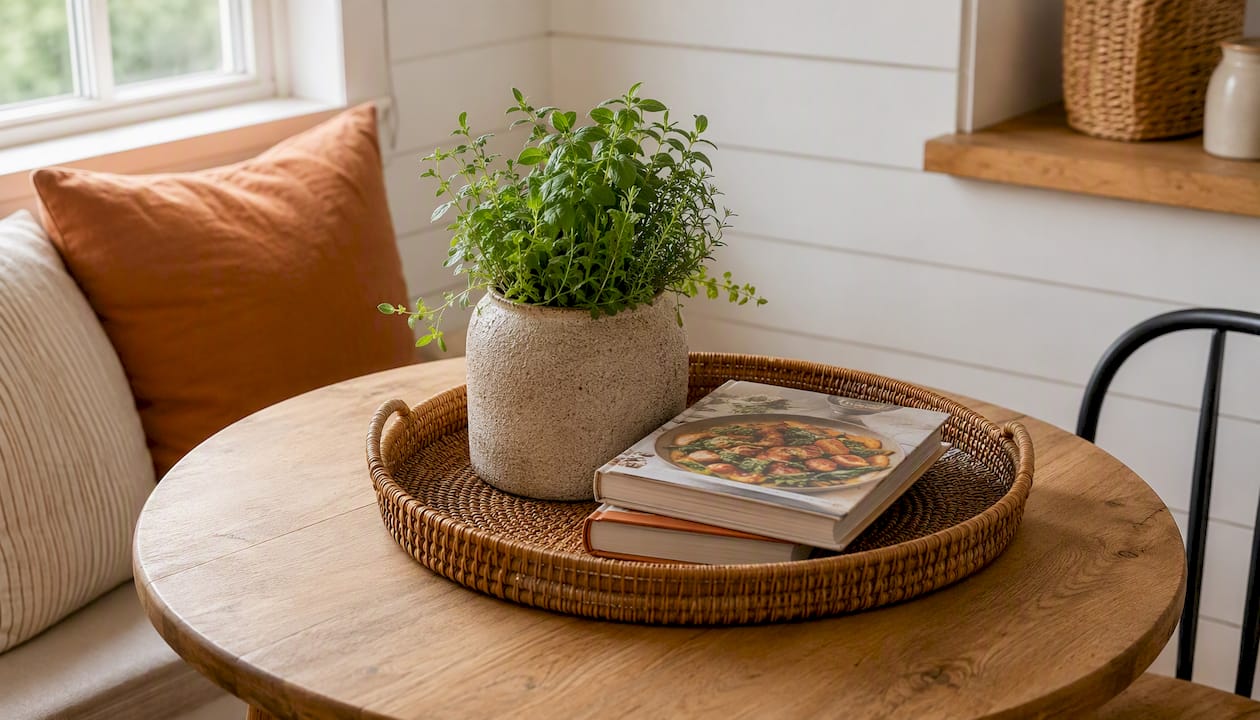
Minimal and negative-space focused
One tray, one stack of two books, one ceramic vase, and nothing else. The surface does most of the work. This approach suits small apartments, staged homes, and anyone who resets the table daily. Color stays neutral — white, stone, warm gray. The organic element is a single stem or a small succulent in a matte pot.
Layered and curated-collector
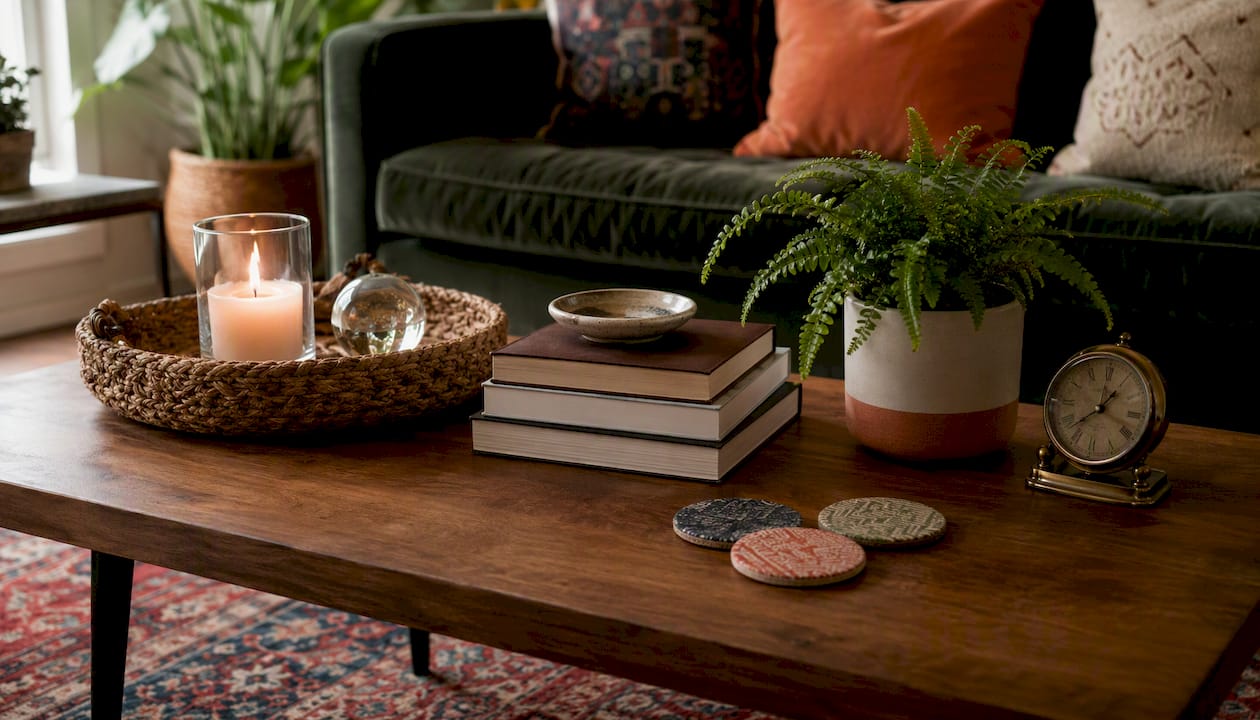
Three to four groupings across the table: a tray with a candle and a small sculpture, a book stack topped with a decorative bowl, and a trailing plant or branch in a tall vase. Textures mix deliberately — polished metal next to raw linen, ceramic next to wood. This look rewards personality-driven objects: a travel souvenir, a meaningful art book, a sculptural piece with a story. Designer Colin King recommends starting from a blank slate so each chosen object has room to breathe rather than compete.
Lived-in and family-friendly
Function leads. A lidded woven tray corrals remotes and coasters. Books are genuinely readable, covers facing the sofa. The sculptural piece is resin or solid wood — nothing that shatters. Colors pull from the room’s existing palette so the table reads coordinated even when a throw pillow lands on it. This approach works in households with kids or pets, where the table gets cleared and reset multiple times a day.
Designer rules that make every arrangement work
Good coffee table decor ideas follow a short list of rules that prevent the two most common failures: clutter and monotony.
- Odd numbers. Groups of three or five read as intentional; groups of two or four read as symmetrical and flat. Place objects in threes whenever possible.
- 30–50% negative space. Professional stylists consistently recommend keeping at least 30% of the surface clear. That open space is what makes the styled objects visible.
- Rule of thirds and zone grouping. Divide the table into thirds mentally. Each third gets its own cluster or vignette. Stacking books creates a visual triangle that pulls the eye across the surface rather than fixing it in one spot.
- The 2–3 rule for the center. Place two or three objects in the center grouping — one tall, one low, and optionally one medium. More than three in a single cluster starts to read as crowded.
Pro Tip: Orient book covers toward the nearest seating area. Books styled this way stay interactive rather than purely decorative — guests actually pick them up, which is the point.
What objects to put on a coffee table
Each item in a well-styled vignette has a job. Here is what each one does and why it earns its place.
- Tray. Organization and containment. A decorative tray corrals small items — remotes, coasters, a lighter — and makes clearing the surface a single motion. A marble tray adds weight and material contrast; a woven tray adds warmth.
- Vase. The tall element. A ceramic or sculptural vase at 12–18 inches provides the vertical anchor the composition needs. An interlocking decorative vase or a modern ceramic vase both work well as the high point.
- Sculpture or figurine — The focal point. A small abstract sculpture at medium height gives the eye somewhere to land. Resin and solid wood options hold up in high-traffic homes.
For households with children or pets, swap fragile glass or delicate ceramics for wood, resin, or woven materials. The curated look stays intact; the accident risk disappears. For pet-friendly living room ideas that extend beyond the table, The Meow Picks covers cat-friendly furniture choices worth reading alongside this guide.
Material contrast matters throughout. Avoid placing a wood decorative piece directly on a wood table — the textures merge and the object disappears visually. Mix matte with polished, soft with hard, light with heavy.
How to style by table shape and size
Layout strategy changes with the footprint. The same objects arranged differently read balanced on one shape and chaotic on another.
Round tables and round ottomans used as coffee tables. Use a single centered cluster. One tray in the middle, objects grouped within it, and one element extending just beyond the tray edge. A round ottoman as a coffee table benefits from a firm tray on top — it creates a stable surface and defines the styling zone. Keep the arrangement low so it does not visually overpower the soft base beneath it.
Rectangular tables. Divide into two or three vignettes along the length. A long table with a single centered grouping looks sparse at the ends. Two clusters — one anchored by a tray, one by a book stack — fill the surface without crowding it. Leave the center third relatively open for practical use.
Square tables. A centered tray works well. Place the tall element at the back of the tray, the medium element in the middle, and the low element at the front. The symmetry of a square table supports a more formal arrangement.
Narrow or oversized tables. On a narrow table, keep objects slim and vertical — a tall vase and a single candle, nothing wide. On an oversized table, the tray should occupy roughly one-third to one-half of the surface width; anything smaller reads as a lost object on a large plane.
As a planning rule of thumb, leave about 18 inches between the sofa and the table edge for comfortable traffic flow. When a single large table feels too dominant for the room, two smaller side tables placed close together often solve the problem while adding flexibility.
Mixing materials and textures without creating clutter
The goal is contrast, not chaos. Two or three materials in deliberate combination read as curated; four or five read as collected without intention.
- Matte ceramic + polished metal. The most reliable pairing. Matte absorbs light; polished reflects it. The tension between them creates visual interest without requiring additional objects.
- Woven tray + stone or marble surface. Warmth against weight. A woven or rattan tray on a marble or stone table introduces organic texture that softens the hard surface.
- Soft textile + hard sculptural piece. A linen-covered book or a fabric-wrapped box next to a resin or metal sculpture creates the same push-pull effect.
What to avoid:
- Wood object on a wood table (textures cancel each other)
- All-matte surfaces with no reflective element (the arrangement reads flat)
- Identical finishes across every object (chrome candle holder, chrome tray, chrome vase — too uniform)
- More than two objects in the same color family without a neutral to separate them
Color coordination follows a simple rule: repeat one color from the room in at least one table object. If the sofa has a navy pillow, a navy book cover or a dark ceramic vase ties the table to the room. For pillow and textile pairing ideas, Noble Abode’s decorative pillow guide covers color repetition in detail.
Common coffee table styling mistakes and how to fix them
Most tables that look “off” have one of five problems. Each has a fast fix.
Overcrowding. Too many objects, no clear focal point. Fix: remove items one at a time until the tray holds three objects maximum. The instinct is to add; the skill is to subtract.
Identical heights. Every object sits at the same level. Fix: introduce a tall vase or a book stack to create the high–medium–low variation the arrangement needs.
Neglecting function. No room for a glass, no accessible spot for a remote. Fix: designate one clear zone outside the tray for practical items. Style around it, not over it.
Fragile pieces in high-traffic homes. A glass sculpture on a table that gets cleared twice a day is a liability. Fix: choose beautiful but durable pieces — resin sculptures, solid wood objects, woven trays — that survive daily use.
Everything centered. When all objects cluster in the exact middle, the ends of the table look abandoned. Fix: shift one grouping toward an end, or add a second small cluster to balance the composition.
Red flags that mean the vignette needs editing: no single object draws the eye first, every piece is the same height, or the table looks like a storage surface rather than a styled one.
A 10–15 minute step-by-step styling routine
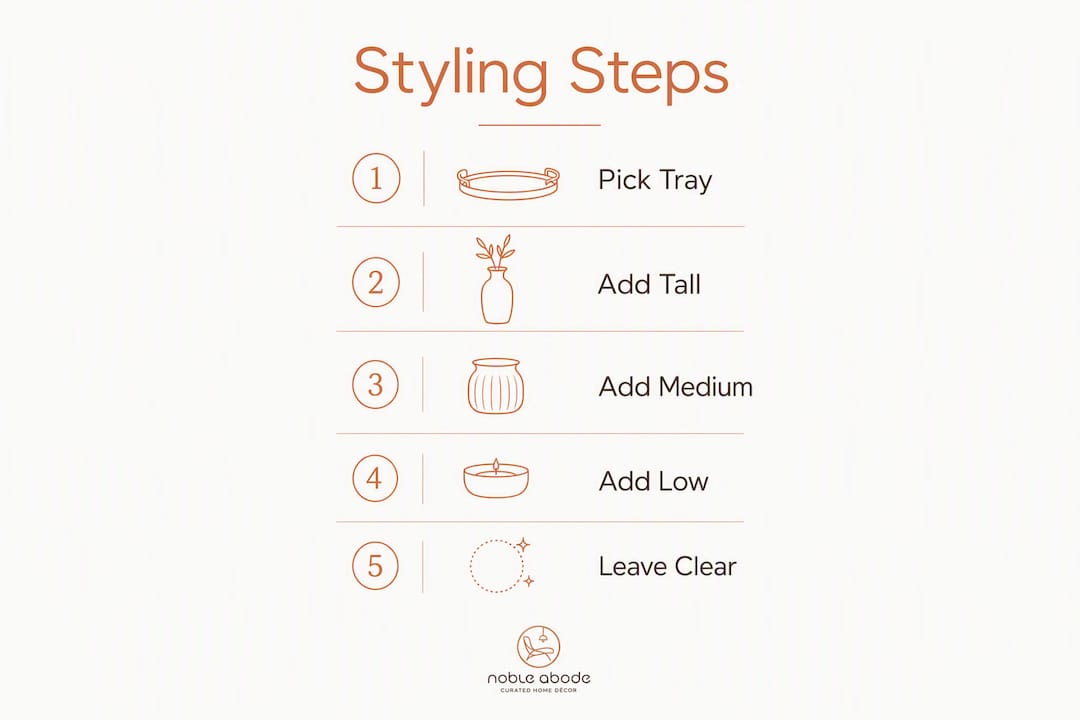
- Add the tall element — (1 minute). Position a vase or sculptural piece at the back of the tray or cluster. Target 12–18 inches in height.
The high–medium–low rule: exact dimensions designers use
The height formula is the single most reliable tool in coffee table styling. Designers recommend a tall element at roughly 12–18 inches, a medium element at 3–6 inches, and a low element at 1–3 inches.
| Element | Recommended height | Typical object |
|---|---|---|
| Tall | 12–18 inches | Vase, sculptural piece, tall candle |
| Medium | 3–6 inches | Book stack, decorative box, small sculpture |
| Low | 1–3 inches | Bowl, flat candle, small tray object |
| Surface to leave empty | 30–50% of total area | Clear zone for drinks and remotes |
The tray itself should occupy roughly one-third to one-half of the table’s surface on a large table. A tray corrals small items and makes resetting the table a single motion — lift the tray, wipe the surface, replace it. On a small table, the tray can cover more of the surface since the table itself defines the boundary.
Styling checklist and shopping categories
Styling session checklist
- Surface cleared before starting
- Tray or book stack placed as foundation
- Tall element added (12–18 inches)
- Medium element added (3–6 inches)
- Low element added (1–3 inches)
- Organic element included (plant, stem, or branch)
- 30–50% of surface left clear
- Photo check completed from seated height
- Fragile items swapped for durable alternatives if needed
Shopping list by category
- Trays. Size to one-third to one-half of table width on large tables; marble or woven for material contrast. Browse Noble Abode’s Luxury Gold Feather Table Tray for a polished option.
- Books. Two to three volumes; choose covers that repeat a room color. Hardcovers stack more cleanly than paperbacks.
- Vases. Tall ceramic or sculptural options at 12–18 inches for the high element. A modern vase for living room decor covers most color palettes.
- Bowls and low objects. Ceramic or stone; 4–8 inches in diameter for a standard tray. A decorative small desk clock also works as a low functional object.
- Candles. Pillar or jar style; unscented if the room already has a diffuser.
- Greenery. Small potted succulents, air plants, or a single stem in a bud vase. Replace stems every one to two weeks.
- Sculptural objects. Resin or solid wood for durability; abstract figures or geometric forms for a modern look.
Key Takeaways
The most reliable coffee table formula: tray plus high–medium–low heights plus odd-numbered groupings, with 30–50% of the surface kept clear for everyday use.
| Point | Details |
|---|---|
| Use the height formula | Combine a tall element (12–18 in), a medium element (3–6 in), and a low element (1–3 in) in every arrangement. |
| Keep negative space | Leave 30–50% of the surface clear so the table stays functional for drinks and remotes. |
| Tray as foundation | A tray sized to one-third to one-half of the table width corrals small items and makes resetting the surface fast. |
| Mix materials deliberately | Pair matte with polished, soft with hard — avoid repeating the same texture as the table itself. |
| Noble Abode for ready-to-use pieces | Noble Abode’s curated trays, vases, and sculptures map directly to the high–medium–low formula with no extra sourcing needed. |
The case for styling real homes, not showrooms
Most coffee table guides show arrangements that would last about four hours in an actual household. The books are pristine, the candle is unlit, and there is no remote in sight. That is editorial styling — useful as a reference point, not as a daily reality.
The formula in this guide is built for tables that get used. The tray exists precisely because remotes and coasters need somewhere to live. The durable sculpture is there because a resin piece survives a knocked elbow; a glass one does not. Leaving 30–50% of the surface clear is not a design preference — it is what keeps the table functional when someone sets down a coffee mug at 7 AM.
Styling is iterative. Start with the five-item recipe, live with it for a week, and edit from there. The tables that look best in real homes are the ones that have been adjusted a dozen times, not the ones arranged once and photographed.
Noble Abode pieces that fit the formula
Noble Abode’s curated decor range maps directly to the high–medium–low recipe. The Abstract Art Figure Decoration works as a medium-height focal point — compact enough for a tray, distinctive enough to anchor a vignette. For the low element, the Key Desktop Storage Decor doubles as a practical box and a styled object. The David Art Sculpture suits a curated-collector arrangement as the tall or medium anchor.

All Noble Abode pieces are selected for everyday durability — no fragile finishes that chip on contact, no materials that require special care. Each item ships ready to place. Browse the full range at Noble Abode and use the checklist above to match each piece to its role in your arrangement.
Useful sources
- How to Style a Coffee Table So It Never Looks Cluttered — Martha Stewart: practical advice on balancing aesthetics and function for everyday living rooms.
- The Coffee Table Styling Tricks Designers Swear By — The Spruce: source for the 30–50% negative-space guideline and zone-grouping rules.
- How to Style Coffee Table Decor — Vogue: Colin King’s blank-slate method and the role of negative space.
- You’re Styling Your Coffee Table All Wrong — House Beautiful: tray function and the one-tray-plus-books-plus-organic-element recipe.
FAQ
What is the 2–3 rule for coffee tables?
The 2–3 rule means placing two or three objects in the center grouping of a coffee table — typically one tall, one medium, and one low element. More than three objects in a single cluster tends to read as crowded rather than curated.
What can you put in the middle of a coffee table?
A tray with two or three objects inside it works best: one tall piece such as a vase, one medium piece such as a book stack or small sculpture, and one low piece such as a candle or bowl. Designers recommend including at least one organic element — a plant or stem — to soften the arrangement.
What are the most common coffee table styling mistakes?
Overcrowding, identical object heights, and ignoring function are the three most frequent errors. The fastest fix is to remove items until one object clearly draws the eye first, then confirm that at least 30–50% of the surface remains clear for everyday use.
Does a round ottoman work as a coffee table?
A round ottoman functions well as a coffee table when topped with a firm tray that creates a stable surface for drinks and decor. Keep the arrangement low and centered so it does not visually overpower the soft upholstered base.
How often should you refresh a coffee table arrangement?
Seasonal updates every two to three months keep the table from going visually stale. Swap the organic element monthly, rotate one decorative object with something from another room, and adjust colors to match seasonal textiles in the space.