

Hand Knotted vs Tufted Rugs: Which Should You Buy?
Hand-knotted rugs are built knot by knot on a loom with no adhesive, making them repairable and capable of lasting multiple generations. Hand-tufted rugs are made with a tufting gun that punches yarn through a canvas backing held together by latex adhesive, which typically degrades within roughly 5–15 years depending on quality and conditions. The short decision rule: choose hand-knotted for investment rooms and long-term ownership; choose hand-tufted for budget-conscious, temporary, or trend-driven spaces.
- Choose hand-knotted if you want a rug for a primary living room, dining room, or entryway where durability, repairability, and long-term value matter. Knot density (measured in knots per square inch, or KPSI) and the absence of any adhesive backing help indicate lasting quality.
- Choose hand-tufted if you need a softer, more affordable option for a bedroom, guest room, or rental space where a 5–15 year lifespan is acceptable and upfront cost is the priority.
Trust signals to check before buying: KPSI (100–300 for quality wool; 600+ for fine silk), structural fringe (warp extensions, not sewn-on trim), and a reversible pattern visible through the back of the rug.
Key Takeaways
Hand-knotted rugs outlast tufted alternatives by decades because they contain no adhesive backing that can degrade, making them repairable and worth the higher upfront cost for primary living spaces.
| Point | Details |
|---|---|
| Construction defines lifespan | Knotted rugs last 25–100+ years; tufted rugs typically last 5–15 years before latex failure. |
| Identification is simple | Flip the rug: visible knots and a mirrored pattern mean knotted; a cloth backing means tufted. |
| Total cost favors knotted | Multiple tufted replacements over 25–30 years often exceed the cost of one quality knotted rug. |
| Fiber choice matters within each type | Wool extends life in both constructions; viscose in tufted suits low-traffic, visual-only spaces. |
| Noble Abode’s selection | Noble Abode curates easy-care rugs, including machine-washable options, for buyers prioritizing low maintenance and style. |
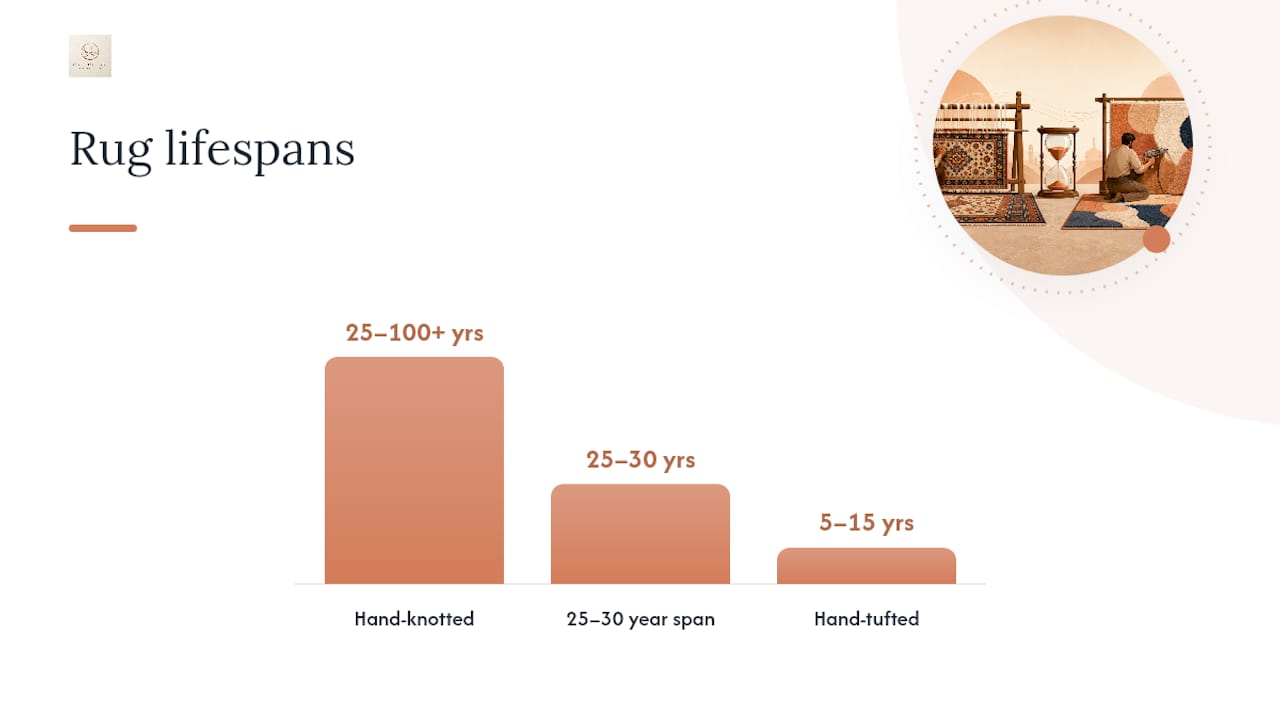
Table of Contents
- What is a hand-knotted rug?
- What is a hand-tufted rug?
- How do fiber choices affect durability and wear?
- How can you tell if a rug is hand-knotted or hand-tufted?
- Which rug type fits your room, budget, and lifestyle?
- The case for knowing what you are buying
- Noble Abode’s curated rug collection
- Further reading and reputable sources
- FAQ
What is a hand-knotted rug?
A hand-knotted rug is built entirely on a loom, where a weaver ties individual knots around pairs of warp threads, row by row, across the full width of the rug. There is no glue, no canvas, and no secondary backing. The pile, the foundation, and the fringe are all one unified structure.
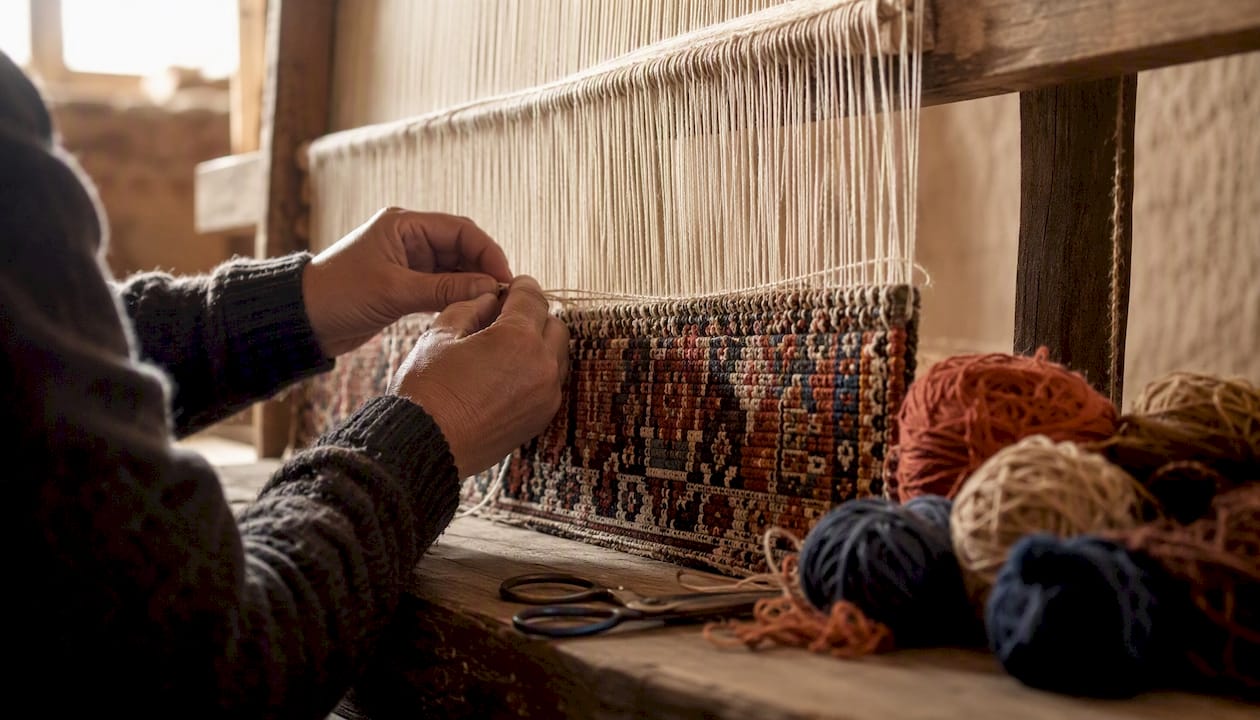
Knot density, expressed as KPSI (knots per square inch), is the primary quality indicator. A well-made hand-knotted rug typically falls in the 100–300 KPSI range for wool construction; fine silk pieces can exceed 600 KPSI. Higher KPSI means finer detail in the pattern, a denser pile, and generally a higher price. A 9x12 rug at 200 KPSI contains millions of individual knots, which explains both the production time (months, not weeks) and the price premium.
Lifespan is where hand-knotted construction separates itself most clearly. With proper care, these rugs can last multiple generations. Antique Persian and Turkish pieces from the 19th century still trade actively on the secondary market. When a hand-knotted rug is damaged, a skilled restorer can re-tie individual knots in the affected area, matching the original pile height and pattern. No adhesive layer means no irreversible failure mode.
The fringe on a hand-knotted rug is structural, not decorative. It is the exposed end of the warp threads that formed the rug’s foundation during weaving. Cutting or replacing it changes the rug’s structural integrity.
What is a hand-tufted rug?
A hand-tufted rug starts with a canvas stretched on a frame. A craftsperson uses a handheld tufting gun to punch loops or cut pile yarn through the canvas at speed. The process is faster than knotting by a significant margin, reducing production time from months to weeks, which is the primary reason tufted rugs cost less.
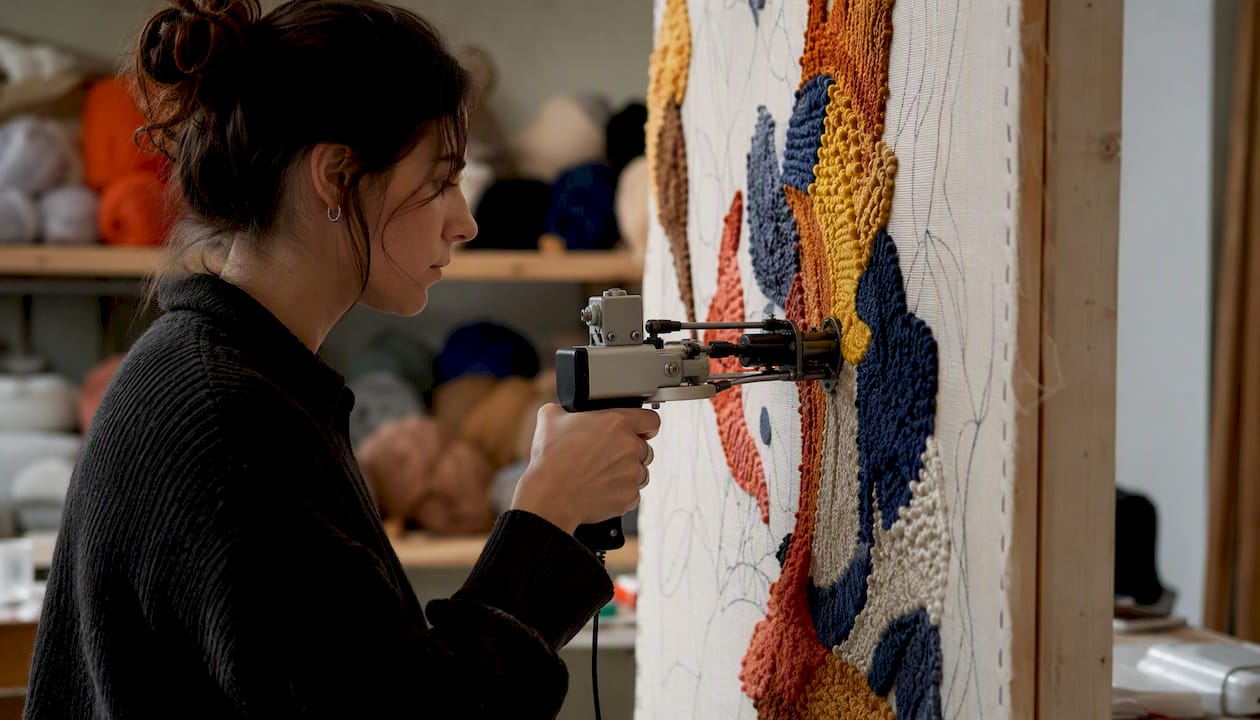
Once the tufting is complete, latex adhesive is applied to the back to lock the yarn in place. A secondary cloth or canvas backing is then glued over the latex to cover it. That latex layer is both the rug’s structural core and its eventual failure point.
The feel is noticeably different from a knotted rug. Tufted pile is softer and plusher initially, and early shedding is common because the yarn is held by adhesive rather than tied knots. Over time, as the latex dries and becomes brittle, the pile can loosen and the backing may crack or crumble. According to Fred Remmers Rug Cleaners, a practitioner-level restoration source, latex degradation causes irreversible structural failure, typically within 5–15 years depending on quality and conditions. Once the backing fails, the rug cannot be meaningfully repaired due to latex degradation.
Fringe on a tufted rug is almost always sewn or glued on separately. It is decorative, not structural.
How do fiber choices affect durability and wear?
Construction type sets the ceiling; fiber choice determines how close you get to it.
Wool is the most practical fiber in both construction types. In hand-knotted rugs, wool pile compacts under traffic over time, becoming denser and more resilient. In tufted rugs, wool extends lifespan compared to synthetics because the fiber itself holds up even as the backing ages. Wool also resists staining naturally and sheds less over time than viscose or synthetic alternatives.
Silk appears almost exclusively in hand-knotted construction. The fiber’s fineness allows KPSI counts above 600, producing the sharp pattern resolution and sheen that defines high-end Persian and Indian pieces. Silk tufted rugs exist but are uncommon; the fiber’s cost makes the tufting shortcut less economically logical.
Viscose and bamboo silk are frequently used in tufted rugs to mimic silk’s sheen at a lower price. The visual effect is appealing, but viscose is fragile under moisture and foot traffic. It crushes, stains easily, and cannot be wet-cleaned without risk of permanent damage.
- Wool + hand-knotted: best long-term durability, 25–100+ years
- Wool + hand-tufted: reasonable mid-range option, 10–15 years
- Viscose + hand-tufted: visual appeal only; expect 5–8 years in moderate traffic
- Synthetics (polyester, polypropylene) + hand-tufted: budget option; durable fiber but latex still limits total lifespan
A note on VOCs and sustainability: Latex-backed tufted rugs off-gas volatile organic compounds (VOCs) as the adhesive cures and again as it ages. Hand-knotted rugs with no adhesive have no equivalent off-gassing concern. For households with children, allergy sensitivities, or sustainability priorities, construction type matters beyond aesthetics. Rug construction guides consistently note that tufted construction’s reliance on synthetic adhesive also limits recyclability at end of life.
When viscose sheen is the design goal and the space is low-traffic (a bedroom accent, a reading nook), a tufted viscose rug is a reasonable choice. For any room where the rug will anchor daily life, wool in a knotted construction is the more defensible investment.
How can you tell if a rug is hand-knotted or hand-tufted?
These four checks work in-store, at home, or when reviewing seller photos online.
- Flip the rug and examine the back. A hand-knotted rug is reversible: the pattern reads through clearly on the underside, and you can see individual knots. A hand-tufted rug has a cloth or canvas backing glued over the latex, hiding the construction entirely. This single test is the most reliable differentiator, as confirmed by rug industry glossary sources.
- Inspect the fringe. On a knotted rug, fringe is the exposed end of the warp threads. It emerges from the rug’s body and cannot be pulled away cleanly. On a tufted rug, fringe is sewn or glued onto the edge. Tug gently: if it separates easily from the body, it is attached, not structural.
- Count knots or look for pattern mirroring. On the back of a knotted rug, you can count individual knots per square inch. On a tufted rug, the backing obscures any such count. If the pattern on the back is a mirror of the front, the rug is knotted.
- Bend the rug and feel the pile. Knotted rugs are denser and less flexible. Tufted rugs feel plusher and bend more easily because the pile is held by adhesive rather than tied structure.
Pro Tip: When buying online, request three specific photos from the seller: a close-up of the back showing the full surface (not just a corner), a close-up of the fringe where it meets the rug body, and a full pile view from a low angle. These three images will confirm construction type before purchase.
Label language can mislead. “Handmade” does not mean hand-knotted. A tufted rug made with a hand-operated tufting gun is technically handmade. Look specifically for “hand-knotted” or “hand-tied,” and ask the seller directly whether there is a fabric backing glued to the underside.
Which rug type fits your room, budget, and lifestyle?
Construction choice should follow use-case, not just preference.
Rooms that justify hand-knotted:
- Living rooms and dining rooms with daily foot traffic, where a rug anchors the space for years
- Entryways, where abrasion resistance and repairability matter
- Any room where the rug is a design centerpiece or a long-term investment
Rooms where tufted works well:
- Bedrooms and guest rooms with light traffic
- Rental apartments or temporary living situations where replacement is expected
- Trend-driven spaces where the design will change in 5–10 years anyway
Budget guidance: If the upfront cost of a quality hand-knotted rug is a barrier, the more useful question is replacement cost over time. A tufted rug at $400 replaced every 10 years costs $1,200 over 30 years. A knotted rug at $1,200 that lasts 30+ years with one professional cleaning every few years is often the lower total cost. Trade buyer analysis treats these as separate product categories precisely because the economics are different, not just the price tags.
Pets and kids: Hand-knotted wool rugs handle pet traffic and spills better over the long term because they can be wet-cleaned and repaired. Tufted rugs with latex backing should not be wet-cleaned aggressively, which limits recovery from pet accidents. For households with heavy pet use, a knotted wool rug in a medium KPSI range (100–200) is more practical than a plush tufted alternative, even at higher upfront cost. For pet-friendly home setups, pairing a durable rug with the right accessories makes maintenance easier across the board.
The case for knowing what you are buying
The rug industry’s terminology has always been loose, and “handmade” is the most overused word in it. A tufted rug made with a hand-operated gun qualifies as handmade by most definitions, yet it shares almost nothing structurally with a hand-knotted piece. The difference is not a matter of prestige. It is a matter of what happens to the rug in year 12.
What most buyers underestimate is the latex failure timeline. A tufted rug does not gradually wear out the way a knotted rug does. It performs well, then the backing cracks, and the rug is effectively finished. There is no gradual decline that signals “time to repair.” The failure is sudden and irreversible. For a bedroom or a guest room, that is a manageable outcome. For a living room where the rug cost $600 and anchors the entire space, it is a frustrating surprise.
The smarter framing is to treat knotted and tufted as different product categories with different economics, not as a quality hierarchy. Tufted rugs are not inferior products. They are purpose-built for affordability, speed, and design flexibility. Design teams use tufted construction deliberately for bold, modern patterns that would take far longer to produce in knotted form. The mistake is buying a tufted rug for a context that needs a knotted one, usually because the label said “handmade” and the price felt like a deal.
For investment rooms, buy knotted. For everything else, buy with clear eyes about the replacement timeline.
Noble Abode’s curated rug collection
Choosing between construction types is easier when the product selection is already filtered for quality and practicality. Noble Abode curates rugs and home decor with durability and easy maintenance as the baseline, not an afterthought.

For buyers who need a low-maintenance, washable option for a bedroom or rental space, the Ornate Room Rug is machine-washable, non-slip, and available in sizes up to 8x10. For buyers building a full room around a rug, Noble Abode’s decor range includes coordinating pieces like the Abstract Art Figure Decoration to complete the space without sourcing from multiple retailers. Browse the full collection at Noble Abode to filter by room, style, and maintenance preference.
Further reading and reputable sources
- Hand-Tufted vs. Hand-Knotted Rugs: 2026 Comparison Guide
- Hand Knotted vs Hand Tufted Rugs: Complete Comparison [2026]
- Hand-Knotted vs Hand-Tufted Rugs: A Trade Buyer’s Guide
- Hand-Knotted vs Hand-Tufted vs Hand-Loomed - Rug Glossary
- Rug Construction Methods Compared: Knotted, Tufted, Woven, Loomed | Kapetto
- Hand Knotted vs Hand Tufted Rugs — Fred Remmers Rug Cleaners
- Noble Abode
FAQ
How do you tell if a rug is hand-knotted or hand-tufted?
Flip the rug over. A hand-knotted rug shows visible knots and a mirrored pattern on the back; a hand-tufted rug has a cloth or canvas backing glued over the latex, hiding the construction. Also check the fringe: structural fringe that emerges from the rug body indicates knotted construction; sewn-on fringe indicates tufted.
Is a hand-knotted rug worth the higher price?
For primary living spaces and long-term ownership, yes. Hand-knotted rugs last 25–100+ years, can be repaired knot by knot, and often cost less per year of use than replacing tufted rugs on a 10–15 year cycle.
How long do hand-knotted rugs last?
With proper care, hand-knotted rugs typically last 25–100+ years. Antique pieces from the 19th century remain in active use, which is not possible with any adhesive-backed construction.
Are hand-tufted rugs worth buying?
Yes, for the right context. Hand-tufted rugs are a practical choice for bedrooms, guest rooms, and rental spaces where a 5–15 year lifespan is acceptable and upfront cost matters. The key is buying with a clear understanding of the latex backing’s lifespan and avoiding wet-cleaning methods that accelerate its degradation.