

Buy Right: A 3 Step Checklist for Picture Frame Mats and Noble Abode Styling
Buy pre-cut picture frame mats when your photo fits a standard size like 5x7 or 8x10. Order custom-cut mats when your artwork is an odd size, oversized, or an heirloom worth protecting long-term. Either way, look for acid-free, conservation-grade board if the piece has any sentimental or lasting value. Once you know which route fits your project, the buying checklist further down covers exactly what to measure and confirm before you order.
TL;DR:
- Pre-cut mats are ideal for standard photo sizes and quick framing, while custom-cut mats offer precise fit for irregular or oversized artwork.
- Accurate measurements of your frame’s outer dimension and artwork are crucial, with a recommended 1/8 inch overlap for the aperture to ensure a secure fit.
- Conservation-grade, acid-free matboard prevents long-term damage, especially for valuable or sentimental pieces, with core color choices affecting visual impact.
- Double mats add depth and visual separation, making them suitable for formal or special display pieces, but increase both cost and complexity.
- Custom orders generally take longer and are non-returnable once cut, so double-check measurements and specifications before submitting your request.
Table of Contents
- Pre-Cut Mats vs Custom-Cut Mats: Which Fits Your Project?
- How Do Outer Dimension and Aperture Work?
- Which Matboard Materials and Core Types Should You Choose?
- Single vs Double Mats: Is the Extra Layer Worth It?
- What Drives Picture Frame Mat Pricing and Turnaround?
- A Three-Step Checklist Before You Order a Picture Frame Mat
- Noble Abode’s Take on Styling Framed Art With Mats
- Does Your Mat Work With Every Frame and Glass Type?
- How Do You Match a Mat to Your Photo or Artwork?
- What Mistakes Should You Avoid When Ordering Mats?
- Which Suppliers Are Worth Considering for Mats?
- What Actually Determines Whether DIY or Professional Cutting Makes Sense?
- Finish the Display: Decor That Pairs With Framed Art
- Sources
- FAQ
Pre-Cut Mats vs Custom-Cut Mats: Which Fits Your Project?
Pre-cut mats come in packaged sets sized for the most common photo and document dimensions: 4x6, 5x7, 8x10, and 11x14. Craft stores and online retailers sell these in single sheets or multipacks, usually with a bevel already cut and centered. They’re built for speed. You buy a mat, drop in a photo, and you’re framed within minutes.
Custom-cut mats work differently. A vendor cuts the outer dimension to match your specific frame or glass size, then cuts the aperture, the actual opening, to fit your artwork’s exact measurements. This matters most when your piece doesn’t fall on a standard grid, when you’re framing something oversized, or when you want the mat centered around an irregular composition. Print Frame Co notes that bevel-cut mats can be produced to any outer size and aperture, then shipped flat and ready to drop into a frame.
Here’s how the trade-offs break down:
- Speed and cost: Pre-cut mats win on both. They’re cheaper per piece and ship or sit on a shelf ready to use.
- Fit and finish: Custom mats win here. The aperture matches your photo precisely instead of forcing your photo to match the mat.
- Availability: Pre-cut sizes are limited to what’s common. Custom cutting handles anything, including panoramic prints, square formats, and multi-opening layouts.
- Best use case for pre-cut: A batch of family snapshots, a rental apartment gallery wall, or a quick gift frame.
- Best use case for custom: A wedding portrait, a diploma, a piece of original art, or any photo printed at a nonstandard lab size.
If you’re framing a school photo tonight, grab a pre-cut pack. If you’re framing your grandmother’s wedding portrait, spend the extra time and money on a custom cut.
How Do Outer Dimension and Aperture Work?
Two measurements control every mat order: outer dimension and aperture. Getting these confused is the single most common ordering mistake.
Outer dimension is the overall size of the mat board, the part that has to match your frame’s rabbet or your glass size. If your frame holds an 11x14 piece of glass, your mat’s outer dimension needs to be 11x14 as well.
Aperture is the window cut into the mat where your photo shows through. Custom Picture Frames explains that the aperture is typically cut slightly smaller than the artwork itself, so the photo’s edges tuck behind the mat board instead of falling through the opening.
The standard practice most vendors follow is cutting the aperture slightly smaller than the artwork on each side to keep the photo secure and hide minor size inconsistencies. For example, an aperture smaller than the photo dimensions is common, with the mat sized to fit the frame and provide a generous border.
To measure and order without a mistake:
- Measure your frame’s actual glass or rabbet opening for the outer dimension.
- Measure your photo or artwork precisely, corner to corner.
- Subtract about 1/8 inch per side from the artwork’s dimensions to set the aperture.
- Decide your border width, typically 1.5 to 2 inches for standard photos.
- Double-check that the outer dimension minus the border matches your calculated aperture.
Which Matboard Materials and Core Types Should You Choose?
Core type and board quality decide whether your mat protects a photo for decades or yellows within a few years. Standard matboard has a wood-pulp core that’s fine for casual, replaceable prints. Conservation-grade and acid-free boards use cotton or purified pulp cores that don’t off-gas acids into your artwork over time.
Wikipedia’s entry on matting) confirms that conservation and archival mats are acid-free and prevent damage from condensation and sticking, which matters most for photographs, documents, and original art you don’t want to replace.
Core color affects the look more than most people expect:
- White core: Shows as a clean white line on beveled edges, which reads as neutral and works with almost any photo.
- Black core: Creates a bold, dark reveal along the bevel cut, useful for black-and-white photography or modern, high-contrast displays.
- Ply and thickness: Standard mats run 4-ply. Heavier 8-ply board adds visible depth and a more substantial bevel edge, often chosen for larger formal pieces.
- Finish: Suede and linen textures add subtle richness for formal portraits, while patterned mats work for casual or kids’ art but can compete with busy photos.
Pro Tip: Skip patterned or heavily textured mats for anything with a lot of visual detail already, like a busy landscape photo. Save the texture for simple, high-contrast subjects where the mat has room to add character without fighting the image.
Single vs Double Mats: Is the Extra Layer Worth It?
A single mat has one board with one aperture. A double, or layered, mat adds a second board underneath the top mat, usually revealing a thin strip of contrasting color around the opening. Frames By Mail supports up to three mat layers on a single order, and most vendors default to a reveal width of about a quarter inch for that inner layer.
Double mats add depth and visual separation that a single mat can’t achieve on its own. That extra layer of color pulls the eye toward the image and gives the whole piece a more finished, gallery-like presence.
- When it’s worth it: Wedding photos, diplomas, certificates, and formal portraits benefit most from the added depth.
- When to skip it: Casual snapshots and kids’ art rarely need the extra cost or complexity.
- Budget impact: Each added layer increases both material cost and cutting time, so a double mat typically costs noticeably more than a single.
- Assembly: Ask your vendor whether layers arrive pre-joined or as separate boards you’ll need to mount yourself, since that changes both price and the skill required to assemble it cleanly.
What Drives Picture Frame Mat Pricing and Turnaround?
Mat pricing scales with a handful of predictable factors: outer size, ply thickness, whether you choose conservation-grade board, how many layers you add, and whether the cut includes anything beyond a standard rectangular aperture.
Pre-cut packs remain the cheapest option per piece since they’re mass-produced in standard sizes. A single custom-cut mat costs more because a vendor is cutting to your exact specifications. Double mats and specialty finishes like suede or linen add further cost on top of that. Oval, circular, or multi-opening apertures also cost more, since those cuts require more precise, often computerized equipment.
Turnaround varies by vendor, but custom orders generally take longer than grabbing a pre-cut pack off a shelf, since each board is cut to order rather than pulled from stock. When your mat ships, check that it arrives with rigid backing or corner protection. Bent matboard doesn’t flatten back out.
- Price drivers: Size, ply, conservation-grade material, number of layers, and cut complexity.
- Turnaround: Pre-cut is instant if in stock; custom cuts take longer since each order is made individually.
- Shipping: Look for flat packaging with corner guards to prevent warping in transit.
- Returns: Custom mats are typically non-returnable once cut, since they’re made to your specific measurements. Measure twice before you submit an order.
A key detail worth remembering: the same 1/8-inch aperture overlap discussed earlier applies whether you’re ordering a $12 pre-cut mat or a $60 custom conservation-grade double mat. Getting that overlap wrong is the most common reason a custom order gets rejected on arrival.
A Three-Step Checklist Before You Order a Picture Frame Mat
Ordering the wrong mat wastes money since custom boards generally can’t be returned once cut. Three steps catch nearly every mistake before it happens.
- Measure your frame and artwork. Get the exact glass or rabbet opening for your outer dimension, then measure your photo or artwork corner to corner. Set your aperture about 1/8 inch smaller than the artwork on each side, and pick a border width, typically 1.5 to 2 inches for most photos.
- Choose your material and style. Go conservation-grade and acid-free for anything valuable or sentimental. Save decorative finishes like suede, linen, or pattern for casual pieces where preservation matters less than appearance.
- Confirm the vendor’s specs before submitting. Check their cutting tolerance, bevel angle, shipping protection, expected turnaround, and return policy for custom orders. If a vendor doesn’t state their tolerance or turnaround clearly, that’s a red flag worth taking seriously.
Pro Tip: Write your measurements down twice, on two separate days, before submitting a custom order. A tired brain misreads a tape measure more often than you’d think, and a custom mat that’s off by a quarter inch usually can’t be salvaged.
Noble Abode’s Take on Styling Framed Art With Mats
A neutral mat lets the frame and the room do the talking instead of competing with your artwork. When advising on displaying framed pieces alongside statement decor, a common goal is balance: let the art breathe, then build the room around it.
For a refined, gallery-like look, pair a piece like Elegant Girl Shelf Art with a wide, neutral conservation mat rather than a bold color or busy pattern. The extra border width gives the piece room to stand out on a shelf or ledge without visual clutter competing for attention. Widening the mat’s border also shifts how large a piece reads on the wall, a detail covered in more depth in our guide to wall art sizing.
Does Your Mat Work With Every Frame and Glass Type?
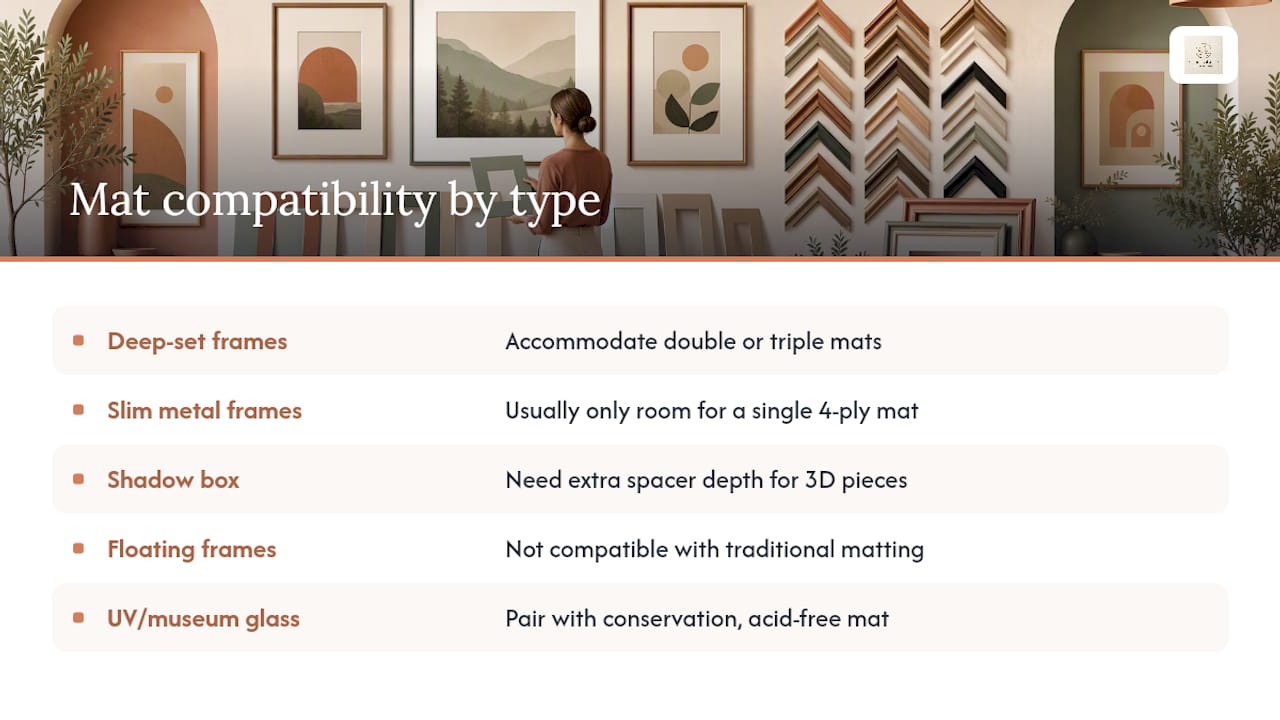
Most standard matboard works with any frame style, wood, metal, or synthetic, since the mat sits inside the frame’s rabbet rather than attaching to the frame itself. What actually matters is depth. Deep-set frames with thick mouldings accommodate double or triple mats easily, while slim, minimalist metal frames may only have room for a single 4-ply mat before the glass won’t seat properly.
Glass and glazing type matters more than most people realize. Regular glass or acrylic glazing works fine with any mat, but if you’re using UV-filtering or museum-grade glass to protect valuable artwork, pairing it with a conservation-grade, acid-free mat makes sense. Otherwise, you’re protecting the piece from light damage while still exposing it to acid migration from the board itself, which defeats half the purpose.
Shadow box frames, the deeper style used for dimensional objects or thick paper, need mats cut with extra spacer depth in mind, since the aperture has to clear whatever three-dimensional element sits inside. If you’re deciding between a framed print and canvas for a given piece in the first place, our comparison of canvas versus framed prints covers when a mat applies at all, since canvas typically skips matting entirely.
One more compatibility note: floating frames, which show the full edge of the artwork without a visible mat border, aren’t compatible with traditional matting at all. If you want that look, matting isn’t the right approach in the first place.
How Do You Match a Mat to Your Photo or Artwork?
The safest default is a warm or cool white mat that doesn’t fight with your image’s dominant tones. Galleries lean toward neutral mats specifically because a neutral border lets the artwork carry the visual weight instead of splitting attention between the image and its frame, according to Wikipedia’s overview of matting conventions.
That said, a mat can be an intentional part of the composition when you want it to be. A few practical pairings work reliably:
- Black-and-white photography: A black-core mat with a white or off-white top layer adds contrast without competing with the tonal range of the photo.
- Warm-toned portraits or sepia prints: A cream or ivory mat echoes the warmth instead of introducing a cold contrast.
- Bold, colorful artwork: Stick to neutral white or gray. Pulling an accent color from the image into the mat itself often backfires and dates the piece quickly.
- Formal documents and certificates: A double mat with a subtle contrasting reveal, navy under white, or maroon under cream, adds gravity without looking busy.
If you’re styling several framed pieces together on a shelf or ledge, consistency across mats matters more than matching any single photo perfectly, as discussed in Interior Doors as focal points: A fresh perspective on home design. Picture ledge styling benefits from a repeated neutral mat color across multiple frames, since designers increasingly favor picture ledges precisely because they let homeowners rotate and rearrange framed art without rehanging. A consistent mat color across the collection makes that rotation look intentional instead of mismatched. For layout ideas beyond ledges, our gallery wall guide covers how mat consistency plays into a cohesive multi-frame display.
What Mistakes Should You Avoid When Ordering Mats?
The most expensive mistake is confusing outer dimension with aperture and submitting the wrong number for one of them. A mat cut to the wrong outer size simply won’t fit your frame’s glass channel, and there’s no fixing that after the fact.
A close second: forgetting the 1/8-inch overlap when calculating your aperture. Order an aperture that exactly matches your photo’s dimensions, and you’ll likely see gaps or the photo slipping loose behind the mat within weeks.
Other frequent errors worth watching for:
- Skipping conservation board on sentimental pieces. Standard wood-pulp mats can yellow and transfer acid onto photos over years. If the piece matters, pay for acid-free.
- Guessing at border width instead of measuring the wall context. A too-narrow border makes a photo look cramped inside a large frame; a too-wide border can overwhelm a small piece.
- Ordering before confirming frame depth. Double and triple mats add thickness that a slim frame moulding may not accommodate.
- Not accounting for glass type. Museum glass paired with a cheap acidic mat wastes half the protection you paid for.
- Measuring once and trusting it. Custom mats are generally non-returnable, so a single measurement error usually means starting over.
Which Suppliers Are Worth Considering for Mats?
Vendors in this space generally fall into two camps: craft-and-hobby retailers offering pre-cut packs and basic custom cutting in-store, and dedicated online mat cutters offering full custom specifications with more material and finish options.
Print Frame Co specializes in bevel-cut custom mats produced to any outer size and aperture, shipped flat and ready to install, which suits anyone ordering an odd size without access to a local frame shop. Frames By Mail supports single-opening custom cuts along with up to three mat layers, useful if you’re building a double or triple mat for a formal piece and want layering options in one order. Custom Picture Frames publishes standard outer-to-aperture pairings that make it easier to double-check your own measurements before submitting an order.
Local frame shops remain worth considering too, especially for anything irregular, oversized, or requiring hand-fitting, since a person looking at your actual piece can catch problems a form on a website can’t.
What Actually Determines Whether DIY or Professional Cutting Makes Sense?
Cutting your own mat with a handheld or straight-edge cutter works fine for practice pieces, inexpensive prints, and anything you won’t be devastated to redo if the bevel comes out crooked. It’s a real skill, and getting a clean 45-degree bevel takes practice most hobbyists don’t have yet.
For anything irreplaceable, an heirloom photo, a diploma, an odd-sized print, hand it to a professional cutter or order custom. The margin for error on a once-in-a-lifetime piece isn’t worth the savings. A practical middle ground: buy pre-cut for the everyday standard-size photos filling out a gallery wall, and reserve custom cutting for the handful of pieces that actually matter.
— Stephane
Finish the Display: Decor That Pairs With Framed Art
An important consideration is finishing the room around the framed mat once your frame is on the wall or ledge. A well-matted photo looks stronger next to decor that doesn’t compete with it, and that’s where a curated selection of Luxury Decor earns its place on a shelf or console beneath your gallery.

Consider how a display actually gets used day to day. A shelf holding framed photos often needs a place to set down keys, sunglasses, or small items, which makes the Light Luxury Multi-function Desktop Storage Box a practical companion piece rather than just another decoration. For a larger entry or living space anchoring a gallery wall, the Modern Luxury Wine Cabinet and Shoe Storage Decor adds storage and visual weight that balances a wall full of smaller framed pieces. And if you’re still deciding what goes inside the frame in the first place, Elegant Girl Shelf Art works especially well with a neutral conservation mat, letting the piece read as a deliberate, gallery-style statement rather than an afterthought.
Browse the full decor collection to find pieces that finish your framed display the way it deserves.
Sources
- Picture Mats Cut to Size – Custom Bevel-Cut Mat Boards | Print Frame Co
- Custom Picture Frame Mats | Frames By Mail
- Photo Mats & Picture Mats | Custom Cut
- Why designers are swapping rigid gallery walls for picture ledges | Homes and Gardens
FAQ
What Is the Best Way to Mat a Picture Frame?
Measure your frame’s glass opening for the outer dimension, then measure your artwork and subtract about 1/8 inch per side to set the aperture. Choose a border width around 1.5 to 2 inches, and go with acid-free, conservation-grade board for anything you want to preserve long-term, as recommended by Wikipedia’s matting overview.
What Can I Use Instead of a Picture Frame Mat?
Some framers skip matting entirely and use a floating frame, which shows the full edge of the artwork with no border at all. Others choose a frame with a deeper rabbet and no mat, letting the artwork fill the entire glass opening, though this removes the protective air gap a mat normally provides between print and glass.
Does Hobby Lobby Cut Mats for Picture Frames?
Craft retailers like this commonly offer in-store custom mat cutting alongside pre-cut packs, though exact services and pricing vary by location and change over time. Check with your local store directly, or use a dedicated online custom mat vendor if you need precise, guaranteed specifications shipped to your door.
Can I Make My Own Picture Frame Mat?
Yes, with a straight-edge or handheld bevel cutter, acid-free matboard, and careful measuring, DIY mat cutting works well for practice pieces and inexpensive prints. For valuable or irregularly sized artwork, a professional or custom-cut mat from a vendor like Print Frame Co reduces the risk of a costly cutting mistake on a piece you can’t replace.