

What Wall Art Sizes Actually Work Above Your Furniture
For art above furniture, aim for 60 to 75% of the furniture’s width, with the center of the piece hung about 57 inches from the floor. Leave a 6 to 10 inch vertical gap between the top of the furniture and the bottom of the frame. That’s the whole rule.
A quick cheat sheet before you keep reading:
- 84-inch sofa → target artwork width of roughly 50 to 63 inches
- 60-inch console or media stand → target width of 36 to 45 inches
- Queen bed (60-inch headboard) → target width of 36 to 45 inches
- Standard sizes worth knowing: 8x10, 11x14, 16x20, 18x24, 20x30, 24x36 inches
- Gallery frames: leave 2 to 4 inches between pieces
Everything below breaks down why these numbers work, how to measure your own space, and what to do when your furniture doesn’t fit a clean formula.
Key Takeaways
Correctly sized wall art follows the 60 to 75% furniture-width rule, a 57-inch center height, and a 6 to 10 inch vertical gap above furniture.
| Point | Details |
|---|---|
| Use the width formula | Multiply furniture width by 0.60 to 0.75 to get your target art width range. |
| Center at eye level | Hang the art’s center at about 57 inches from the floor, adjusting for low furniture or tall ceilings. |
| Respect the vertical gap | Leave 6 to 10 inches between the top of the furniture and the bottom of the frame. |
| Measure outer dimensions | Always account for mat and frame width, not just the print size, before ordering. |
| Shop pre-sized pieces | Noble Abode’s canvas sets and décor pieces are curated to fit common furniture widths without custom framing. |
Table of Contents
- How to Pick the Right Wall Art Size for Your Room
- Standard Wall Art Sizes and When to Use Each
- How Do You Measure a Wall for Art?
- Where Should the Center of a Painting Be on the Wall?
- What Size Art Should You Hang Above a Sofa or Bed?
- How Frames, Mats, and Orientation Change the Final Size
- How to Test Your Wall Art Size Before You Buy
- A Quick Checklist for Getting Wall Art Sizes Right
- Shop Wall Art Sized for the Furniture You Already Own
- Sources
- FAQ
How to Pick the Right Wall Art Size for Your Room
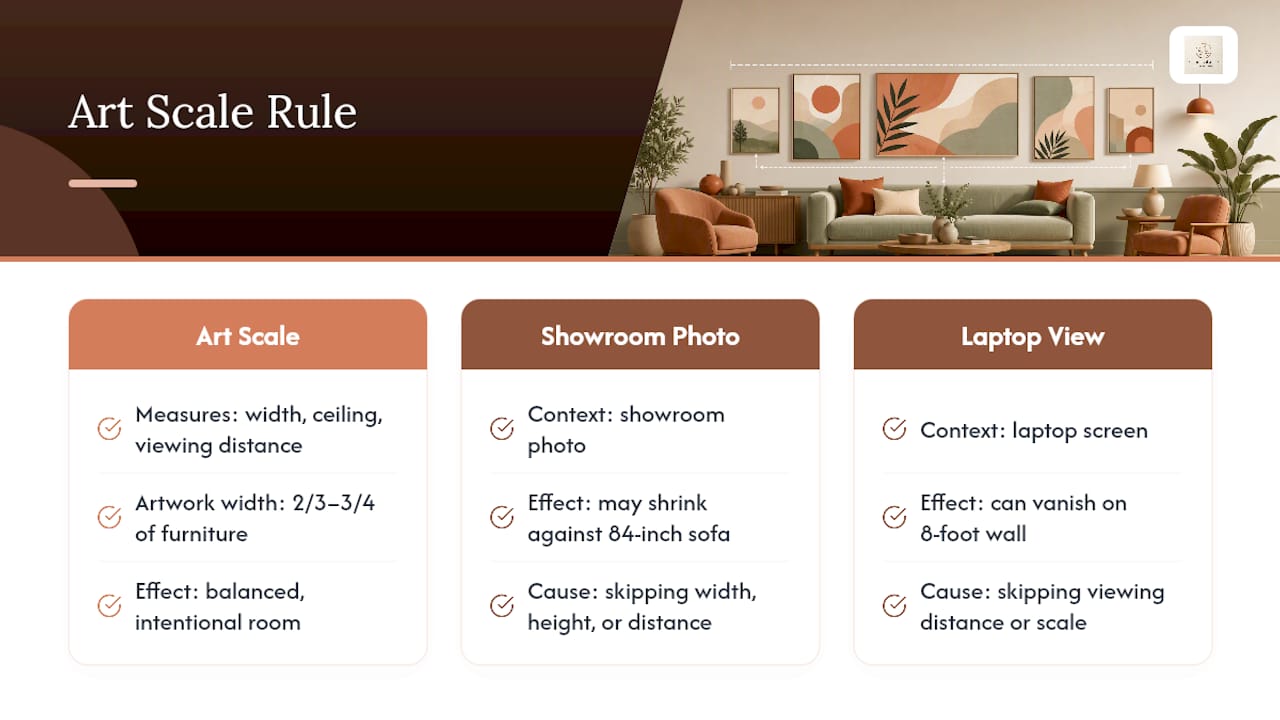
Getting wall art sizes right comes down to three measurements: the width of what’s below it, the height of the ceiling above it, and the distance you typically view it from. Most sizing mistakes trace back to skipping one of those three. A piece that looks generous in a showroom photo can shrink against an 84-inch sofa, and a print that felt bold on a laptop screen can vanish on an 8-foot wall.
The industry doesn’t have a single official name for this discipline, but decorators commonly call it “art scale” or “proportional hanging.” Whatever you call it, the math behind it is consistent: artwork sized to two-thirds to three-quarters of the furniture width creates the visual balance that makes a room feel intentional rather than accidental.
Standard Wall Art Sizes and When to Use Each
Not every wall needs a showstopper. Matching the size to the location matters as much as matching it to the furniture.
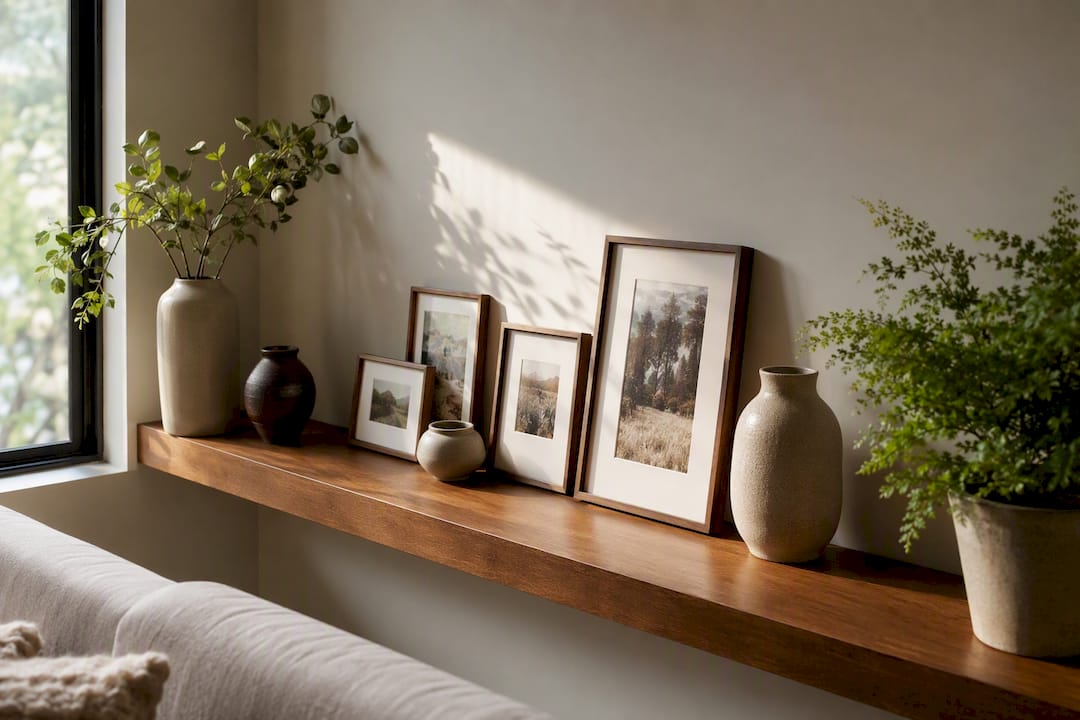
Compact sizes like 5x7, 8x10, and 11x14 inches work best on shelves, in small nooks, or as fillers inside a larger gallery arrangement. They read as accents, not anchors.
Medium sizes in the 12x16 to 18x24 range suit bedrooms, home offices, entryways, and smaller furniture like accent chairs or narrow consoles. This is the range where a single piece can still carry a wall without overwhelming it.
Large sizes from 20x30 up to 24x36 inches and beyond become statement pieces. These are the sizes that sit above a sofa or fill a tall stairwell wall where a smaller print would look lost.
| Size Category | Common Dimensions | Typical Placement |
|---|---|---|
| Compact | 5x7, 8x10, 11x14 in | Shelves, nooks, gallery fillers |
| Medium | 12x16, 16x20, 18x24 in | Bedrooms, offices, entryways |
| Large | 20x30, 24x36+ in | Above sofas, tall or wide walls |
These dimensions belong to a handful of standard ratio families (roughly 4:5, 3:4, and 2:3), which is why frames and mats are so widely available in these exact sizes. A few things to keep in mind when comparing listings:
- Print size and framed size are rarely the same number.
- A mat can add 2 to 4 inches on each side, and a wide frame profile adds more.
- Always check whether a product listing quotes the print dimension or the outer framed dimension. The gap between the two changes how much wall space you actually need.
How Do You Measure a Wall for Art?
Measuring takes five minutes, but it’s the step most people skip before hitting “buy.”
- Measure furniture width arm-to-arm for sofas and chairs, or edge-to-edge for consoles, dressers, and headboards.
- Measure the open wall span if you’re not anchoring to a specific piece of furniture, noting outlets, switches, or trim that might interfere.
- Note your ceiling height. Standard 8-foot ceilings support the classic 57-inch center rule; 10-foot or vaulted ceilings often call for taller art or a stacked arrangement to avoid a piece looking stranded.
- Apply the multiplier. Take the furniture width and multiply by 0.60 for a more conservative look, or 0.75 for a bolder, fuller one.
- Round toward the nearest standard size, favoring the larger option when you land between two sizes.
Here’s the math on an 84-inch sofa, one of the most common widths in American living rooms. Multiplying by 0.60 to 0.75 puts the target art width between 50 and 63 inches. A 24x36 canvas with a slim frame lands near the low end of that range. Step up to a 30x40 piece or a two-panel diptych, and you’re closer to the upper end.
Frame and mat thickness eat into that math, too. A print rated at 30 inches wide can finish at 33 or 34 inches once it’s matted and framed, so measure the outer dimensions before ordering, not just the print size on the listing.
Orientation matters here as well. Wide, low furniture like sofas and consoles generally pairs better with landscape orientation or a horizontal multi-panel set. Narrow, tall furniture like a bar cart or a slim bookshelf favors portrait orientation. If you’re combining multiple panels into one grouping, measure the combined width, including the gaps between panels, and apply the same 60 to 75% formula to that total.
Pro Tip: Before you order anything, tape out the final outer dimensions, frame included, directly on the wall. It takes two minutes and it’s the single best way to catch a size that looked right on screen but feels wrong in the room.
Where Should the Center of a Painting Be on the Wall?
Fifty-seven inches from the floor to the center of the piece is the standard most galleries and decorators use, and it holds up because it approximates average adult eye level. That said, it’s a starting point, not a law. Lower it slightly in a room with low-slung furniture or where people spend most of their time seated. Raise it a few inches in spaces meant to be viewed standing, like a foyer or hallway.
The vertical gap above furniture matters just as much as the center height. A gap of 6 to 10 inches between the top of the furniture and the bottom of the frame is the range that reads as intentional. Go tighter than 6 inches and the art starts to look like it’s resting on the sofa. Push past 10 to 12 inches and the piece feels disconnected, like it drifted up the wall on its own.
The 6 to 10 inch rule: This narrow window is what separates a wall that feels curated from one that feels like the art and the furniture belong to two different plans.
For gallery walls, spacing between individual frames typically runs 2 to 4 inches. Tighter spacing (around 2 inches) reads as more modern and graphic. Wider spacing (closer to 4 inches) gives each piece more breathing room and suits a more traditional layout.
A few more placement notes worth keeping in mind:
- If your frame hangs from wire, account for how much the wire drops the actual hanging point below the top of the frame.
- Measure to the visual center of the frame, not the hook or hanger on the wall.
- When furniture sits unusually low, like a media console under 24 inches tall, prioritize the 57-inch center over the vertical gap rule. Consistency across a room matters more than chasing an exact gap in one spot.
What Size Art Should You Hang Above a Sofa or Bed?
Location changes the math slightly, even though the underlying formula stays the same.
Above the sofa, apply the 60 to 75% width rule directly to the sofa’s arm-to-arm measurement. A 60-inch loveseat calls for roughly 36 to 45 inches of art. An oversized 96-inch sectional can support 58 to 72 inches, which usually means a large single canvas or a two- to three-panel set rather than one oversized print.
Above the bed, use the same percentage range against headboard width, though the vertical relationship shifts. Instead of a 6 to 10 inch gap, aim for something closer to 3 to 8 inches above the headboard, since beds sit lower and the eye naturally reads the wall space differently than it does above a sofa.
Over a mantel, scale down. A single horizontal piece or a small cluster sitting 6 to 12 inches above the mantel top usually looks more balanced than one oversized canvas, especially since mantels often carry their own decor below the art.
In hallways and narrow spaces, portrait orientation in smaller sizes, or a vertical stack of two or three pieces, works better than a single wide piece that a hallway’s width can’t accommodate.
For gallery walls and art pairs, treat the entire grouping as one rectangle when you measure. A three-panel set spanning 60 inches total gets sized against furniture exactly the way a single 60-inch canvas would. A two-piece floral canvas set styled above a console works this way, as does a three-piece marble abstract set stretched across a longer sofa.
A few layout patterns to consider when matching art to furniture width:
- Single large piece: simplest option, best for sofas and beds under 84 inches.
- Diptych (two panels): good for wider furniture or when you want negative space between panels to feel intentional.
- Triptych (three panels): works well above long sectionals or as a stretched statement piece over a headboard.
- Gallery grid: four or more smaller pieces in a grid, ideal for stairwells, hallways, or large blank walls without an anchoring furniture piece.
Pro Tip: On rooms with tall or vaulted ceilings, resist the urge to go wider. A taller, narrower piece or a vertically stacked pair usually reads better than an oversized horizontal canvas, which can look squat against extra ceiling height.
How Frames, Mats, and Orientation Change the Final Size
The print size on a listing is rarely the size that ends up on your wall. An 11x14 print matted and framed inside a 16x20 frame occupies the same wall footprint as a plain, unmatted 16x20 print, even though the printed image itself is smaller. That’s not a downside. It’s actually a useful trick when you want a smaller image to carry more visual weight.
A few practical takeaways:
- Wider mats and heavier frame profiles both increase perceived presence, even when the print itself stays modest in size.
- A thin, dark metal frame reads smaller and more minimal than the same print in a thick, light wood frame.
- Landscape orientation suits wide, low furniture. Portrait suits narrow, tall spaces. Square art is the most flexible and works in both gallery groupings and standalone spots.
- Picture a plain 16x20 print on a wall, then picture the same print with a 3-inch white mat and a 1.5-inch black frame. The second version reads noticeably larger and more finished, even though the printed image hasn’t changed.
Pro Tip: When shopping online, favor listings that show the framed outer dimensions and, ideally, a room mockup. A print size alone doesn’t tell you what will actually show up on your wall.
How to Test Your Wall Art Size Before You Buy
A tape-it-out mockup takes about 10 minutes and prevents the single most common and most expensive sizing mistake: ordering something that looks right on a screen and wrong on the wall.
- Cut kraft paper or use painter’s tape to outline the outer framed dimensions directly on the wall.
- Position the top edge of your mockup 6 to 10 inches above the furniture, or center it at 57 inches if there’s no furniture below.
- Step back to your normal viewing distance and check the visual test from where you actually sit or stand.
- Photograph the mockup. A photo often reveals scale problems your eye glosses over in person.
The most common mistakes worth watching for: art that’s too small for the furniture below it, hanging too high because the frame’s outer size wasn’t accounted for, and uneven spacing in gallery arrangements that only becomes obvious once everything is up; for ideas on complementing your wall art with other decor elements, see how to choose scents for each room to enhance your room’s ambiance room ambiance.
Pro Tip: Take the mockup photo from your usual seating position, not standing in the middle of the room. That’s the vantage point that actually matters.
A Quick Checklist for Getting Wall Art Sizes Right
Screenshot this before your next order:
- Measure furniture width, not just the wall span.
- Apply the 60 to 75% rule to get your target art width.
- Confirm the outer framed dimension, not just the print size.
- Tape out the mockup before you commit to a size.
- Center at 57 inches from the floor unless low furniture or high ceilings call for an adjustment.
Rules exist to be broken with intention, not by accident. An eclectic gallery wall can mix scales deliberately, pairing a large anchor piece with several smaller ones, as long as the overall grouping still respects the furniture-width rule when measured as one unit.
Pro Tip: Balance visual scale with texture, not just size. A large canvas paired with a slim console can feel top-heavy until you add a lamp, a stack of books, or a low sculptural piece to fill the vertical gap between the furniture and the frame.
Why scale matters to how a room actually feels
Correct scale does something a lot of decorating advice undersells: it changes how tall a room feels, not just how the wall looks. An undersized piece above a sofa makes the ceiling feel higher and the wall feel emptier, while a piece sized to the furniture grounds the whole seating area. At Noble Abode, we choose pieces specifically because their proportions hold up against real furniture, not just in a product photo.
Shop Wall Art Sized for the Furniture You Already Own
Finding the right dimensions is only half the job. Finding a piece that actually comes in that size, with framing and styling that match your room, is the harder part. Noble Abode curates decor sized for the furniture people actually own, not just gallery walls.

The 2pcs Floral Leaf Canvas Art Posters work well as a paired set above a console or loveseat, sized to fill that 60 to 75% width range without a custom framing job. For shelf or tabletop styling near a smaller framed piece, the Black Décor Statue adds sculptural weight without competing with the art above it. If your living room needs a full refresh around a new piece, the Nordic Modern Minimalist Luxury Living Room Décor collection and Modern Light Luxury Sofa Cushions round out the scale of the space so the art doesn’t have to do all the work alone. For more art specifically, browse Noble Abode’s wall art selection and check the framed dimensions before you measure your wall.
Sources
- How to Choose the Right Art Size for Any Wall | Minted
- Standard Frame Sizes for Wall Art: Size Chart & Guide
FAQ
What Is a Standard Size for Wall Art?
Common standard sizes include 8x10, 11x14, 16x20, 18x24, 20x30, and 24x36 inches, which correspond to widely available frame and mat combinations.
What Is the 2/3 Rule for Wall Art?
The 2/3 rule (also expressed as 60 to 75%) means your artwork’s width should equal roughly two-thirds to three-quarters of the furniture width beneath it, such as a sofa or console.
How Big Is 20x30 Wall Art?
A 20x30 print measures 20 inches wide by 30 inches tall in portrait orientation, or 30 by 20 inches in landscape, and typically fits above furniture with widths commonly found in medium to large pieces or as part of a larger multi-panel set.
What Are Common Artwork Sizes?
Beyond the standard framed sizes like 8x10 and 16x20, common canvas and print sizes also include 12x16, 24x36, and multi-panel sets like the 3pcs Floral Leaf Canvas arrangement, which combines several smaller panels into one wider visual footprint.
How High Should Wall Art Hang Above a Couch?
Leave a vertical gap of 6 to 10 inches between the top of the sofa and the bottom of the frame, which typically places the art’s center near the standard 57-inch eye-level guideline.
Recommended
- Small Living Room Decorating Ideas for Apartments – Noble Abode
- Abstract Art Figure Decoration for Modern Home Office – Noble Abode
- 3 Pcs Metal Wall Art Decor Minimalist Abstract Woman Wall Art metal Mo – Noble Abode
- Yatsen Bridge Banksy Wall Art Paintings Inspirational Canvas Paintings – Noble Abode