

Canvas vs Framed Print: Which Should You Choose?
Choose canvas for decor-driven, large-scale display and framed paper prints for fine-art detail, archival presentation, or close-viewing pieces. The three factors that determine the right call are image detail priority, presentation style, and total landed cost (print + framing + shipping + installation), as outlined in this cost, detail, and longevity comparison.
Quick decision signals:
- Canvas: painterly images, large statement walls, ready-to-hang convenience, glare-prone rooms
- Framed paper: high-detail photography, typography, limited editions, archival or rotating displays
Note that hybrid options exist. Floater frames for canvas and museum glazing for paper prints shift the balance on both sides.
Key Takeaways
Canvas suits large-scale decor and glare-prone rooms; framed paper suits fine-art detail and archival presentation. Always calculate total landed cost before comparing formats.
| Point | Details |
|---|---|
| Canvas for decor and scale | Best for large walls, painterly images, and ready-to-hang convenience with no framing required. |
| Paper for detail and archival use | Photo paper preserves sharper detail and suits close-viewing or collectible pieces. |
| Calculate total cost | Include printing, framing, glazing, shipping, and hardware. Base print price alone does not reflect total landed cost including framing, glazing, shipping, and hardware. |
| Viewing distance and lighting | Canvas texture is invisible beyond 8 feet; glazed paper creates glare in bright or directional light. |
| Noble Abode canvas options | Ready-to-hang canvas art from Noble Abode ships stretched, styled for immediate display in home or office. |
Table of Contents
- How does a canvas vs framed print actually get made?
- Side-by-side comparison: canvas vs framed paper print
- Pros and cons: the real trade-offs for each format
- Which images and rooms suit each format?
- Cost, lifespan, and protection: what you actually pay
- Installation, shipping, and care: practical steps
- How size, viewing distance, and lighting change the decision
- Five questions to choose between canvas and framed print
- Environmental impact and sustainability
- A practical perspective on canvas vs framed prints for home decor
- Ready-to-hang canvas décor from Noble Abode
- Sources
- FAQ
How does a canvas vs framed print actually get made?
Understanding the construction of each format makes every other comparison easier to follow.
Canvas prints

A canvas print starts with a poly-cotton or cotton canvas substrate. An inkjet or giclée printer lays pigment-based inks directly onto the fabric surface. The printed canvas is then hand-stretched over wooden stretcher bars and stapled at the back or sides. Gallery-wrapped canvas arrives ready to hang with no additional framing required.
Edge treatment options include:
- Gallery wrap: the image continues around the sides
- Mirror wrap: the edge reflects a mirrored portion of the image
- Solid color wrap: a neutral border fills the sides
- Printed edge: a thin decorative border
Most canvas prints also receive a protective coating, either matte, satin, or gloss, applied after printing to guard against moisture and UV exposure.
Framed paper prints
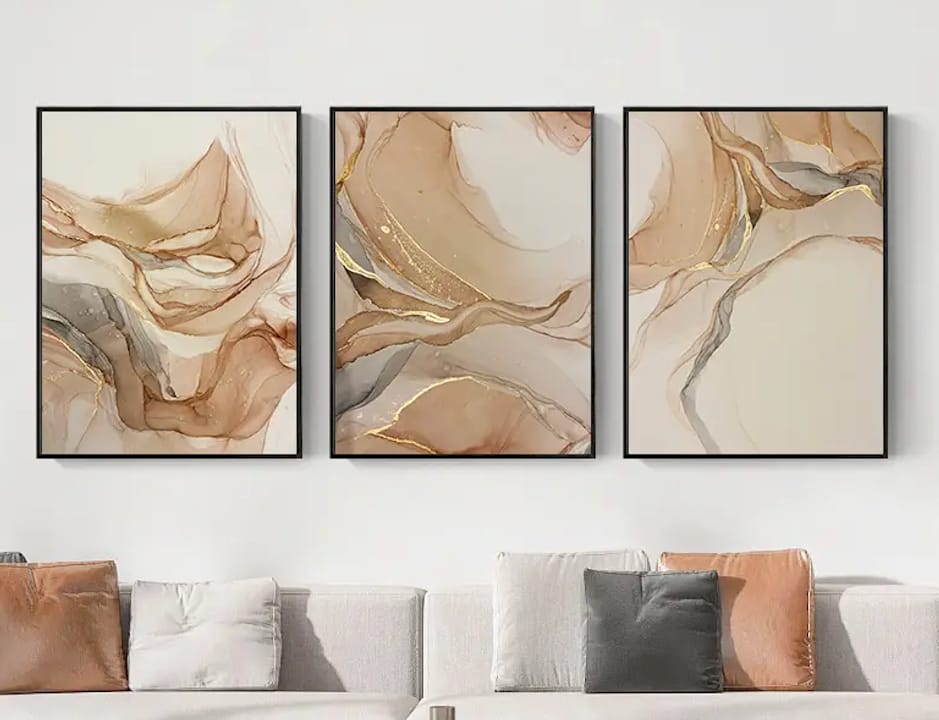
A framed paper print starts with a sheet of photo paper or fine-art paper (cotton rag, baryta, or heavyweight matte). Archival pigment inks are printed onto the paper, which is then mounted inside a frame with optional matting to create visual breathing room around the image. Glazing, either standard glass, anti-reflective glass, or acrylic, sits in front to protect the surface. A backing board seals the rear.
Finish choices matter here:
- Gloss paper: vivid color, high contrast, prone to glare
- Satin/luster paper: balanced sharpness with reduced glare
- Matte fine-art paper: soft, gallery-appropriate, minimal glare
- Baryta paper: film-like depth, favored for black-and-white photography
Side-by-side comparison: canvas vs framed paper print
| Dimension | Canvas Print | Framed Paper Print |
|---|---|---|
| Best for | Large decor, painterly images, statement walls | Fine-art photography, typography, archival display |
| Image/detail fidelity | Softer micro-detail; DMAX ~1.9 | Sharper detail; higher DMAX on photo paper |
| Typical total cost | Lower framing cost; higher shipping bulk at large sizes | Higher framing + glazing cost; heavier at large sizes |
| Durability & protection | UV coating optional; no glazing standard | Glazing protects from dust, UV, and handling |
| Finish & presentation | Textured, painterly, frameless gallery look | Polished, matted, classic gallery or archival look |
| Installation & hanging | Lightweight; D-ring or sawtooth hardware included | Heavier with glass; wall anchor or two-point hang recommended |
| Shipping & storage | Ships stretched in a box; bulkier | Ships rolled or flat; easier to store unframed |
Canvas becomes more practical at very large sizes because glass weight and framing costs for paper prints scale significantly beyond common frame dimensions. Floater frames for canvas and museum glazing for paper are hybrid strategies that change both presentation and protection without forcing a binary choice.
Pros and cons: the real trade-offs for each format
Canvas print pros and cons
Pros:
- Ready-to-hang straight from the box, no framer needed
- No glass means no glare under mixed or directional lighting
- Textured surface adds a painterly, tactile quality
- Scales well to very large sizes without prohibitive cost
- Lightweight relative to a framed and glazed equivalent
Cons:
- Canvas weave disperses ink, softening micro-detail and reducing maximum black density (DMAX lower for canvas than photo paper, indicating softer contrast and detail)
- Uncoated canvas is more vulnerable to humidity and surface abrasion
- Ships in a rigid box, which is bulkier than a rolled paper print
- Fewer presentation options without additional framing decisions
Framed paper print pros and cons
Pros:
- Preserves fine detail, sharp linework, and deep blacks
- Matting adds visual separation and a polished gallery finish
- Glazing protects from dust, UV, and accidental contact
- Archival paper and inks support long-term conservation
- Easier to reframe, archive, or rotate in a display program
Cons:
- Glass or acrylic glazing creates glare under certain lighting
- Heavier than canvas at equivalent sizes, requiring secure wall anchors
- Total cost is higher when matting, glazing, and a quality frame are included
- Large framed prints with glass are fragile to ship and handle
Pro Tip: Museum or UV-filtering acrylic glazing eliminates most glare complaints and adds meaningful UV protection without the weight penalty of standard glass. It costs more upfront but extends print life noticeably.
Which images and rooms suit each format?
The right format depends on what the image contains and where it will live.
When framed paper is the better choice
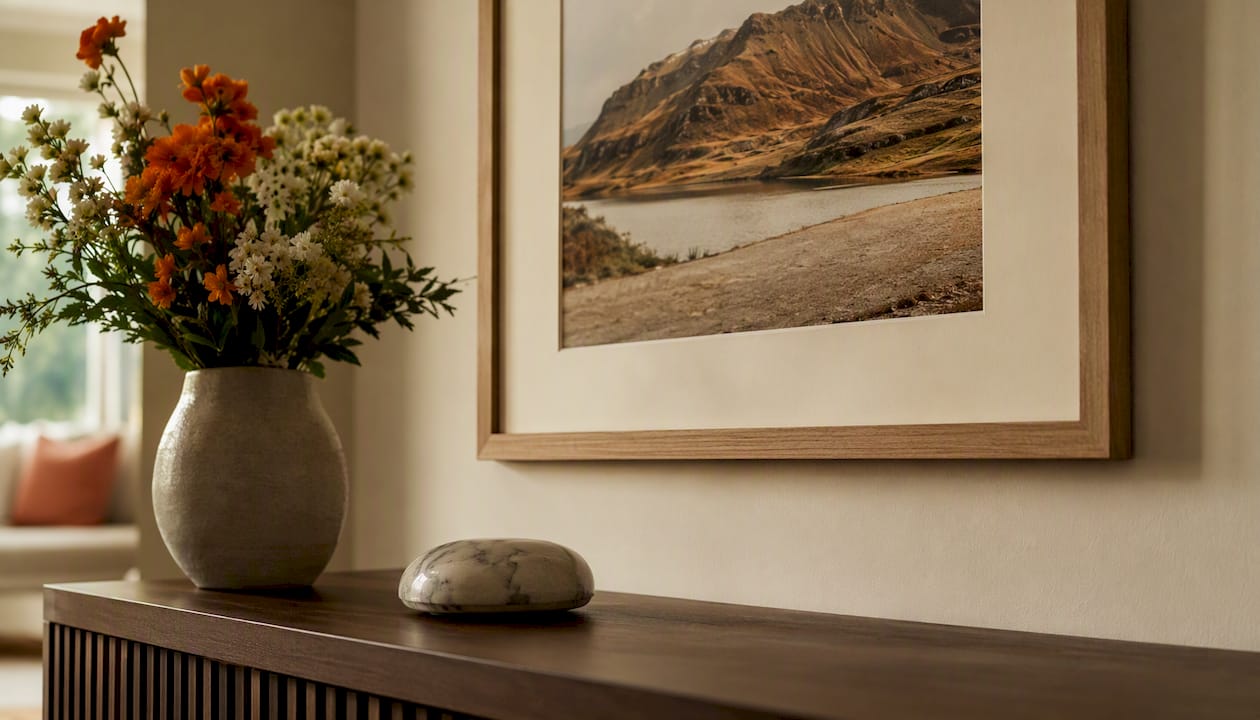
Choose a framed paper print when the image relies on fine detail to communicate. High-resolution landscape photography, architectural shots, typographic art, maps, and botanical illustrations all lose something meaningful when printed on canvas. The weave softens edges that the image depends on. Pieces displayed at close range, on a desk, in a hallway, or above a console table, reward the sharpness that quality photo paper delivers.
Limited-edition prints and archival pieces also belong behind glass. If the work has collectible or investment value, glazing and acid-free matting are the responsible choice.
When canvas is the better choice
Canvas suits images where texture adds to the effect rather than working against it. Painterly images, large abstract pieces, and bold graphic art all translate well to a canvas surface. Living rooms, lobbies, and open-plan spaces where the piece reads from across the room are natural fits. At that distance, the canvas weave is invisible and the textured surface reads as intentional depth.
Glare-prone rooms are another strong case for canvas. A wall that catches afternoon sun or sits opposite a window will create distracting reflections on glazed paper prints. Unglazed canvas sidesteps that problem entirely.
Contextual notes
High-traffic areas with kids or pets favor canvas for its durability and the absence of breakable glass. Hospitality settings and multi-location office programs often standardize on canvas for the same reasons. For rotating seasonal displays, rolled paper prints are operationally simpler to store and swap than stretched canvas.
Cost, lifespan, and protection: what you actually pay
Cost components by format
| Cost Component | Canvas Print | Framed Paper Print |
|---|---|---|
| Base printing | Moderate (canvas substrate + inks) | Moderate (paper + archival inks) |
| Stretching/mounting | Included or low add-on | Not applicable |
| Matting | Not standard | $15–$60+ depending on size and layers |
| Frame | Optional (floater frame adds cost) | $30–$200+ depending on profile and size |
| Glazing | Not standard | $20–$100+ (acrylic or glass, UV options higher) |
| Protective coating | Often included | Not applicable |
| Hanging hardware | Usually included | Usually included |
| Shipping | Higher volume/box size | Lower unframed; higher when framed with glass |
A fair comparison must include all components. Canvas can appear cheaper when only the base print price is quoted, but a framed paper print with a floater-frame equivalent canvas often lands at a similar total.
Lifespan and protection factors
Longevity is driven by inks, coatings, glazing, and display conditions rather than by the canvas-vs-paper label alone. Both formats can last decades with proper material choices. Key variables:
- Ink type: pigment-based inks outlast dye-based inks on both substrates
- UV exposure: direct sunlight degrades both formats; UV glazing or UV coatings slow this significantly
- Humidity: canvas is more sensitive to humidity fluctuations than glazed paper
- Handling: glazing protects paper from fingerprints and abrasion; canvas coatings offer partial protection
A well-glazed archival paper print behind UV-filtering acrylic can outlast an uncoated canvas in a bright room. The reverse is also true: a properly coated canvas in a controlled environment holds up well for decades.
Installation, shipping, and care: practical steps
Receiving your print
Canvas arrives stretched in a rigid box. Check the corners of the stretcher bars for any warping and confirm the canvas surface is taut with no slack. Paper prints often ship rolled in a tube or flat in a protective sleeve. Unroll paper prints carefully and allow them to flatten for 24–48 hours before framing.
Hanging steps
Canvas:
- Locate wall studs or use appropriate drywall anchors rated for the print’s weight
- Use the D-ring or sawtooth hardware already attached to the stretcher bar
- Level with a spirit level before final tightening
Framed paper:
- Two-point hanging (two hooks) is recommended for larger or heavier frames to prevent tilting
- Use wall anchors rated above the frame’s actual weight, especially with glass glazing
- Keep the frame away from direct heat sources and exterior walls with temperature swings
Care and cleaning
- Dust canvas gently with a soft, dry brush or microfiber cloth; never use liquid cleaners on uncoated canvas
- Clean glazed frames with a dry or lightly dampened cloth on the frame itself; avoid spraying glass cleaner directly onto the glazing
- Keep both formats out of direct sunlight and away from high-humidity areas like bathrooms
- Maintain indoor humidity between 45–55% for best long-term results
Pro Tip: Before final installation, check that all mounting hardware is fully tightened, the frame backing is sealed, and corner protectors are removed. A loose D-ring on a heavy canvas is the most common cause of wall damage after hanging.
How size, viewing distance, and lighting change the decision
Scale and placement affect which format performs better in a specific spot.
Viewing distance guidelines
- Large pieces (36 inches and above) viewed from 8+ feet: canvas texture is invisible at this distance, and the painterly surface reads as intentional. Detail loss is irrelevant.
- Medium pieces (16–36 inches) viewed from 4–8 feet: both formats work. The choice shifts to finish preference and room lighting.
- Small pieces or close-viewing spots (within 3–4 feet): paper’s sharper detail and deeper blacks become perceptible. This is where DMAX differences matter.
Lighting considerations
Glare is the most common complaint with framed paper prints. Standard glass reflects ambient light directly, which washes out the image from certain angles. Anti-reflective acrylic solves most of this but adds cost. Canvas, being unglazed, has no reflective surface and performs consistently under mixed, directional, or overhead lighting.
Track lighting and picture lights work well with both formats. For canvas, warm-toned lighting enhances the textured surface. For framed paper, a cooler, diffused light source reduces glare and renders color more accurately.
Five questions to choose between canvas and framed print
Use this checklist before placing an order.
- Does the image contain fine detail, sharp linework, or typography? Yes → framed paper. No → canvas is viable.
- Will the piece hang in a glare-prone spot? Yes → canvas or anti-reflective glazed paper. No → either format works.
- What is the total budget, including framing, glazing, and shipping? Calculate all components, not just the base print price, before comparing formats.
- Will the piece be moved, rotated, or archived? Yes → rolled paper prints are simpler to handle and store.
- Is the piece larger than 36 inches on any side? Yes → canvas is often more practical; glass weight and framing costs for large paper prints add up quickly.
Hybrid middle ground: A floater frame gives canvas a finished, gallery-style presentation without covering the edges. Museum glazing on a paper print eliminates most glare. Neither option is a compromise; both are deliberate choices.
Pro Tip: Run a full-cost check: add printing, framing, glazing, shipping, and any installation hardware before comparing canvas and paper prices. The base print price alone is almost never the real cost.
Environmental impact and sustainability
Both formats carry an environmental footprint, and the differences are worth knowing.
Canvas substrates vary. Fine-art papers made from cotton rag are often acid-free and produced without wood pulp, which reduces the chemical processing involved. Archival papers from certified mills (look for FSC certification) represent the more sustainable paper option.
Ink type matters on both sides. Pigment-based inks, standard for archival printing, are more stable and require fewer reprints over time, which reduces waste. Dye-based inks fade faster, leading to replacement prints.
Framing materials add complexity. Solid wood frames from sustainably managed forests are preferable to MDF or composite profiles. Acrylic glazing is lighter than glass (reducing shipping emissions) but is petroleum-derived. Standard glass is heavier but recyclable.
Canvas prints, being ready-to-hang without additional framing, skip the material and energy cost of a frame entirely. That is a genuine sustainability advantage for decor-focused buyers who do not need archival presentation.
A practical perspective on canvas vs framed prints for home decor
The canvas-vs-paper debate gets framed as an aesthetic question, but the more useful frame is functional. What does the wall need to do?
For most home decor decisions, canvas wins on practicality. It arrives ready to hang, skips the framer, and holds up in the varied lighting conditions of a real living room. The textured surface adds depth that flat paper behind glass cannot replicate at distance. For statement walls, large abstracts, and multi-panel arrangements, canvas is the natural fit.
Framed paper earns its place when the image itself is the point. Portrait photography, fine-art prints, and typographic pieces all depend on detail and tonal range that canvas softens. Behind UV-filtering acrylic with a clean mat, a paper print looks considered and permanent in a way that a stretched canvas does not always achieve.
The mistake most buyers make is choosing by base print price. A $40 canvas print and a $40 paper print are not equivalent purchases once framing, glazing, and shipping are included. Run the full cost before deciding.
Ready-to-hang canvas décor from Noble Abode
Noble Abode takes the guesswork out of the canvas-for-decor decision. The curated selection covers ready-to-hang canvas art designed for immediate styling, from floral leaf canvas sets suited to living rooms and bedrooms to abstract office canvas pieces that work in professional spaces. Each piece ships stretched and ready, with no framer required.
For buyers who want a complete wall arrangement, Noble Abode’s multi-panel canvas sets and complementary decor objects make it straightforward to style a full wall without sourcing pieces from multiple suppliers. Browse the collection and match your wall size, room lighting, and image preference to a piece that ships ready to hang.
Sources
- Canvas vs Paper Prints: Cost, Detail, Longevity
- How To Choose Between Canvas Prints and Framed Prints | Shutterfly
- Canvas vs photo paper prints : Which Medium Best Fits Your Artistic Vision? - Sky Art Print
- To frame, or not to frame? We’ll help you answer this …
FAQ
Does canvas look better framed or unframed?
Canvas prints are designed to display unframed as a gallery wrap, and most look clean and intentional that way. A floater frame adds a finished border without covering the edges, which suits more formal or traditional interiors.
Should you frame a canvas print?
Framing a canvas is optional, not required. A floater frame changes the presentation and can complement certain decor styles, but the gallery-wrap format is complete on its own and the more common choice for modern interiors.
Is canvas better than a paper print?
Neither format is universally better. Canvas suits large decor, glare-prone rooms, and painterly images. Framed paper suits fine-detail photography, archival pieces, and close-viewing spots where sharpness and tonal depth matter.
Which format lasts longer?
Longevity depends on inks, coatings, and display conditions rather than the substrate label alone. A well-glazed archival paper print behind UV-filtering acrylic can outlast an uncoated canvas in a bright room. Both formats are long-lived with proper material choices.