

Try Before You Drill: Mirror Placement for Small Rooms (Renters)
The fastest fix for a small room is a large mirror set opposite or adjacent to your main window, or a full-length mirror angled about 45 degrees in an unused corner — a strategy reinforced by experts advising to go bold in small spaces with removable wallpaper for added impact. Both placements pull daylight deeper into the room and stretch the sense of depth. Renters can lean a mirror against the wall with anti-tip straps instead of drilling. Expect two results within a day: more usable light and a room that reads noticeably larger.
TL;DR:
- Placing a large, angled mirror in a corner or opposite a window maximizes light reflection and creates a sense of depth in small rooms.
- Test mirror placement by leaning it at 45 degrees first, at different times of day, before permanent mounting to avoid glare and unfavorable reflections.
- Avoid reflecting clutter, mess, or a bed directly, as these can double visual noise and create discomfort rather than expanding space.
- Use vertical or horizontal orientation to enhance ceiling height or room width, and select frames that complement the mirror’s function without distracting from the reflection.
- Renters should prioritize adhesive strips and anti-tip straps for safety and flexibility, reserving permanent hardware for situations that have been thoroughly tested.
Table of Contents
- Where to Place a Mirror for Maximum Light and Space
- Why Mirror Placement Tricks the Eye
- Mirror Placement Mistakes That Undo the Effect
- Choosing the Right Size, Shape, and Frame
- How to Mount a Mirror Safely in a Small Space
- A Quick Test Before You Commit
- What Most Advice on Mirror Placement Gets Wrong
- Finishing the Look Around Your Mirror
- Sources
- FAQ
Where to Place a Mirror for Maximum Light and Space
Not every wall deserves a mirror. Some spots multiply light and depth; others just hang there. Here’s the order of priority for small bedrooms and living rooms, ranked by impact.
- Full-length mirror, angled in a corner. Lean a tall mirror at roughly 45 degrees in a dead corner that gets little other use. This catches light from two directions at once and creates a sense of a room extending past its actual walls. Secure it with an anti-tip strap even when leaning.
- Opposite or adjacent to a window. A large mirror placed across from or beside a window grabs daylight and throws it toward the darker half of the room. Avoid hanging it directly behind where you’d stand to check your reflection. Backlighting from the window turns your face into a silhouette, which defeats the point in a bedroom or entryway.
- Above a dresser or vanity. Center the mirror over the furniture piece, not the wall, and keep the bottom edge close enough to the surface to be functional for grooming.
- Horizontal mirror in a narrow hallway. A low, wide mirror hung at eye level widens the visual path without jutting into the walkway the way a bulky console mirror would.
- Behind seating or a sofa. A mirror mounted on the wall behind a sofa adds a vertical line above the furniture’s horizontal mass, and if it faces a window or an attractive built-in, it reflects that feature back into the seating area.
For most small rooms, one well-placed large mirror beats a scattered collection. Save groupings for accent walls where the goal is texture, not light.
Why Mirror Placement Tricks the Eye
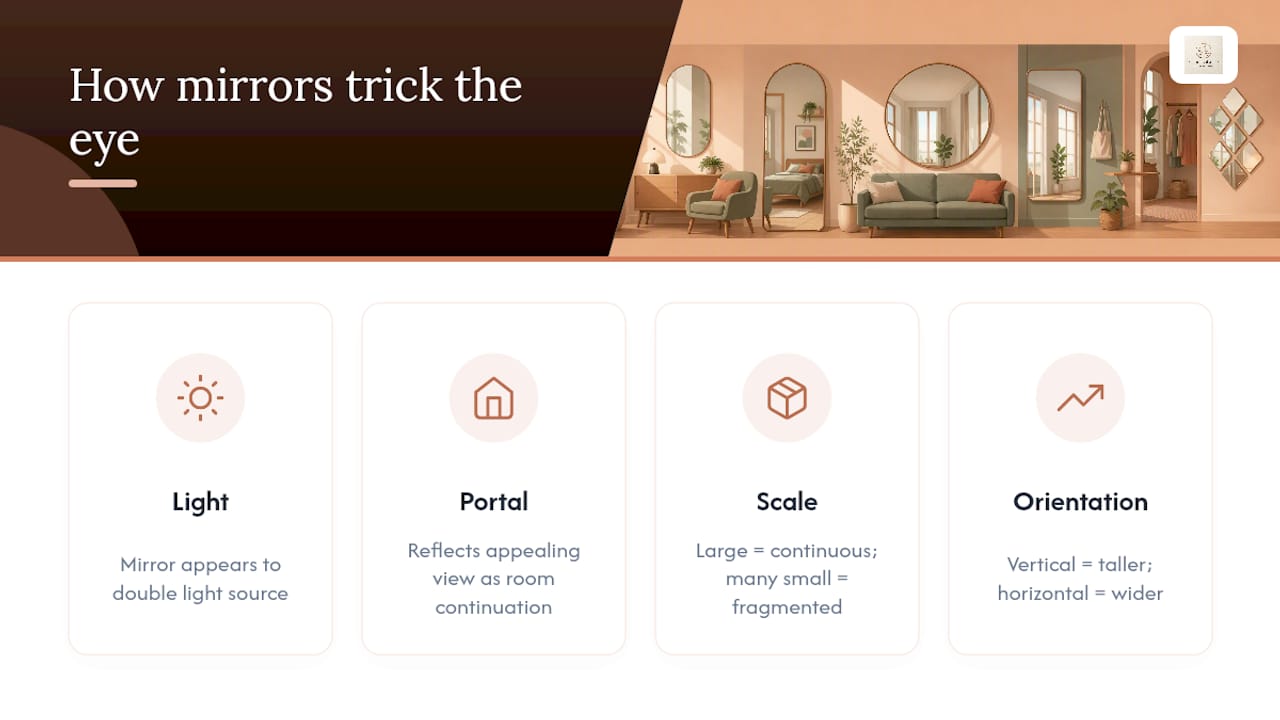
Mirrors work by multiplying light paths. A single mirror opposite a window effectively doubles the light source without adding a single lumen. Homes & Gardens calls this the closest thing to a free renovation, since the light was always there. It just needed somewhere to bounce.
There’s also what designers describe as a “portal effect.” When a mirror reflects something genuinely appealing (a garden view, a bright hallway, an architectural detail), the brain reads it as a continuation of the room rather than a flat reflective surface. That’s why reflecting adjacent brighter spaces works better than reflecting a blank wall.
Scale matters more than quantity. One large mirror preserves a clean, continuous reflection. Several small mirrors fragment that reflection into disconnected pieces, which can make a room feel busier rather than bigger. Orientation shapes the illusion too: a vertical mirror pulls the eye up and exaggerates ceiling height, while a horizontal mirror stretches a room’s apparent width.
Mirror Placement Mistakes That Undo the Effect
A poorly placed mirror can make a small room feel worse, not better. Reflecting a messy closet, a cluttered desk, or a pile of laundry doubles the visual noise instead of doubling the light. Design professionals also caution against mirrors that face a bed directly, since some people find that reflection unsettling first thing in the morning or last thing at night.
Here’s what to check before you commit to a spot:
- Avoid backlighting yourself: don’t place a mirror where a window sits directly behind where you’d stand to use it for grooming.
- Start the mirror’s centerline around average eye level height from the floor, then adjust based on who uses it most.
- Test the wall at three points in the day, morning, midday, and late afternoon, to catch glare or harsh hotspots you wouldn’t see at a single glance.
- Never hang a heavy mirror above a bed unless it’s professionally mounted with hardware rated for that weight.
- Keep reflected surfaces (counters, dressers, entry tables) tidy, since the mirror will show every stray item twice.
Pro Tip: Prop the mirror against the wall first and live with it for a day before drilling a single hole. Light shifts more than people expect, and a spot that looks great at noon can throw ugly glare across the room by 4 p.m.
Choosing the Right Size, Shape, and Frame
Bigger is almost always better here. A mirror that feels slightly oversized for the wall will do more for the room than a modest one centered with lots of empty space around it. For living rooms, floor mirrors of a substantial size tend to read as intentional rather than accidental.
Orientation should match your goal. Choose vertical when the ceiling is the room’s weak point, horizontal when width is what’s missing (hallways and narrow living rooms benefit most here). For a related approach to widening a tight passage, see this guide on art for narrow hallways, which applies the same width-first thinking to wall art.
Frame choice depends on the mirror’s job. A thin, polished, or slim metal frame keeps the main light-bouncing mirror from competing visually with the reflection itself. Save ornate or decorative frames for smaller accent mirrors, and if you’re grouping a few, keep the finishes matched so they read as one composed piece instead of a random collection.
How to Mount a Mirror Safely in a Small Space
Permanent installation calls for a French cleat on anything heavy. Professional installers favor this method because it distributes weight evenly and lets you re-level the mirror without redrilling. If a mirror weighs more than you can comfortably lift alone, hire a professional installer rather than guessing at wall anchors.
Renters have real options too:
- High-strength adhesive strips rated for the mirror’s specific weight work well on smooth, painted drywall.
- Leaning mirrors need an anti-tip strap anchored to a stud, even in a low-traffic corner.
- Rubber floor bumpers keep a leaning mirror from sliding or scratching flooring over time.
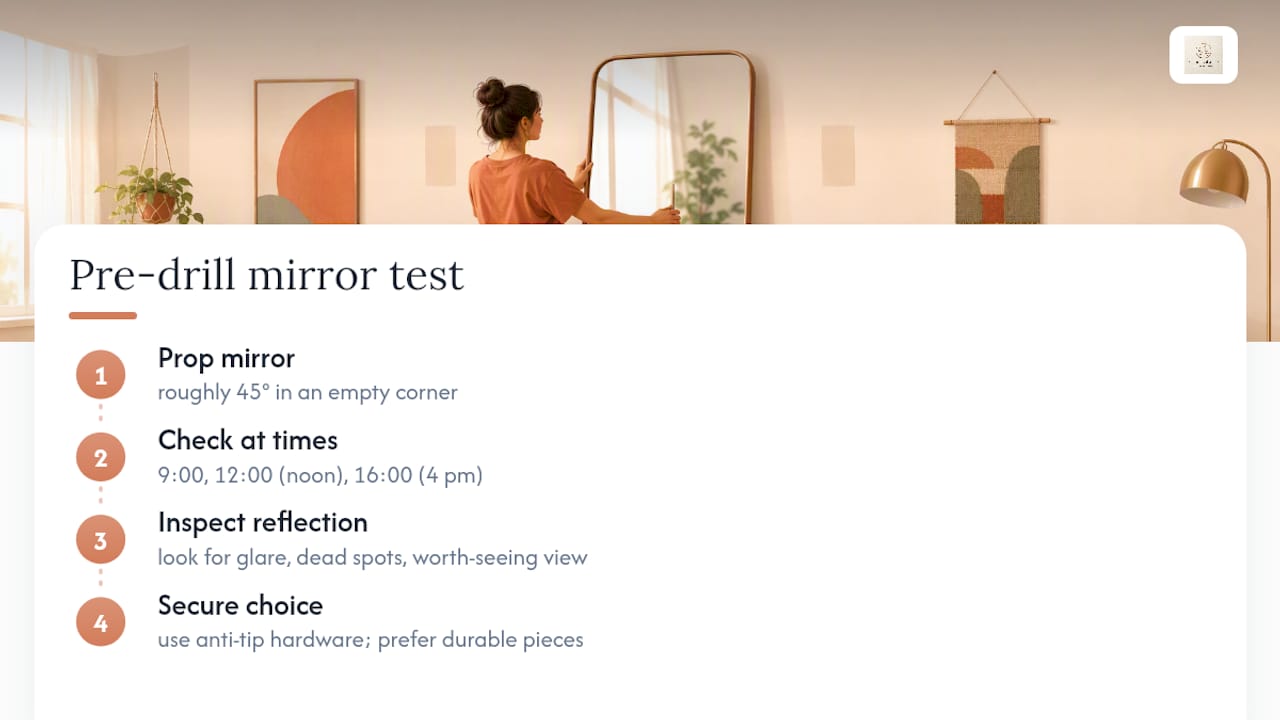
Pro Tip: Mark your intended mounting points with painter’s tape first, then prop the mirror in front of the tape for a day. If the spot still looks right at 9 a.m., noon, and 4 p.m., you’re ready to commit.
A Quick Test Before You Commit
Run this before touching a drill: prop a mirror at roughly 45 degrees in an empty corner and check it at 9 a.m., noon, and 4 p.m. Watch for glare, dead spots, and whether it’s actually reflecting something worth seeing. Pair the placement with anti-tip hardware regardless of whether the final setup is leaning or mounted, and lean toward durable, well-made pieces that will hold up to being repositioned once or twice while you get it right.
What Most Advice on Mirror Placement Gets Wrong
Most guides treat mirror placement as a formula: put it here, get bigger room. The reality is messier, and that’s actually good news. The research keeps circling back to the same point: test before you drill. A wall that looks perfect on paper can throw glare across your whole living room the moment the afternoon sun hits it wrong.
The bigger mistake in conventional advice is treating mirrors as decoration first and light tools second. Flip that order. A mirror’s job in a small room is optical work: capturing daylight, extending sightlines, borrowing a view. Once that job is done well, styling around it is the easy part.
If there’s one habit worth adopting over any specific placement rule, it’s proving the spot with a leaning test before committing hardware. Renters especially should lean on adhesive strips and anti-tip straps rather than rushing to permanent mounts. You can always upgrade to a French cleat once you’re certain the wall earns it.
— Stephane
Finishing the Look Around Your Mirror
Once the mirror is doing its job, the surface beneath it deserves the same attention. A dresser or console under a mirror gets reflected twice, so clutter there reads as double clutter, and a styled vignette reads as double styling.

A slim glass vase for flower arrangements works well here because its transparency keeps the reflected image light rather than heavy. For more texture, a ceramic flower vase set grouped in odd numbers gives the mirror something layered to reflect without crowding the surface. If the dresser top tends to collect loose items, a multi-function desktop storage box keeps everything corralled so the mirror reflects a tidy vignette instead of a junk drawer’s contents.
Small-space decor pieces that hold up under daily use while looking intentional in a reflection, not just from the front, are ideal for mirror surfaces. Consider selecting one or two pieces to anchor your mirror’s surface to complete the look.
Sources
This guide draws on placement patterns from Apartment Therapy and Homes & Gardens, practical window-facing guidance from The Decor Advisor, and mounting safety standards from The Spruce.
- Do mirrors make a room look bigger? — The Decor Advisor
- Mirror decorating mistakes and mounting tips — The Spruce
FAQ
Do Mirrors Actually Make a Small Room Look Bigger?
Yes. A large mirror placed opposite or adjacent to a window reflects daylight deeper into the room and creates a sense of continued space beyond the wall.
Where Should You Not Put a Mirror in a Room?
Avoid facing a mirror toward clutter, a messy closet, or directly opposite the bed, since design professionals note this can feel unsettling and simply doubles visual mess.
Which Direction Should a Mirror Not Face?
A mirror shouldn’t face a window in a way that backlights the person using it, since that turns your reflection into a silhouette during grooming or dressing.
Where Should Mirrors Go for the Best Light and Flow?
Place mirrors where they reflect a window, an attractive view, or a brighter adjacent room, since this “borrows” light and creates a more open, connected feel rather than reflecting a dead corner or blank wall.
Is It Better to Have One Large Mirror or Several Small Ones?
One large mirror typically outperforms a cluster of small mirrors in a small room, since a single reflection reads as continuous space while multiple small mirrors can fragment the view.