

Smart Lighting for Small Spaces: Practical Ideas That Work
The best approach to lighting for small spaces combines layered lighting with scale-appropriate, space-saving fixtures. Three moves you can make this weekend:
- Swap existing bulbs for 2700K warm white LEDs in living areas and bedrooms. Warm white visually softens and expands a room compared with cooler, harsher bulbs.
- Add one floor torchiere or a plug-in sconce. A torchiere bounces light off the ceiling for broad, indirect ambient coverage without requiring any wiring.
- Hang a large mirror opposite your main window or primary light source. Mirrors amplify both natural and artificial light and are one of the most cost-effective visual enlargement tools available.
A practical planning rule: aim for roughly one light source for every moderate area of the room. For a studio, that means a few fixtures working together. Energy Star-rated LED bulbs keep running costs low while delivering the brightness and color quality these layered setups need. Noble Abode curates compact, style-forward lamps and decor pieces designed specifically for smaller rooms.
Key Takeaways
Layered lighting with warm 2700K bulbs, scale-appropriate fixtures, and at least one mirror opposite a light source is the most reliable method for making a small room feel brighter and larger.
| Point | Details |
|---|---|
| Layer all three types | Combine ambient, task, and accent light; one fixture cannot do all three jobs. |
| Use 2700K warm white bulbs | Warm white expands and softens small living and sleeping areas visually. |
| One source per 80–100 sq ft | Plan for a few fixtures working together in a studio for even coverage. |
| Renter-friendly first | Plug-in sconces, torchieres, and adhesive LED strips need no hardwiring or permits. |
| Noble Abode curated picks | Compact lamps, mirrors, and accent pieces from Noble Abode integrate directly with layered small-space setups. |
Table of Contents
- Why does layered lighting matter in small rooms?
- What fixture types work best in small rooms?
- How do you set up lighting by room type?
- Smart bulbs, dimmers, and simple scene control
- Renter-friendly lighting options that need no hardwiring
- What should you check before buying lights for a small room?
- Noble Abode picks for small-space lighting and decor
- Sources
- FAQ
Why does layered lighting matter in small rooms?
Flat, single-source lighting is the fastest way to make a small room feel like a storage unit. Layered lighting is the standard framework designers use to create depth, define zones, and make compact spaces feel larger and more functional.
The three layers work like this:
- Ambient lighting is the base layer. It fills the room with general illumination, typically from a ceiling fixture, torchiere, or recessed lights.
- Task lighting targets specific activities. A desk lamp, under-cabinet strip, or bedside reading light all qualify.
- Accent lighting adds dimension. Think LED strips behind a headboard, a small picture light, or a candle-style wall sconce.
No single fixture can do all three jobs well. A bare overhead bulb creates harsh shadows and flat contrast. Add a floor lamp and a bedside lamp, and the same room reads as layered, warm, and intentional.
Lumen and color temperature quick guide: For living rooms and bedrooms, target 1,500–3,000 lumens total across all fixtures, with bulbs rated at 2700K–3000K (warm white). Kitchens and bathrooms benefit from 4,000–5,000K (cool white to daylight) for better task visibility. A single 800-lumen bulb replaces a standard 60-watt incandescent and works well for most table and floor lamps.
What fixture types work best in small rooms?
Each fixture type solves a different problem. Here is a compact guide to the options that earn their footprint.
Wall sconces (hardwired or plug-in). Mount flush to the wall, freeing floor and surface space entirely. Hardwired versions require an electrician; plug-in sconces need only an outlet and a removable hook. Best for bedside reading light and hallways.
Pendant lights. Drop from the ceiling over a dining spot, kitchen island, or reading nook. A single pendant over a small table anchors the zone without consuming floor space. Low-hung pendants in a studio visually separate the dining area from the living zone.
Flush and semiflush ceiling fixtures. The go-to overhead option for rooms with ceilings under 8–9 feet. Low-profile designs keep proportions balanced where a chandelier or large arc lamp would feel crowded. Hardwired, so renters should confirm with their landlord before swapping.
Recessed and track lighting. Recessed cans disappear into the ceiling entirely. Track lighting lets you aim individual heads at art, shelves, or work surfaces. Both require installation but deliver the cleanest look in very small rooms.
LED strip lights and under-cabinet strips. Adhesive-backed strips install in minutes and add accent or task light under shelves, behind headboards, or along toe kicks. Renter-friendly when using removable adhesive mounts.
Floor torchieres and arc floor lamps. A torchiere that bounces light off the ceiling is the best substitute for a hardwired overhead fixture in apartments without ceiling lights. Arc lamps extend over a sofa or reading chair. For rooms with ceilings under 8–9 feet, choose a shorter torchiere rather than a tall arc to keep proportions balanced.
Small table lamps. Compact bases with linen, paper, or rattan shades diffuse light evenly and add warmth. Pair with a dimmer-compatible bulb for flexible brightness.
Pro Tip: Match fixture diameter to furniture scale. A table lamp base wider than one-third of the surface it sits on will crowd the space. For a nightstand under 18 inches wide, a lamp with a 6–8 inch base keeps the surface usable.
| Category | Space footprint | Best rooms | Renter-friendly | Brightness role |
|---|---|---|---|---|
| Wall sconces | Minimal (wall-mounted) | Bedroom, hallway, living room | Yes (plug-in versions) | Ambient / accent |
| Pendant lights | Minimal (ceiling-hung) | Dining nook, kitchen, studio | Yes (plug-in versions) | Ambient / task |
| Flush / semiflush ceiling | Minimal (ceiling-mounted) | Any room, low ceilings | Requires landlord approval | Ambient |
| Recessed / track | None (in-ceiling) | Living room, kitchen | No (hardwired) | Ambient / task |
| Floor torchiere / arc lamp | Small floor footprint | Living room, studio | Yes | Ambient |
| Small table lamp | Surface space required | Bedroom, desk, side table | Yes | Task / accent |
| LED strip / under-cabinet | None (adhesive) | Kitchen, bedroom, shelving | Yes (removable adhesive) | Accent / task |
How do you set up lighting by room type?
Small bedroom
The goal is to free the nightstand and eliminate the single overhead bulb. Sconces, plug-in pendants, and LED strips are proven strategies for doing exactly that. A practical three-layer setup: general overhead or torchiere for ambient light, task-specific plug-in wall sconces flanking the bed, and LED strip accent lighting behind the headboard for soft glow. Tuck a compact rechargeable lamp on the dresser if you need a fourth point of light without running another cord.

Small living room
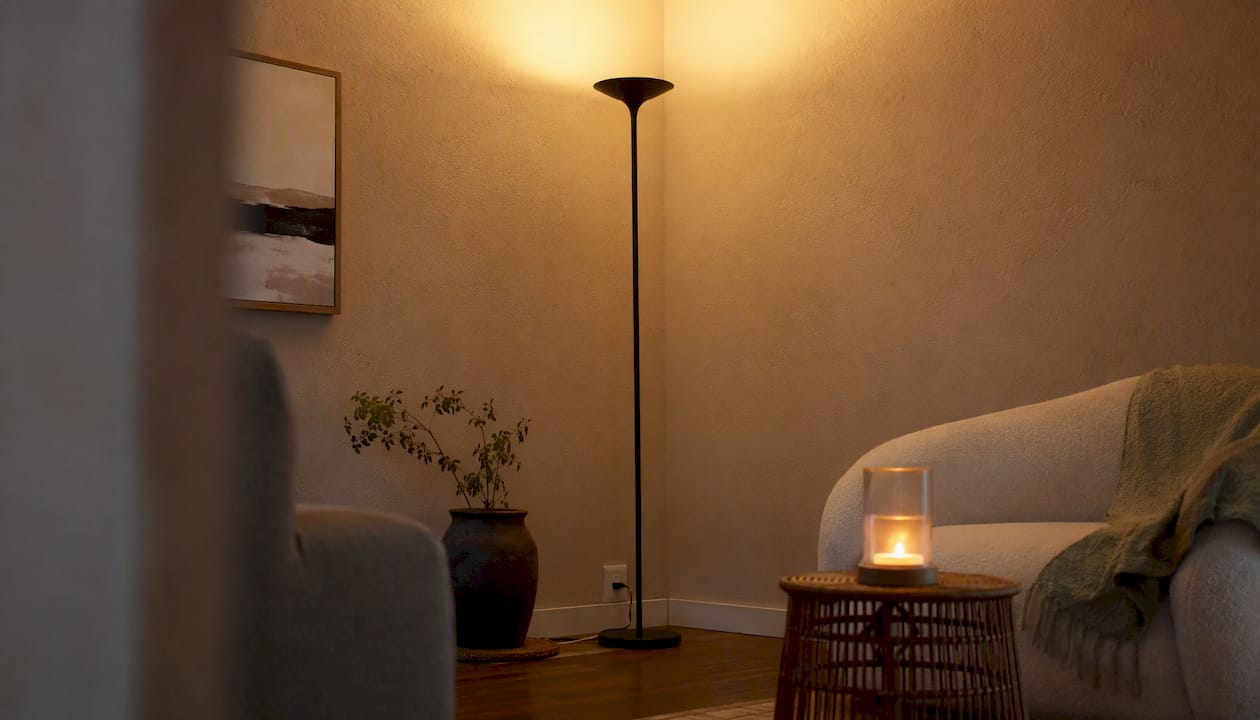
Start with a torchiere in the corner farthest from the window. It fills the room with indirect ambient light and draws the eye upward, making the ceiling feel higher. Add a small table lamp on the side table for task light and a picture light or LED strip behind the TV for accent. For small living room arrangements, tuck the floor lamp behind the sofa rather than beside it to keep the walkway clear.
Studio apartment
Zone separation is the priority. Use a pendant over the dining spot to anchor that area visually. A torchiere handles ambient light for the living zone. A dedicated desk lamp covers the work area. Hang a large mirror on the wall opposite the main window to double the perceived light in the space. For more on zoning a studio, Noble Abode’s studio decorating guide covers furniture placement and lighting interaction in detail.
Smart bulbs, dimmers, and simple scene control
Controls add flexibility without adding fixtures. A few practical options:
- Smart bulbs (Wi-Fi or Zigbee-based) let you adjust brightness and color temperature from a phone or voice assistant. Useful for switching between a bright-cleaning mode and a dim evening setting.
- Plug-in dimmers attach between the lamp cord and the outlet. No wiring required. Confirm the bulb is dimmer-rated before using one.
- In-line cord dimmers install on the lamp cord itself. A simple, low-cost option for floor and table lamps.
- Smart plugs turn any existing lamp into a scene-capable, schedule-controlled light. At roughly $10–15 per plug, a smart plug is often cheaper than replacing every bulb with a smart version.
Good task lighting at the right brightness also reduces eye strain during focused work.
Compatibility note: Most LED bulbs are not compatible with older incandescent dimmers. If a bulb flickers or hums, replace the dimmer with an LED-rated model. Check the bulb packaging for a “dimmable” label before purchasing.
Renter-friendly lighting options that need no hardwiring
No landlord approval needed for any of these:
- Plug-in sconces. Mount with a removable adhesive hook or a single small nail. Run the cord along the wall and cover with a cord channel for a clean look.
- Plug-in pendants. Hang from a removable ceiling hook rated for the fixture’s weight (e.g., a plug-in pendant hung from a removable ceiling hook rated at 10 lbs). Route the cord along the ceiling edge with adhesive clips.
- Arc floor lamps and torchieres. No installation at all. Position, plug in, and adjust.
- Adhesive LED strips. Press-and-stick installation under shelves, along baseboards, or behind headboards. Use 3M Command-style strips for clean removal.
- Clamp lamps. Attach to a shelf, headboard, or desk edge. Useful for task light without any surface footprint.
- String lights. Drape over a curtain rod, along a shelf, or behind a sheer curtain panel for soft ambient accent light.
Safety basics: use hooks and adhesive mounts rated for the fixture’s weight. Keep cords routed against walls and away from foot traffic. Avoid installing any light fixture, including LED strips, in areas with regular moisture exposure unless the product is rated for damp locations.
What should you check before buying lights for a small room?
A short checklist for evaluating any fixture listing:
- Lumen output. Confirm it matches the room’s needs (see the table below).
- Color temperature (K). 2700K–3000K for living and sleeping areas; 4000K–5000K for kitchens and bathrooms.
- Dimmer compatibility. Look for “dimmable” on the bulb packaging and verify the dimmer is LED-rated.
- Fixture dimensions. Measure the mounting surface or floor area before ordering. A lamp that looks compact online can be oversized in a small room.
- Mounting type. Plug-in vs. hardwired. Renters should default to plug-in unless the landlord permits hardwiring.
- Return policy. Lighting scale is hard to judge from photos. A flexible return window matters.
When to hire an electrician: any hardwired installation (recessed cans, track lighting, ceiling fixture swap) requires one unless you are experienced with residential wiring. A licensed electrician typically charges $50–$100 per hour for straightforward fixture swaps in the US.
| Room type | Recommended total lumens | Color temperature |
|---|---|---|
| Living room | 1,500–3,000 lm | 2700K–3000K |
| Bedroom | 1,500–3,000 lumens | 2700K |
| Kitchen | 4,000–5,000 lumens | 4000K–5000K |
| Bathroom | 4,000–5,000 lumens | 4000K–5000K |
| Home office / desk | 1,500–3,000 lumens | 3000K–4000K |
Noble Abode picks for small-space lighting and decor
Noble Abode’s curated selection includes several product types that pair directly with the lighting strategies above:
- Compact table lamps. A slim-base lamp with a linen or paper shade delivers warm, diffused task light without crowding a nightstand or side table. Pairs with the bedroom three-layer setup described above.
- Decorative mirrors. A statement mirror placed opposite a window or torchiere amplifies light across the room. Noble Abode’s mirror selection includes options sized for small walls where a large mirror would overwhelm.
- Lightweight floor torchieres. A slender torchiere with a neutral finish blends into a corner and provides the ambient base layer a studio or living room needs.
- Sculptural accent pieces. A small sculpture or art figurine placed near a lamp creates a lit vignette that draws the eye and adds depth to a corner without additional fixtures.
Pro Tip: Pair a slim bedside sculpture with a plug-in wall sconce directly above it. The sconce light grazes the sculpture’s surface, creating a layered vignette that reads as intentional styling rather than a bare bulb on a wall.
Product links appear in the shop section below. For broader small-apartment decorating ideas that integrate lighting with furniture and decor choices, Noble Abode’s blog covers room-by-room guidance.
The swap that actually changes a small room
The single most reliable weekend upgrade is replacing every bulb in the room with 2700K warm white LEDs and adding one torchiere or two plug-in wall sconces. That combination alone shifts a flat, harsh room into something that feels considered and warm. Most people focus on buying new furniture when the lighting is what is actually making the space feel cramped and dim. A $15 bulb swap and a $40 torchiere will do more for a small room than a new rug. Noble Abode’s lamp and decor selections are chosen with exactly this kind of practical, high-impact styling in mind.
Style-forward small-space lighting from Noble Abode
Noble Abode offers a curated selection of lamps, mirrors, and accent decor sized and styled for compact rooms. Each piece is chosen for clean proportions, warm finishes, and the kind of craftsmanship that holds up over time. Browse the collection to find a compact rechargeable table lamp or a statement accent piece that anchors your lighting setup.
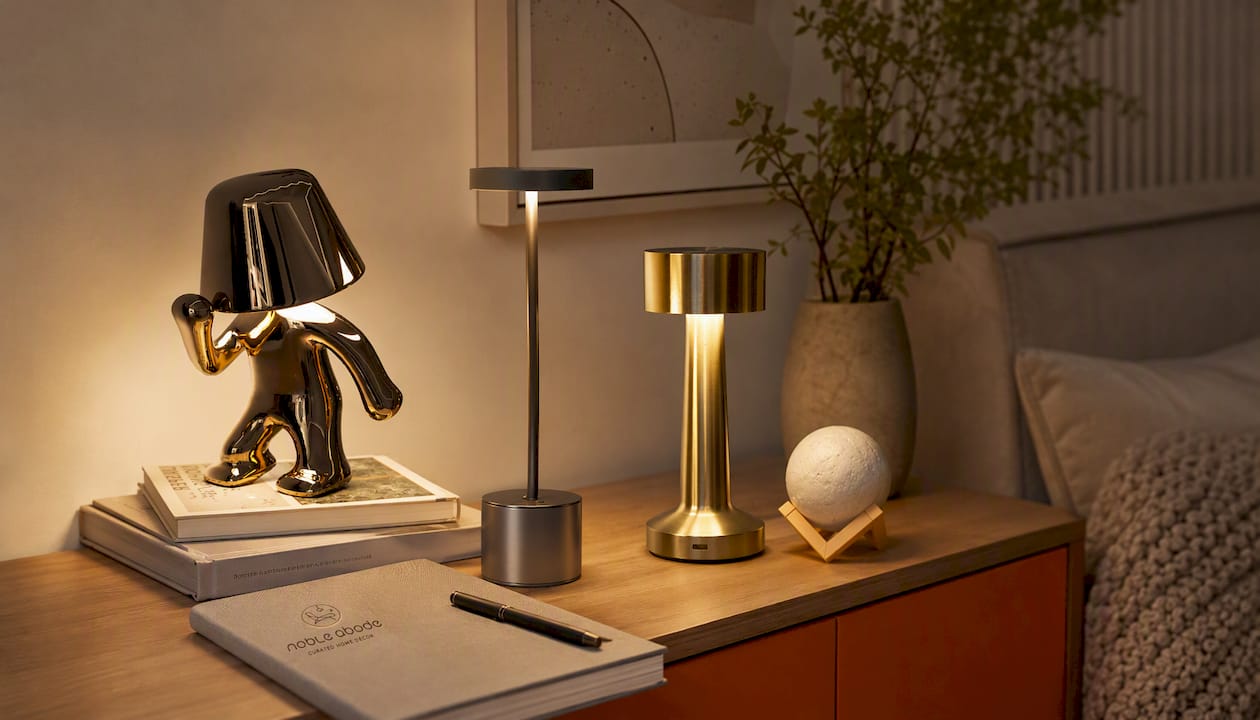
Pair any lamp with a sculptural accent from Noble Abode’s decor range, such as the Reading Women Statue, to build a styled vignette that makes your lighting work harder visually. Visit Nobleabode to browse the full small-space collection.
Sources
- Besthomehq
- Top 17 Small Apartment Lighting Ideas to Brighten Even the Darkest Space
- Best Small Apartment Lighting Ideas: Pendants & Wall Sconces 2026
- Small Space Lighting Ideas: 10 Ways to Transform Your Tiny Home With Light - Tiny Room
FAQ
What is the best lighting for a small room?
Layered lighting combining ambient, task, and accent sources is the most effective approach. Use warm white 2700K bulbs and aim for one light source per 80–100 square feet.
How do you light a small apartment without ceiling fixtures?
A floor torchiere bouncing light off the ceiling is the best substitute for a hardwired overhead fixture. Pair it with plug-in sconces and a table lamp for full layered coverage.
Are plug-in sconces and pendants renter-friendly?
Yes. Plug-in sconces and pendants require no hardwiring, install with removable hooks, and remove cleanly at move-out, making them ideal for renters.
What color temperature bulb should you use in a small bedroom?
Use 2700K warm white bulbs. Warm white softens the room visually and creates a more relaxed atmosphere compared with cooler daylight bulbs.
How do mirrors help with lighting in small spaces?
A mirror placed opposite a window or primary light source reflects and amplifies both natural and artificial light, making the room feel brighter and larger without adding any fixtures.