

6 Questions to Decide Matte Black vs Oil Rubbed Bronze for Homeowners
Choose matte black for modern, high-contrast rooms that need a low-maintenance, uniform look, and choose oil rubbed bronze when you want warmth, vintage character, and a finish that develops patina with age. The two can work together if you keep one dominant and treat the other as a deliberate accent. For the exact criteria to decide, jump to the choosing checklist below.
TL;DR:
- Matte black offers a consistent, uniform finish created through industrial coating processes, making it more durable and predictable over time.
- Oil rubbed bronze varies significantly between brands due to its hand-applied, artisanal finishing process, which introduces natural variation and patina development.
- Lighting conditions heavily influence the appearance of both finishes, with warm bulbs emphasizing ORB’s copper highlights and cool lighting enhancing matte black’s crispness.
- Mixing finishes works best when grouped by function or tone, with deliberate placement rather than consistent throughout a whole room, to create intentional contrast.
- Matte black is generally lower-cost and better suited for high-traffic areas requiring predictability, while oil rubbed bronze adds warmth and character as a feature finish.
Table of Contents
- Matte Black vs Oil Rubbed Bronze: What They Actually Look Like Side-by-Side
- How Each Finish Is Made (and Why That Predicts How It Wears)
- Durability, Maintenance, and Long-Term Wear: The Real Trade-Offs
- How to Choose Between Matte Black and Oil Rubbed Bronze
- Mixing Matte Black With Oil Rubbed Bronze: Designer Rules That Work
- Style Pairings by Room: Kitchen, Bath, Entry, and Living Space
- A Publisher’s Perspective on Choosing and Bridging These Finishes
- Common Fixtures and Applications for Each Finish
- Why the “Pick One and Stick With It” Advice Misses the Point
- Finish the Room With Pieces That Bridge Both Metals
- Sources
- FAQ
Matte Black vs Oil Rubbed Bronze: What They Actually Look Like Side-by-Side
Matte black is a true, neutral black with a light-absorbing surface that reads the same in every room. Manufacturers typically apply it as a powder coating or a 2K matte paint system, which is why a matte black cabinet pull from one brand usually matches a matte black faucet from another almost exactly. That consistency is a manufacturing feature, not an accident.
Oil rubbed bronze (often shortened to ORB) starts as a warm, dark brown-black base and gets hand-rubbed or multi-step coated so copper and bronze highlights show through at the edges and raised details. No two makers produce quite the same warmth or highlight level, which is part of the finish’s appeal and also its biggest risk. Fixture Elite’s comparison of oil rubbed bronze and matte black faucets notes that ORB reads as warm dark brown with copper accents that shift with age, while matte black stays visually flat and consistent over time.
Lighting changes both finishes more than most homeowners expect.
- Warm bulbs (2700K to 3000K) bring out ORB’s copper highlights and make matte black look slightly softer, less stark.
- Cool white light (4000K and up) flattens ORB’s warmth and makes matte black look crisper and more graphic.
- Natural north-facing light tends to make matte black look almost charcoal rather than true black.
- Direct sun on a south-facing window can wash out ORB’s darker tones and mute the contrast that makes it distinctive.
Pro Tip: Bring a hardware sample home and set it on your counter or vanity for 24 hours before buying a full set. The finish that looks perfect under a showroom’s cool LEDs can read completely different under your kitchen’s pendant lights at 8 p.m.
Because oil rubbed bronze varies by manufacturer, compare samples from the same maker whenever you’re buying pieces for one room. Mixing an ORB faucet from one brand with ORB cabinet knobs from another is one of the most common ways a “coordinated” kitchen ends up looking mismatched.
How Each Finish Is Made (and Why That Predicts How It Wears)
The manufacturing process behind each finish tells you almost everything about how it will hold up.
Matte black hardware is usually produced through powder coating, electroplating, or single-stage matte paint application. Powder coating in particular bakes a dry pigment onto metal under heat, creating a hard, even shell that resists chipping better than liquid paint. PPG’s matte black polyester urethane powder coating is one example of this category, engineered specifically for durability and color consistency across batches. PPG’s Matte Black Vista powder coating documentation makes the same point: the process is built for uniform results on many substrates, which is why matte black fixtures from a given manufacturer tend to look identical whether you buy one or twenty.
Some matte black formulations go further. Molteni Vernici’s 12623 Absolute Black finish is engineered to absorb light while resisting fingerprints and general wear, which pushes back on the assumption that all matte black shows every touch and smudge. Coating quality matters more than the color itself.
Oil rubbed bronze starts with a brass or bronze base, then goes through an oil rub or hand-applied finishing process that deposits the darker patina and leaves lighter bronze tones exposed on raised details. This step is inherently less automated than powder coating, which explains why ORB varies so much between brands and even between production runs from the same brand.
A finish born from a controlled industrial process will behave predictably for years. A finish born from hand application will always carry some variation, and that variation is the entire reason people choose it.
Before buying, ask any retailer or installer how the finish was applied and what warranty covers finish failure. A powder-coated matte black should carry a clear durability warranty. An oil rubbed bronze piece, by nature, may only warranty the base hardware and not the coloring, since patina change is expected rather than considered a defect. Manufacturer tech sheets, not marketing copy, are the most reliable way to verify these claims.
Durability, Maintenance, and Long-Term Wear: The Real Trade-Offs
Matte black’s biggest practical advantage is predictability. It comes from a controlled coating process, it looks the same in every room of the house, and it’s typically the more affordable option across cabinet hardware, faucets, and light fixtures. Its main weakness shows up under hard use: a quality-coated matte black resists marks well, but a cheaper single-stage paint can scratch down to bare metal and show a bright, silvery line that’s hard to disguise.
Oil rubbed bronze earns its following through character. It hides small dings and daily wear better than almost any other finish, because the variation is already built into the surface. Its downside is consistency. Two ORB faucets from different manufacturers rarely match, and the finish can develop water spots in humid environments if it isn’t sealed properly. BathSelect’s comparison of ORB and matte black showers points out that performance in wet environments depends heavily on sealing and coating quality, not just the finish name.
Here’s how the two compare across the fixtures homeowners ask about most:
- Kitchen and bath faucets: Matte black shows water spots less than shiny finishes but can show mineral scale if your water is hard. ORB tends to disguise scale better but needs gentler, non-abrasive cleaning to protect the oil-rubbed layer.
- Cabinet hardware: Matte black holds up well to daily hand contact if it’s a real powder coat. ORB on knobs and pulls develops a “worn-in” look at high-touch points within a year or two, which some homeowners love and others find inconsistent.
- Lighting fixtures: Both finishes perform well since lighting sees less physical contact. Choose based on the room’s undertone rather than durability here.
- Plumbing fixtures overall: TopChooser’s comparison of matte black and oil rubbed bronze cabinet hardware notes matte black generally hides fingerprints and water spots better, while ORB varies by manufacturer and hides minor wear rather than eliminating the appearance of marks.
| Factor | Matte Black | Oil Rubbed Bronze |
|---|---|---|
| Undertone | Neutral, true black | Warm brown/bronze with copper highlights |
| Sheen | Flat, light-absorbing | Slight variation, highlights catch light |
| Durability | High with quality powder coat | Good, but coating quality varies by maker |
| Maintenance | Wipe clean, avoid abrasives on cheap coatings | Gentle cleaning, avoid stripping the oil-rubbed layer |
| Typical cost | Often the lower-cost option | Often priced higher for hand-finishing labor |
| Mixes with | Cool metals, graphic patterns | Warm woods, brass, traditional details |
Pro Tip: Reserve harsh degreasers and abrasive scrub pads for neither finish. A soft cloth with mild dish soap protects both the powder coat on matte black and the hand-applied layer on oil rubbed bronze equally well.
Kitchens with kids or heavy daily traffic tend to favor matte black for its consistency and lower repair anxiety. Homes chasing a warmer, more lived-in look, especially in baths and entryways, lean toward oil rubbed bronze specifically because the wear becomes part of the design.
How to Choose Between Matte Black and Oil Rubbed Bronze
Six factors decide this choice better than personal preference alone.
- Room lighting. Warm bulbs flatter ORB; cool LEDs favor matte black’s crisp edge.
- Existing metals in the room. Brass and warm woods already in the space pull you toward ORB; chrome, steel, and graphic black-and-white palettes pull you toward matte black.
- Traffic level. High-touch areas like kitchen cabinet pulls benefit from matte black’s predictable wear pattern.
- Finish consistency needs. If you’re buying hardware across multiple rooms over time, matte black’s manufacturing consistency reduces mismatch risk.
- Warranty and finish method. A powder-coated piece should carry a documented finish warranty; a hand-finished ORB piece typically won’t, and that’s normal.
- Budget. Matte black is usually the lower-cost route across comparable product lines, since ORB’s hand-finishing adds labor cost.
Ask any retailer or installer these six questions before you commit:
- Is the finish powder-coated, electroplated, or hand-rubbed?
- Can I see a physical sample under my room’s actual lighting, not the showroom’s?
- What does the warranty cover: the hardware itself, the coating, or both?
- Will this specific piece match hardware I already own from a different product line?
- How does this finish perform in humidity, if it’s going in a bathroom?
- What’s the manufacturer’s recommended cleaning method?
If you want uniformity and low upkeep across a full house, matte black is the more forgiving choice. If you want warmth and don’t mind embracing visible aging as a feature, oil rubbed bronze delivers character no manufactured finish can fake.
Watch for two red flags in product photos and specs: listings with no close-up shot of the actual texture (a sign the seller is hiding inconsistency), and ORB descriptions that use the words “uniform” or “consistent,” since that’s not how the finish naturally behaves. For more on how hardware color ages in a home over years rather than months, One Day Doors & Closets’ guide to hardware colors that don’t go out of style is a useful reference point.
Mixing Matte Black With Oil Rubbed Bronze: Designer Rules That Work
Yes, you can mix the two finishes, but only with a plan. A single ORB towel bar in an otherwise all-matte-black bathroom looks like a leftover part, not a design decision.
Group by function rather than by room. Fix It in the Home’s guide to mixing black and oil rubbed bronze recommends keeping all plumbing fixtures in one finish and all lighting fixtures in the other, since that division reads as intentional even when the two metals sit close together.
Two setups illustrate this well:
- Kitchen: Matte black cabinet pulls and drawer hardware (dominant, 70%), paired with oil rubbed bronze pendant lights over the island (accent, 30%). The warm bronze glow softens the room without fighting the black hardware’s clean lines.
- Bathroom: An oil rubbed bronze faucet and shower fixtures (dominant) paired with a black-framed mirror and black sconces (accent). The warmth stays at counter level while the black frame adds a graphic anchor above.
Bridging materials do a lot of the heavy lifting here. Wood tones, and countertops with both warm and cool mineral veining, visually connect a cool matte black with a warm ORB accent so the room doesn’t feel like it’s fighting itself. A guide to mixing wood tones for cohesive rooms covers this bridging principle in more depth if you’re building a full room palette around mixed metals.
Pro Tip: When in doubt, split by function rather than by fixture. Put every faucet, drain, and showerhead in one finish, and every light fixture in the other. It’s the simplest rule to remember and the hardest one to get wrong.
The mistakes that make mixed finishes look accidental instead of intentional: splitting close to 50/50 so neither finish reads as dominant, combining two finishes on a single fixture (like a black faucet body with bronze handles), and adding just one lonely accent piece with no repetition anywhere else in the room.
Style Pairings by Room: Kitchen, Bath, Entry, and Living Space
Matte black pairs naturally with white oak, walnut, and cooler-toned quartz countertops that have gray or white veining. It reads especially well against high-contrast palettes: white cabinets, black hardware, and a black-framed mirror or light fixture repeating the accent. In an entry, a matte black light fixture over a light wood console creates the kind of graphic contrast that photographs well and ages without looking dated.
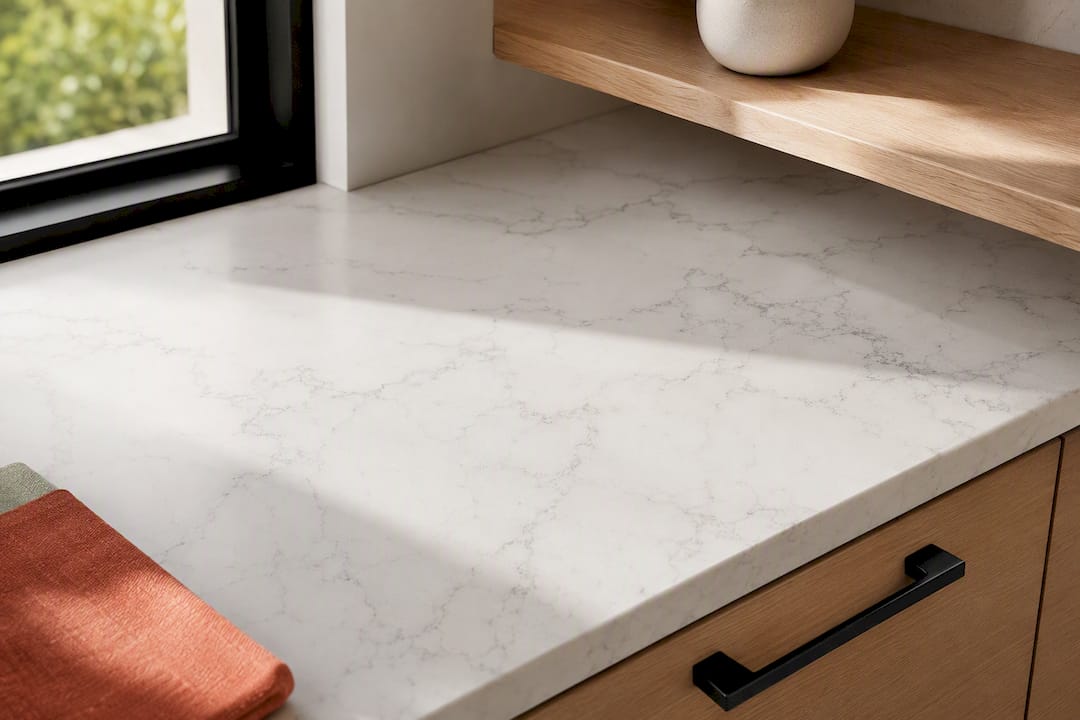
Oil rubbed bronze pairs best with warm wood tones like cherry or reclaimed oak, cream or warm-white cabinetry, and countertops with beige or gold veining. It suits traditional and transitional kitchens, farmhouse baths, and any living space built around a warmer, collected-over-time feel rather than a sharp, modern one.
Kitchen example, matte black: black cabinet pulls, a black single-hole faucet, and a matte black pendant light over the sink, tied together with a light wood open shelf holding a matte black metal flower vase as a repeat accent.
Kitchen example, oil rubbed bronze: ORB cabinet knobs, a bronze bridge faucet, and warm pendant lighting at 2700K over a butcher block island.
Bathroom example, matte black: black shower fixtures, a black-framed mirror, and one warm terra cotta accent to keep the room from feeling cold. Noble Abode’s entryway lighting guide has useful notes on fixture placement that apply just as well to bathroom lighting decisions.
Bathroom example, oil rubbed bronze: an ORB faucet and towel bar, warm wood vanity, and a soft white or cream vessel sink to let the bronze do the visual work.
Small decor accents, repeated two or three times in a space, do more to unify a mixed-finish room than any single statement piece. A neutral ceramic vase or matte black candle holder placed on a counter and echoed on a shelf across the room ties the whole palette together far better than one large piece standing alone.
A Publisher’s Perspective on Choosing and Bridging These Finishes
Matte black earns its popularity honestly: it’s consistent, widely available, and forgiving for anyone assembling a kitchen or bath in stages over a year rather than all at once. Oil rubbed bronze earns its following just as honestly, through warmth that manufactured finishes struggle to replicate.
Neither finish needs to win the room alone. Some accent pieces work well as the bridge between the two, since neutral materials don’t compete with either metal’s undertone.
- A plain ceramic jug vase placed near black hardware softens the room’s contrast without pulling warmth away from a bronze faucet nearby.
- The metal matte black flower vase repeats a matte black accent in a room where the dominant finish is oil rubbed bronze, giving the mix intentional structure.
- A warm-toned table lamp placed opposite a black light fixture lets both undertones exist in the same sightline without one canceling out the other.
Place repeat accents at eye level and at counter height. A room reads as coordinated when the eye catches the same finish twice, not once.
Some product durability notes and finish photos are listed on product pages, so you can compare a piece’s actual coating against your existing hardware before buying.
Common Fixtures and Applications for Each Finish
Both finishes show up across the same three fixture categories, but they earn their place differently.
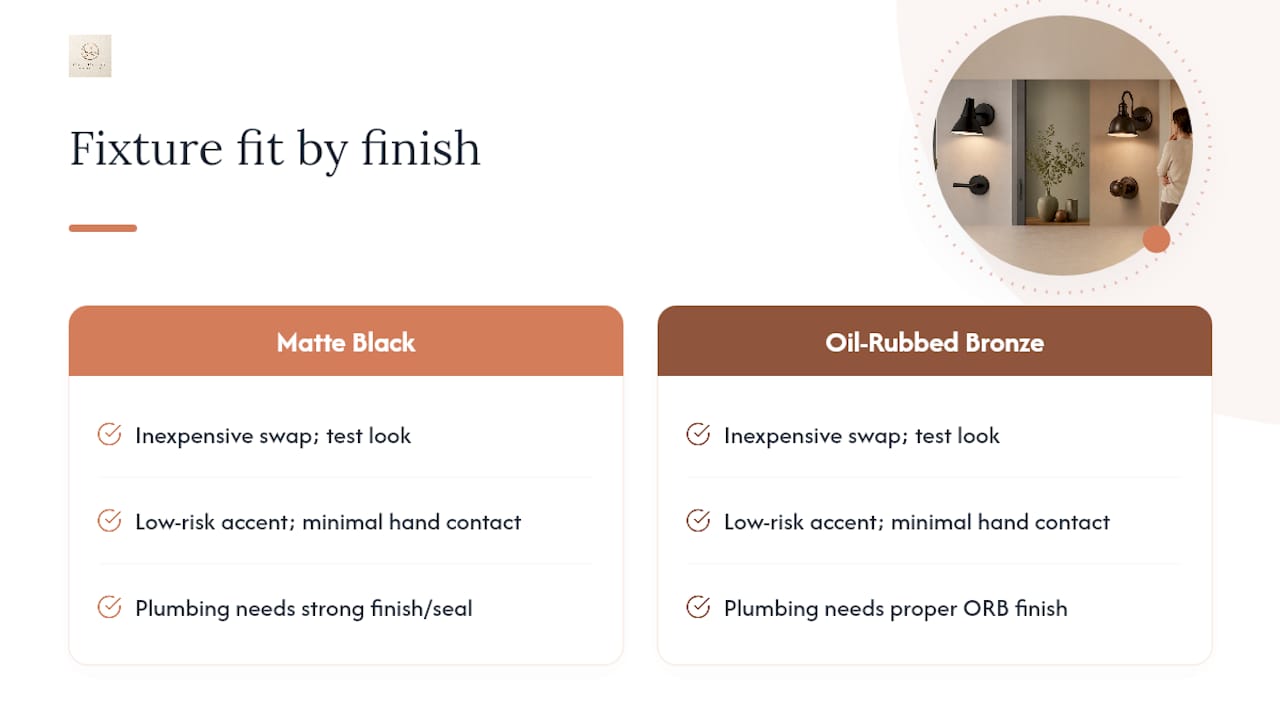
Hardware. Cabinet pulls, knobs, and drawer handles are the most common entry point for either finish, since they’re inexpensive to swap and let homeowners test a look before committing to plumbing or lighting.
Lighting. Pendant lights, sconces, and chandeliers in both finishes are widely available, and lighting is the lowest-risk place to introduce an accent finish since fixtures see minimal hand contact.
Plumbing. Faucets, shower systems, and drain hardware carry the most performance pressure, since they face constant water exposure and cleaning. This is where finish method matters most: a well-sealed powder-coated matte black faucet and a properly finished ORB faucet can both perform for years, but a poorly coated version of either will fail faster.
Door hardware, cabinet legs, and even furniture hardware increasingly come in both finishes too, which is part of why matte black and oil rubbed bronze show up together so often in whole-home renovations rather than single rooms. Choosing one finish as the “hardware standard” for the house and the other as a room-specific accent tends to produce the most cohesive result across a full renovation timeline.
Why the “Pick One and Stick With It” Advice Misses the Point
Most guides treat this as a binary choice: pick matte black or pick oil rubbed bronze and use it everywhere. That advice is safe, but it undersells what both finishes can do together when the split is deliberate.
The real question isn’t which finish is objectively better. It’s which finish should dominate, and where the second one earns its place. Homeowners who get this wrong usually don’t fail because they mixed finishes. They fail because they mixed them evenly, with no logic tying the choices together.
Prioritize the lighting in your specific rooms before anything else. A finish that looks perfect in a showroom under cool LEDs can read completely differently under your own warm pendant lights, and that mismatch causes more buyer’s remorse than the finish choice itself ever does.
— Stephane
Finish the Room With Pieces That Bridge Both Metals
Once your hardware and fixtures are settled, the pieces that tie a mixed-finish room together are usually the small decor accents, not the metal itself. Noble Abode’s curated collection gives you a way to soften contrast or add warmth without touching a single screw.

The Fluted Vase, Sleek Vase, and Minimal Vase each work as neutral bridges between a matte black kitchen and warmer wood tones, since their ceramic and glass finishes don’t compete with either metal’s undertone. The Italian Designer Glass Table Lamp adds warm ambient light that flatters oil rubbed bronze accents in the evening, while a Luxury Ruffled Electroplated Ceramic Vase makes a strong enough visual statement to anchor a mixed-finish console table on its own.
Unlike a full hardware swap, these pieces let you test a warmer or cooler direction in a room before making a bigger commitment. Browse the full vases collection or the broader luxury decor collection to find the accent that bridges your specific matte black and oil rubbed bronze choices, and check current pricing directly on the product page.
Sources
- 12623™ Absolute Black – Molteni Vernici
- Oil Rubbed Bronze Vs Matte Black Faucet: Which Is Best for You? – Fixture Elite
- Mixing Black & Oil Rubbed Bronze: Unlock a Designer Look - Fix It In The Home
FAQ
Is Oil Rubbed Bronze Close to Matte Black?
Not quite. Oil rubbed bronze has a warm dark brown base with visible copper and bronze highlights, while matte black is a neutral, uniform black with no warm undertone. Under warm lighting the two can look closer together, but side by side under neutral light, the difference is clear.
What Is the Difference Between Oil Rubbed Bronze and Matte Black?
The core difference is undertone and manufacturing consistency: matte black is neutral and produced through processes like powder coating for uniform results, while oil rubbed bronze is warm toned and hand finished, which means it varies between manufacturers and develops patina over time. Fixture Elite’s comparison covers this appearance gap in more detail.
Is Matte Black Hardware Outdated?
No, matte black remains one of the most widely used finishes in modern and transitional homes, largely because of its consistency and affordability across cabinet hardware, faucets, and lighting. It continues to dominate contemporary kitchen and bath design as of 2026.
Is Oil Rubbed Bronze Outdated?
Oil rubbed bronze isn’t outdated. It’s cycling back into favor, and Rocky Mountain Hardware’s design coverage points to renewed interest in handcrafted bronze finishes in higher-end residential design. It tends to suit traditional, transitional, and warm-toned interiors better than stark modern spaces.