

Mixing Wood Tones: Simple Rules for Cohesive Rooms
Yes, mixing wood tones improves a room, and it works when you anchor with one dominant tone, add one or two supporting tones, repeat each at least twice, and match undertones before you match color depth. That last part trips up most people. A room does not need matching furniture to feel put together. It needs a system.
The formula designers actually use:
- Anchor: identify your dominant wood (usually the floor or largest piece).
- Support: add one or two more tones, never more than three total.
- Repeat: each tone shows up at least twice, so it reads as a choice, not an accident.
- Match undertone: warm with warm, cool with cool, or bridge with neutral.
- Proportion: apply a 60/30/10 or 70/30 split across large, medium, and small elements.
Quick fixes if a room already feels off: repeat an existing tone somewhere new, add a piece with real contrast instead of a near-match, or bridge two clashing woods with a black-stained accent or a textured rug.
Key Takeaways
Mixing wood tones works reliably when you anchor with one dominant tone, add one or two supporting tones, repeat each at least twice, and match undertones before value.
| Point | Details |
|---|---|
| Identify your anchor | Your floor, cabinetry, or largest furniture piece sets the dominant wood tone for the room. |
| Use a proportion rule | Apply a 60/30/10 or 70/30 split across large, medium, and small wood elements. |
| Match undertones first | Warm, cool, red, and neutral woods pair more reliably by temperature than by matching shade depth. |
| Limit tones and repeat them | Stick to two or three wood tones per room and repeat each one at least twice. |
| Bridge mismatches | Black-stained wood, rugs, and metal accents neutralize clashing pairings. |
| Shop anchor and bridge pieces | Noble Abode’s storage cabinets, sculptural accents, and canvas art offer ready ways to repeat or bridge a wood tone without refinishing furniture. |
Table of Contents
- How to Start Mixing Wood Tones the Right Way
- What Wood Undertone Should I Match?
- How Many Wood Tones Should You Mix?
- How Do You Blend Clashing Wood Tones?
- Should You Test Wood Samples Before Buying?
- Who’s Behind This Guide to Mixing Wood Tones
- A Small Fix That Changed a Whole Room
- Shop Pieces That Anchor or Bridge a Mixed-Wood Room
- Sources
- FAQ
How to Start Mixing Wood Tones the Right Way
Start by naming the wood you cannot avoid. In most living rooms, that is the floor. In a dining room, it might be the table. In a kitchen, it is the cabinetry. Whatever covers the most square footage or sits at eye level automatically becomes your dominant tone, and every other wood decision gets measured against it.
Once you know your anchor, apply a proportion rule instead of guessing. Studio McGee’s approach to mixing wood tones centers on this same logic: identify the dominant tone first, then build outward.
- Dominant wood (60-70%): floors, cabinetry, or your largest furniture piece.
- Secondary wood (20-30%): a coffee table, dining chairs, or a media console.
- Accent wood (10%): picture frames, a small side table, a bowl or tray.
A living room with medium oak floors might pair a walnut coffee table (secondary) with a scattering of dark-stained frames and a wood bowl (accent). A kitchen with light maple cabinets can carry a walnut island as the secondary tone, echoed once more in open shelving brackets.
Pro Tip: Walk the room and count wood surfaces before buying anything new. If you already have three tones without realizing it, your job is to add repetition, not more variety.
What Wood Undertone Should I Match?
Undertone matters more than whether a wood is light or dark. Two pieces can sit at nearly the same value and still clash if one leans orange and the other leans gray. Homes & Gardens notes that undertone is often the real reason a wood pairing feels wrong, even when the shades look close on paper.
Wood undertones generally fall into four camps:
- Warm: yellow or orange casts, common in oak, pine, and honey-toned finishes.
- Cool: gray or ashy casts, seen in whitewashed oak and some modern walnuts.
- Red: pink or reddish casts, typical of cherry and mahogany.
- Neutral: balanced tones with little color bias, often found in unstained or lightly treated woods.
Matching undertones gives you more freedom than matching value ever will. A light warm oak floor pairs comfortably with a dark warm walnut table, even though they sit at opposite ends of the color spectrum, because the underlying temperature agrees.
Test this in your own space rather than trusting a showroom sample. Bring a swatch or small piece home and set it against your existing wood in daylight, then again under lamplight, since undertones shift depending on the bulb. A neutral wood piece, such as a lightly finished oak stool, can act as a buffer between a warm floor and a cooler accent table.
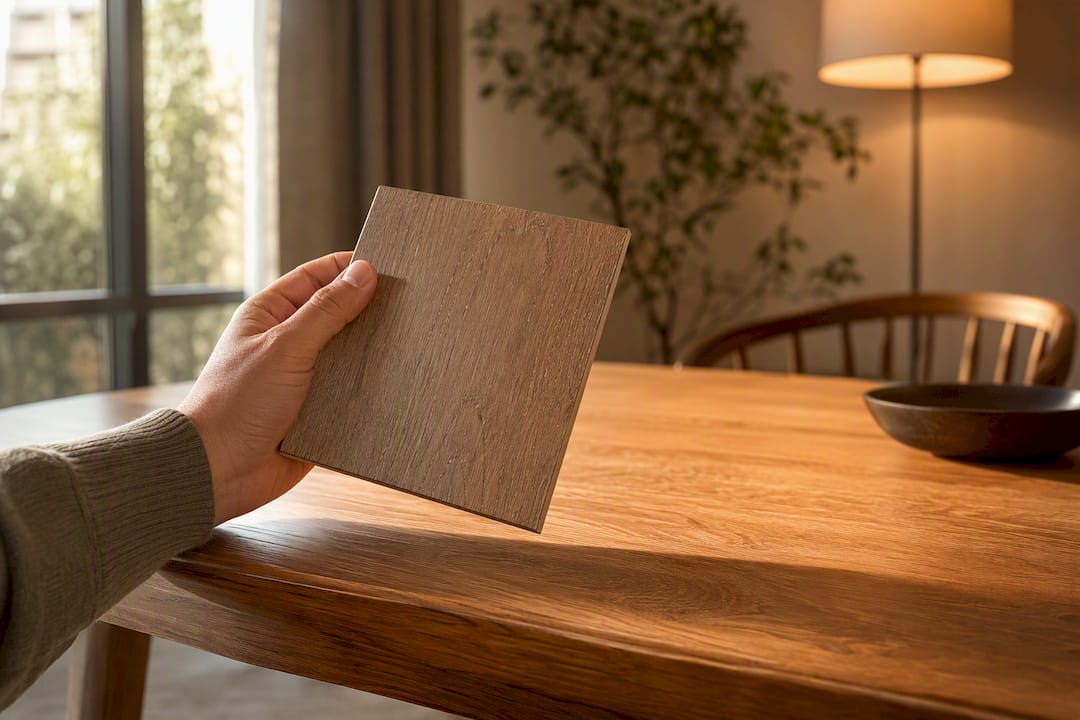
Pro Tip: If you are stuck between two woods that almost match, stop trying to force it. Homes & Gardens’ guidance on wood pairing points out that near-misses often look worse than a deliberate contrast, so either commit to a clear difference or swap one piece for a true match.
How Many Wood Tones Should You Mix?
Two or three tones per room is the ceiling most designers work within. Beyond that, a space stops reading as curated and starts reading as cluttered, no matter how nice each individual piece is. Sunset Magazine’s reporting on mixing light and dark wood backs this directly: limit a room to two or three tones and repeat each one elsewhere so the mix feels intentional rather than incidental.
- Pick your trio: one dominant, one medium, one dark or light contrast, depending on what you already own.
- Repeat each tone twice minimum: a walnut coffee table needs a partner, whether that is a picture frame, a lamp base, or a stack of books on a shelf.
- Spread them across the room: avoid stacking all your dark wood on one side and all your light wood on the other.
- Add a mid-tone buffer: when two woods feel too far apart in contrast, a medium tone placed between them softens the jump.
Nearly identical woods often cause more visual tension than clearly different ones. If two pieces are close but not quite matched, the mismatch reads as a mistake. Push them further apart or bring in a third tone to separate them, and the pairing suddenly looks deliberate.
How Do You Blend Clashing Wood Tones?
Bridging techniques rescue pairings that would otherwise fight each other. Chris Loves Julia’s guide to mixing wood tones treats black-stained or painted wood, along with rugs and textiles, as the standard tools for tying disparate tones into one scheme.
- Black-stained or painted furniture acts as a neutral, since black reads as an absence of undertone rather than another competing wood color.
- Rugs and textiles pull warm and cool tones into the same visual field by echoing colors from both.
- Metal and upholstery accents in brass, black iron, or a warm-toned fabric can soften the transition between a warm oak floor and a cooler gray-toned cabinet.
- Trim and doors painted white instead of stained can also stop a wood tone from competing where it does not need to; one guide on white trim and wood doors walks through exactly this trade-off.
Pro Tip: A single black-stained stool or side table can rescue an entire room where the existing woods do not quite agree. Treat black as your reset button, not just an accent color.
Should You Test Wood Samples Before Buying?
Yes, and skipping this step is the single most common reason a wood pairing looks great in a showroom and wrong at home. Sunset Magazine recommends sampling pieces in the actual room and checking them under both natural and artificial light before committing.
- Order or borrow a sample of any new wood piece rather than trusting a product photo.
- Place it in the room where it will actually live, not near a window in a different part of the house.
- Check it at two times of day: midday natural light and evening lamp light shift undertones noticeably.
- Photograph it next to your existing wood and compare the images on-screen, since cameras often reveal undertone clashes the eye misses in person.
- Step back to the doorway and look at the whole room. Distribute tones the way you would arrange a gallery wall. If every dark piece is clustered on one wall, distributing wood tones across the room instead of grouping them fixes the imbalance instantly.
Who’s Behind This Guide to Mixing Wood Tones
This guide comes from the Noble Abode editorial team, written by Stephane, who covers practical styling systems for the Noble Abode library, including pieces on building a neutral living room palette and broader styling ideas for transforming a space.
Noble Abode curates decor built to fill exactly the roles this guide describes: repeating a tone, bridging two mismatched woods, or adding a controlled accent. A few examples that map directly onto the rules above:
- A statement storage piece like the Modern Luxury Wine Cabinet can anchor a dining or entry space in a single dominant tone.
- Small accents such as a desktop storage box let you repeat an existing wood tone without buying furniture.
- Neutral sculptural pieces act as a visual buffer between warm and cool woods, the same role a black-stained accent plays.
A Small Fix That Changed a Whole Room
A reader once described a living room with honey-oak floors, a gray-washed console, and a cherry side table, three woods that had never once agreed with each other. The fix wasn’t a full furniture swap. Swapping the cherry table for a black-stained one instantly gave the room a neutral bridge, and the oak and gray-wash suddenly read as an intentional pairing instead of a mismatch.
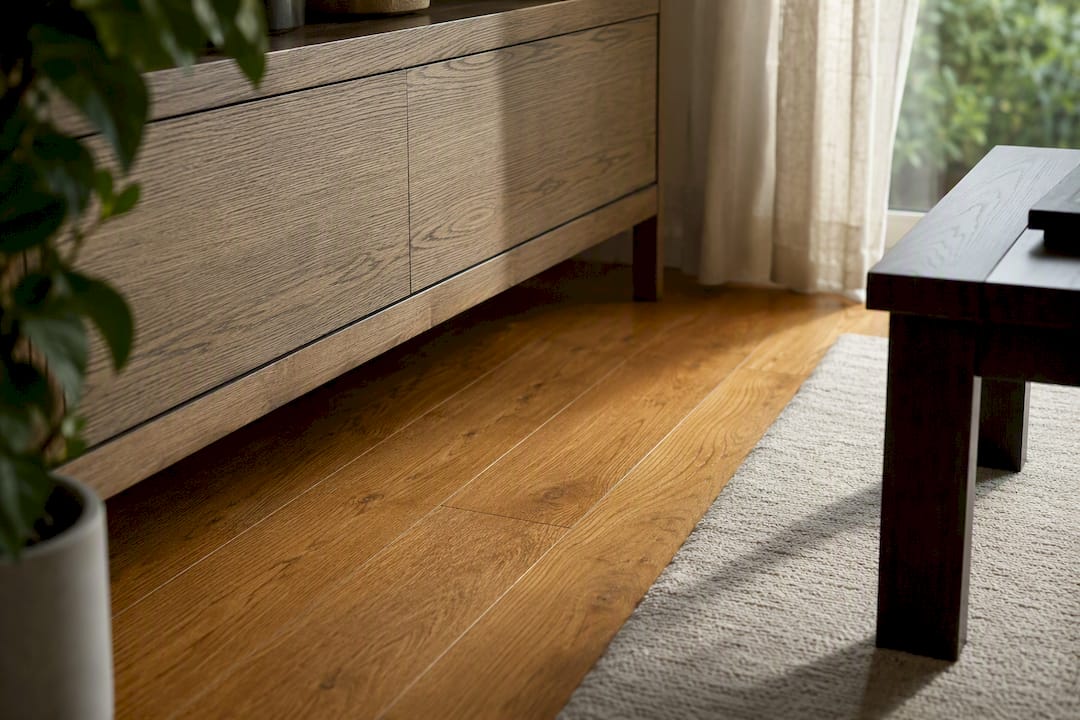
Try this yourself: find your one clashing piece, and consider a black stain before you consider replacing it.
Shop Pieces That Anchor or Bridge a Mixed-Wood Room
Once you know your dominant tone and your bridging strategy, the fastest way to execute it is with pieces built to repeat or soften a tone without demanding a full furniture overhaul. Noble Abode’s curated collection is built around exactly that kind of statement piece, so you can adjust a room’s wood balance without refinishing a single surface.
 The Modern Luxury Wine Cabinet and Shoe Storage Decor works as a dominant anchor piece in an entryway or dining space, especially when its finish echoes your floor’s undertone. For bridging warm and cool mixes, a neutral sculptural piece like the Black Décor Statue reads as an undertone-free neutral, the same trick as a black-stained stool. And repeating a warm accent tone across a room gets easier with something like the 2pcs Floral Leaf Canvas Art Posters, which pulls warm tones off a wood surface and echoes them at eye level.
If your dining table needs a finishing touch that pairs metal and wood tones rather than fighting them, the Light Luxury Western Tableware Set and an Italian Designer Glass Table Lamp both add contrast without adding another competing wood tone. Browse the full Noble Abode decor collection to find the anchor or bridge piece your room is missing.
Sources
- The 5 Things You Need To Know About Mixing Wood Tones In Your Home - Emily Henderson
- How to mix different wooden tones like an interior designer | Homes and Gardens
- How to Mix Wood Tones Like a Pro - Chris Loves Julia
FAQ
Can You Mix Light and Dark Wood in the Same Room?
Yes, mixing light and dark wood often looks more intentional than pairing two similar tones, as long as you repeat each tone at least twice in the space.
How Many Wood Tones Are Too Many in One Room?
Most designers cap a single room at two or three wood tones; adding more tends to make the space feel busy rather than layered.
Do Wood Undertones Matter More Than Light or Dark Value?
Yes, undertone (warm, cool, red, or neutral) often determines whether woods clash more than whether one is lighter or darker than the other.
Can You Mix Metals Along With Wood Tones?
Yes, mixing metals like brass and chrome works the same way as mixing wood tones, using one dominant metal, one or two accents, and repeating each finish across the room.
What’s an Easy Fix if My Wood Tones Already Clash?
Add a black-stained or neutral piece, such as a sculptural accent from Noble Abode, to act as a visual buffer between the two competing tones.