

Rug Prices $50–$5,500: Size, Material, and Annual Cost
Expect to pay roughly $50 to $300 for entry-level rugs, $300 to $1,200 for mid-range pieces, and $1,200 or more for premium hand-knotted rugs. Material and construction drive most of that spread. A rug pad, delivery, and occasional professional cleaning add another layer of cost most shoppers forget to budget for until the invoice arrives.
TL;DR:
- The most labor-intensive aspect of rug pricing is the craftsmanship involved in hand-knotting, which can increase costs by requiring weeks or months of work.
- A hand-knotted wool or silk-blend rug of size 8x10 often exceeds $1,800, with knot density and origin significantly influencing the final price.
- Budget synthetic rugs under $150 are suitable for low-traffic areas but tend to wear out quickly, while mid-range wool blends offer better durability at $300 to $800.
- Upgrading to premium hand-knotted rugs usually involves spending over $1,200, with factors like knot density, material quality, and provenance driving the premium.
- Buying used, direct from importers, or at estate sales can cut costs by 30% to 50%, but it requires careful inspection of the rug’s condition and construction.
Table of Contents
- How Much Do Rugs Cost by Size and Type?
- What Makes Rugs So Expensive?
- What Do You Actually Get at Each Price Point?
- How Do You Budget for a Rug the Smart Way?
- Where Should You Buy a Rug to Get the Best Price?
- When Do the Standard Rug Price Rules Not Apply?
- Stephane’s Take: Matching Rug Budget to How You Actually Live
- Get a Mid-Range Rug That Doesn’t Cut Corners
- Sources
- FAQ
How Much Do Rugs Cost by Size and Type?
Size and material together set the baseline, but the two variables don’t move in lockstep. A synthetic 8x10 can cost less than a wool 5x8, which trips up a lot of first-time buyers comparing listings by size alone.
| Size | Budget (synthetic) | Mid-range (wool blend) | Premium (hand-knotted) |
|---|---|---|---|
| 3x5 | $30–$80 | $100–$250 | $400–$900 |
| 5x8 | $80–$180 | $250–$600 | $900–$2,200 |
| 6x9 | $120–$250 | $350–$800 | $1,300–$3,000 |
| 8x10 | $150–$350 | $400–$1,000 | $1,800–$4,200 |
| 9x12 | $200–$450 | $500–$1,200 | $2,200–$5,500 |
These ranges line up with what most U.S. buyers actually pay, where mid-range 6x9 to 8x10 rugs commonly land between $150 and $800, and hand-knotted 9x12 pieces often run $1,100 to $3,300 or higher depending on origin.
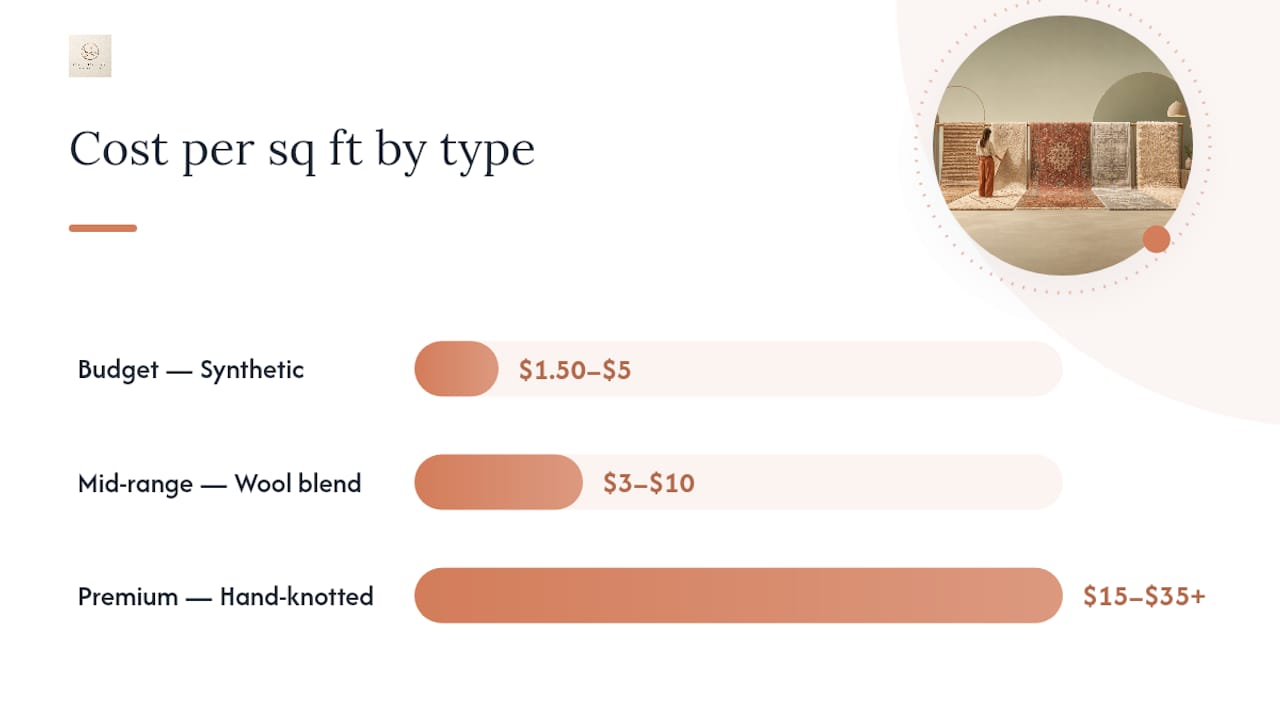
Per square foot, budget synthetics typically run $1.50 to $5, mid-range natural blends $3 to $10, and premium hand-knotted rugs $15 to $35 or more. Two 8x10 rugs can look identical in a product photo and differ by $2,000, because one is machine-tufted polyester and the other is hand-knotted wool with a knot count nobody bothered to photograph.
What Makes Rugs So Expensive?
Ask “why are rugs so expensive” and the honest answer is almost always labor, not marketing. A machine can punch out a rug in minutes. A skilled weaver working a traditional loom needs weeks or months for the same size.
Material sets the floor. Polypropylene and polyester are the cheapest and least durable. Wool blends sit in the middle, holding shape and hiding dirt better. Silk and hand-spun wool sit at the top, prized for sheen and drape but far more delicate.
Construction matters as much as fiber. Hand-knotted construction and natural fibers drive up price because of the labor and raw-material cost involved, while synthetics stay cheap precisely because machines make them fast. Our guide on hand-knotted vs. tufted rugs breaks down how much longevity you actually gain by paying more.
Knot density, measured in knots per square inch (KPSI), is the clearest technical explanation for why two hand-knotted rugs of the same size can cost wildly different amounts. Higher KPSI means finer detail and far more hours at the loom, and it’s one of six core factors that determine a hand-knotted rug’s price, alongside size, material, origin and age, condition, and total labor hours.
Origin and condition round it out. A rug with documented provenance, natural dyes, and no repairs commands a premium over a similar-looking piece with an unclear history.
Before buying, check:
- Material percentages listed exactly (e.g., “90% wool, 10% viscose”)
- Whether the listing says “hand-knotted,” “hand-tufted,” or “hand-finished” (each means something very different)
- A photo of the rug’s back, which reveals knot density and construction
- Country of origin and, for antiques, whether dyes are natural or synthetic
Pro Tip: Sellers sometimes blur “hand-tufted” and “hand-knotted” in casual descriptions. Confirming the exact term prevents you from paying hand-knotted prices for a lower-skill, faster-made rug.
What Do You Actually Get at Each Price Point?
Sticker prices only mean something once you can picture what’s behind them.
At $50 to $150, you’re looking at small synthetic rugs, entryway runners, or thin accent pieces. They work fine for low-traffic spots but flatten and shed fibers within a couple of years.
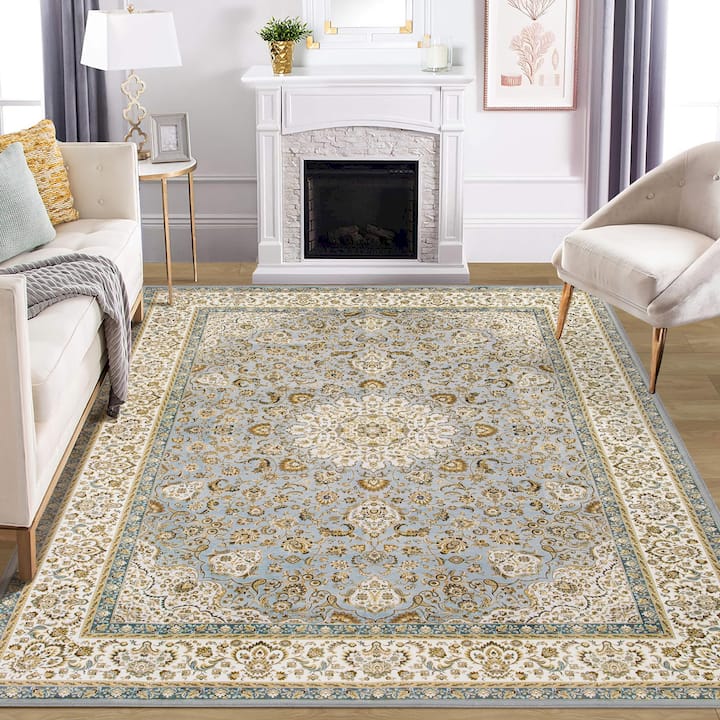
At $300 to $800, mid-range wool blends and quality hand-tufted rugs in 6x9 or 8x10 sizes become realistic. This is where most living rooms and bedrooms land, balancing durability with a reasonable price per square foot.
At $1,200 and up, you’re in hand-knotted wool, silk-blend, or antique territory. Materials and hours of skilled labor justify the jump, and pieces in this range often hold value better than they lose it.
| Budget | What you get | Typical size |
|---|---|---|
| $50–$150 | Synthetic accent rug, thin pile | 3x5 or runner |
| $300–$800 | Wool blend or hand-tufted | 6x9–8x10 |
| $1,200–$3,300+ | Hand-knotted wool or silk blend | 8x10–9x12 |
| $2,200–$5,500+ | Fine hand-knotted, antique, or large custom | 9x12+ |
A few notes on outliers:
- Outdoor rugs (polypropylene, UV-treated) typically cost less than comparable indoor synthetics but wear out faster in direct sun.
- Custom sizes and shapes (round, runner lengths over 10 feet) usually add 20% to 40% over standard-size equivalents.
- Antique and one-of-a-kind pieces don’t follow standard per-square-foot math at all. Rarity, not size, sets the price.
For living room picks that map to these bands, our expert-picked living room rugs roundup shows real examples at each tier.
How Do You Budget for a Rug the Smart Way?
Sticker price tells you almost nothing about value until you divide it by how long the rug will actually last.
- Measure the room first. Use the correct sizing rules so you’re not comparing a rug that’s too small to one that’s properly sized.
- Set a per-square-foot ceiling. Decide upfront whether you’re shopping the $1.50 to $5 synthetic tier or the $15+ hand-knotted tier, and stick to it while browsing.
- Calculate cost per year. A $300 wool-blend rug expected to last 8 years runs about $37.50 a year. A $2,000 hand-knotted rug lasting 25 years runs $80 a year, still more expensive annually, but often cheaper than replacing a $150 synthetic rug every 2 years, which also works out to $75 a year with none of the visual upgrade.
Rethinking cost this way changes the math: a well-made wool rug amortized over decades can be cheaper per year than buying cheap synthetics on repeat, even though the upfront number looks scarier.
Splurge on rugs in daily-traffic zones (living rooms, hallways) or pieces meant to be heirlooms. Economize on rooms with low foot traffic, rentals, or spaces you expect to redecorate within a few years. Renters generally do better sticking to the $150 to $500 range since they won’t recoup a premium investment when they move.
Where Should You Buy a Rug to Get the Best Price?
Channel matters almost as much as material. Big-box retailers offer convenience and easy returns but often carry the highest markup on mass-produced synthetics. Direct importers and specialty dealers cut out a layer of markup, frequently pricing hand-knotted rugs more fairly because they buy closer to the source. Estate sales and auctions can turn up genuine bargains on quality wool or antique pieces, but they require inspecting the rug in person for wear, moth damage, or repairs before you commit.
Buying used or going direct can save 30% to 50% compared to retail, largely because you’re skipping the showroom’s overhead. Online marketplaces split the difference: lower prices, but you’re relying on photos and seller descriptions instead of touching the pile yourself.
Before you buy, factor in the extras for making your house look expensive:
- A rug pad, typically $30 to $100 depending on size, extends the life of any rug and is worth reviewing through a rug pad selection guide
- Delivery fees on larger rugs, which can run $20 to $75
- Professional cleaning, generally $80 to $150 per visit for wool or delicate fibers
Pro Tip: Watch for listings that use vague terms like “luxury” or “designer” without naming the material or construction method. That’s usually a sign the retail markup is doing more work than the rug itself.
When Do the Standard Rug Price Rules Not Apply?
Silk rugs and fine antiques break the usual math. They cost more upfront, need gentler care (no steam cleaning, minimal direct sunlight), and can actually appreciate over time if provenance and condition hold up. That makes them a different kind of purchase entirely, closer to an investment or a keepsake than a floor covering.
On the opposite end, outdoor and washable machine-made rugs trade longevity for convenience. They’re priced lower than comparable indoor synthetics and designed to be tossed in a washing machine or hosed down, not to last twenty years.
The real question to ask is whether you want a decorative splurge (an antique or silk piece you’ll protect and admire) or a functional, furniture-grade rug that needs to survive kids, pets, and daily wear. Both are legitimate choices. They just call for completely different budgets and expectations.
Stephane’s Take: Matching Rug Budget to How You Actually Live
Most people overspend on the wrong room and underspend on the one that gets used daily. If a rug sits under a dining table or in a hallway, a durable wool blend earns its keep. Save silk or hand-knotted pieces for rooms with lighter traffic. At Noble Abode, we curate rugs where the materials and price point line up honestly, so what you pay reflects what you’re actually getting, not just what the listing implies.
— Stephane
Get a Mid-Range Rug That Doesn’t Cut Corners
If the $300 to $1,200 mid-range band fits your budget, the Ornate Room Rug gives you a soft floral design in a machine-washable 8x10 that fits the durability-without-overpaying zone this guide covers. It skips the trade-off between looking premium and being practical for daily life, which is exactly where a lot of shoppers in this price tier get stuck.
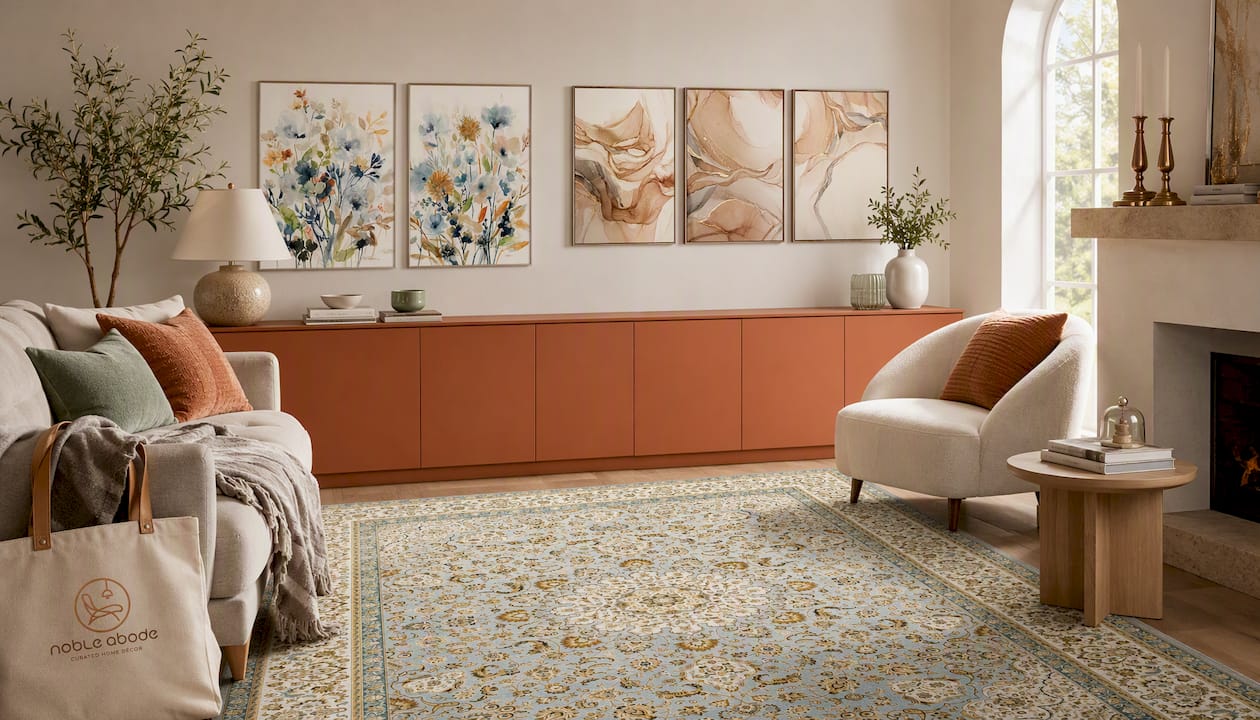
Once the rug is in place, finishing the room usually comes down to what’s on the walls. The floral leaf canvas art set pairs naturally with a floral rug’s palette, while the abstract marble wall art set works better for a more neutral, modern room. Browse the Ornate Room Rug page now to check sizing against your room measurements before you commit to a budget elsewhere.
Sources
- Why Are Good Rugs So Expensive? Here’s Why They’re Worth It
- How much do rugs cost
- Rugs Price Guide for U.S. Buyers: Costs, Quotes, and Savings 2026 – Current Cost
FAQ
How Much Does an Average Rug Cost?
Most rugs fall between $100 and $800, depending heavily on size and material, with synthetics at the low end and wool blends pushing toward the higher end of that range.
What Is the Average Cost of an 8x10 Rug?
An 8x10 rug typically runs $150 to $350 in synthetic materials, $400 to $1,000 for wool blends, and $1,800 to $4,200 or more for hand-knotted construction.
What Is the Average Cost of a 9x12 Rug?
A 9x12 rug generally costs $200 to $450 in synthetic fibers, $500 to $1,200 for mid-range wool blends, and $2,200 to $5,500 for premium hand-knotted pieces.
How Much Should a 5x7 Rug Cost?
A rug around 5x7 size aligns with the 5x8 range, typically $80 to $180 for synthetics, $250 to $600 for wool blends, and $900 to $2,200 for hand-knotted options.