

How High to Hang Art: The 57-Inch Rule Explained
Hang the vertical center of most artwork 57 inches from the floor. That’s the museum and gallery standard, and it puts art at average standing eye level in almost any room.
A few things override it. Furniture below the piece changes the math, wire slack changes your nail placement, and rooms used mostly for sitting call for a slightly lower center. Noble Abode applies this same standard when photographing and sizing pieces for real rooms, not just gallery walls.
- Center of artwork: 57 to 60 inches from the floor
- Above a sofa, console, or bed: leave a gap instead of measuring from the floor
- Always account for wire slack before marking the wall
Key Takeaways
Center most artwork at 57 inches from the floor, but let furniture gaps, wire slack, and seating height override that number when the room calls for it.
| Point | Details |
|---|---|
| Standard center height | Hang the vertical center of artwork at 57 to 60 inches from the floor. |
| Calculate, don’t guess | Use hook height = 57 minus half the art height, plus wire slack, before marking the wall. |
| Furniture changes the math | Leave a visual gap between the artwork and the furniture below, adjusting the distance to suit sofa, console, or headboard. |
| Gallery walls act as one piece | Find the cluster’s visual center, hang it at 57 inches, and space frames 2 to 3 inches apart. |
| Noble Abode sizes for real walls | Products like the Banksy-style canvas and metal line art set are scaled for standard furniture-gap rules. |
Table of Contents
- Why the 57-Inch Rule Works for Hanging Art
- How to Calculate Your Nail or Hook Height
- Hanging Art Above a Sofa, Console, or Bed
- Planning a Gallery Wall Without Guesswork
- Adjusting Height for Stairwells and Seated Rooms
- Choosing the Right Hooks, Anchors, and Wall Hardware
- Common Hanging Mistakes and a Pre-Hang Checklist
- How Noble Abode Applies These Rules to Real Rooms
- Hanging Art on Sloped or Uneven Walls
- Why Lighting Changes Where You Should Hang Art
- Adjusting for Different Ceiling Heights
- Securing Heavy or Valuable Art Beyond a Basic Hook
- Where the 57-Inch Rule Falls Short
- Noble Abode Pieces for Every Placement
- Sources
- FAQ
Why the 57-Inch Rule Works for Hanging Art
The 57-inch mark isn’t arbitrary. It’s an approximation of average adult standing eye level, and it’s the number museums and galleries have used for decades to keep collections feeling cohesive from room to room. Walk through any well-curated gallery and you’ll notice something: pieces of wildly different sizes still feel like they belong together. That’s no accident. It’s a single horizon line.
When every piece in a room shares the same center height, your eye reads the wall as organized even when the frames themselves vary in size, shape, and orientation. Skip this discipline and a room full of otherwise great art can look scattered.
A few adjustments matter:
- 57 inches works for most rooms with standard 8 to 9-foot ceilings.
- 60 inches can look more balanced in rooms with higher ceilings or larger-scale furniture, where 57 inches starts to feel low relative to the volume of the space.
- Rooms used mainly for sitting, like a living room centered on low sofas, often call for a slightly lower center. More on that shortly.
The goal isn’t hitting an exact number. It’s consistency across your walls.
How to Calculate Your Nail or Hook Height
The 57-inch rule tells you where the center of the art goes, not where to put the nail. Those are two different numbers, and mixing them up is the most common hanging mistake homeowners make.
Use this formula, drawn from standard gallery practice:
Hook height = 57 − (art height ÷ 2) + (distance from taut wire to top of frame)
Here’s how it plays out with a 24-inch tall canvas and 3 inches of wire slack:
- Start with 57 (your target center height).
- Subtract half the art’s height: 57 − 12 = 45.
- Add the wire slack measurement: 45 + 3 = 48.
- Mark your wall at 48 inches. That’s where the hook goes.
Before you drill anything, run this checklist:
- Measure the frame’s exact height, not the estimated size on the box.
- Pull the wire taut with the frame upright and measure from the top of the frame to the wire. Skipping this step is the single biggest source of hanging error, often throwing pieces 2 to 4 inches off target.
- Double-check your arithmetic before marking the wall.
Pro Tip: Measure the wire slack with a second person holding the frame exactly as it will hang. Wire measured while the frame lies flat on a table almost always reads too short.
Hanging Art Above a Sofa, Console, or Bed
Furniture changes everything. The 57-inch rule assumes a bare wall. Once a sofa, console, or headboard sits below the art, the furniture becomes the reference point, not the floor.
- Above a sofa: leave 6 to 8 inches between the top of the sofa back and the bottom of the frame. Size the art to a substantial portion of the sofa’s width, commonly about two-thirds. A single small frame centered over a large sectional reads as an afterthought, not a design choice.
- Above a console or credenza: leave 4 to 8 inches between the surface and the bottom of the frame, and factor in whatever sits on top, a lamp or a stack of books eats into that visual gap.
- Above a headboard: leave 4 to 8 inches above the headboard, and center the piece over the bed itself, not necessarily the headboard, since headboards are often narrower than the mattress.
The most common sizing mistake is choosing art that’s too small for the furniture beneath it, a 16-inch square canvas over an 84-inch sofa gets swallowed by the wall around it. The fix is usually simple: size up, or group two or three smaller pieces into one wider composition that fills the same visual footprint. A ready-to-hang 36x24 canvas lands close to that two-thirds ratio for many standard sofas.
Planning a Gallery Wall Without Guesswork
A gallery wall isn’t a collection of individually hung pieces. It’s one composition, and it needs to be measured that way. Treat the entire cluster as a single unit, find its visual center, and hang that center at 57 inches, the same standard you’d use for a lone canvas.
- Lay every frame out on the floor first and arrange them until the spacing and balance feel right. This is the only way to avoid a wall full of patched nail holes.
- Trace paper templates for each frame and tape them to the wall. This lets you test the layout before you drill a single hole.
- Keep 2 to 3 inches of space between frames so the grouping reads as cohesive rather than cluttered.
- Measure the overall height and width of the finished cluster, then find its center point. That center goes at 57 inches, matching every other piece on your walls.
Size the whole arrangement the same way you’d size a single canvas over furniture, roughly two-thirds of the sofa or console width below it. For a deeper walkthrough of spacing templates and layout math, Noble Abode’s gallery wall layout guide covers the planning stage in more detail.
Adjusting Height for Stairwells and Seated Rooms
Standard rules assume a flat floor and a standing viewer. Neither is always true.
Stairwells move the floor reference with every step, so hanging from a fixed 57-inch line looks crooked against the angle of the stairs. Instead, measure 57 inches up from the tread directly beneath each piece. This keeps the diagonal line of your artwork parallel to the staircase itself, which is what actually reads as intentional. Noble Abode’s guide to art for narrow hallways covers adjacent placement challenges in tight vertical spaces.
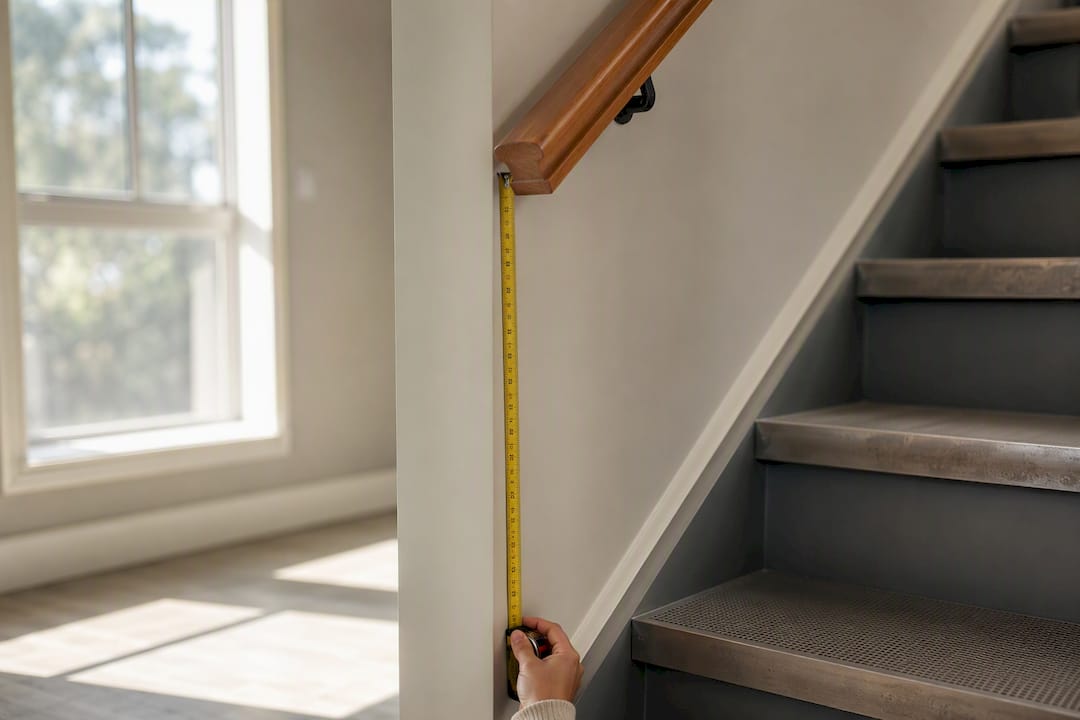
Tall ceilings don’t mean you should hang everything at 66 or 70 inches just to fill the volume. That usually just puts the art out of comfortable viewing range. Better options: increase the scale of the piece itself, or stack two pieces vertically. A modest raise to 60 inches is fine; going much further usually isn’t.
Seated rooms, dining rooms, reading nooks, spaces built around low furniture, benefit from a slightly lower center, roughly 54 to 58 inches, since the primary viewer is sitting, not standing.
Choosing the Right Hooks, Anchors, and Wall Hardware
The hardware you use should match the actual weight of the framed piece, not a guess. A picture hook rated for 20 pounds shouldn’t hold a heavy framed canvas with glass, and drywall without an anchor rarely holds anything beyond the lightest poster frame.
- Drywall: use rated anchors for anything over a few pounds; a bare nail into drywall alone is only reliable for very light, small frames.
- Masonry or brick: requires masonry screws or anchors rated for the wall type, standard drywall anchors won’t grip.
- Heavier or oversized pieces: use two hooks spaced along the wire, or a French cleat system that distributes weight across the wall instead of one point.
- Tools worth having on hand: tape measure, level, and a stud finder to confirm you’re anchoring into something solid.
Pro Tip: Have a second person hold the frame upright against the wall while you confirm the taut wire measurement one last time. It takes thirty seconds and catches almost every math error before it becomes a hole in the wrong spot.
Common Hanging Mistakes and a Pre-Hang Checklist
Most hanging problems trace back to the same handful of errors.
- Hanging to the top of the frame instead of measuring to the center, this is the single most common mistake and the fastest way to end up with mismatched heights across a room.
- Forgetting wire slack. Skipping this measurement throws the actual center off by 2 to 4 inches even when your math on paper was correct.
- Sizing art too small for the furniture beneath it, leaving the wall feeling unbalanced no matter how good the piece is on its own.
- Skipping the level. A slightly crooked frame is far more noticeable than a frame hung an inch off the ideal height.
Before you drill: measure the piece, calculate hook height using the formula above, mark the wall, dry-run the layout on the floor or with paper templates, level it, and use hardware rated for the actual weight. When in doubt between two heights, choose the lower one. A slightly low piece looks intentional; a slightly high one looks like a mistake.
How Noble Abode Applies These Rules to Real Rooms
These aren’t abstract measurements to Noble Abode. Every product in the catalog gets sized and photographed with the 57-inch standard and furniture-gap rules in mind, because a beautifully made piece still falls flat if it’s hung wrong.
- A floral leaf canvas set works well as a console or small sofa statement piece, sized to fit the two-thirds width guideline.
- The three-piece metal line art set is built for gallery-style spacing in a bedroom or hallway.
…
Hanging Art on Sloped or Uneven Walls
Sloped ceilings and angled walls, common in attics, dormers, and converted lofts, break the standard center-height math because there’s no single consistent floor-to-ceiling distance to measure against.
Start by picking a fixed reference point rather than trying to average the slope. Measure 57 inches up from the floor at the point on the wall where the art will actually hang, not at the highest or lowest point of the slope. If the wall angles sharply, this local measurement matters more than any room-wide average.
For walls with a pronounced slope, smaller and lighter pieces generally look more natural than one large canvas, since a big frame will visually emphasize the wall’s tilt rather than distract from it. Grouping two or three smaller pieces, each hung level despite the surrounding slope, tends to read better than a single oversized piece fighting the angle.
Always hang the frame level to true horizontal, using a bubble or laser level, not level relative to the slanted wall or ceiling line. A frame hung “parallel” to a sloped ceiling looks crooked to the eye, even if it matches the architecture. This is one spot where trusting your level over your instinct matters most.
Uneven walls, common in older homes with plaster or settled framing, call for the same approach: measure and level from a true horizontal reference, use a stud finder to confirm you’re anchoring into solid material rather than an uneven patch, and don’t assume the baseboard or trim line is straight enough to measure from.
Why Lighting Changes Where You Should Hang Art
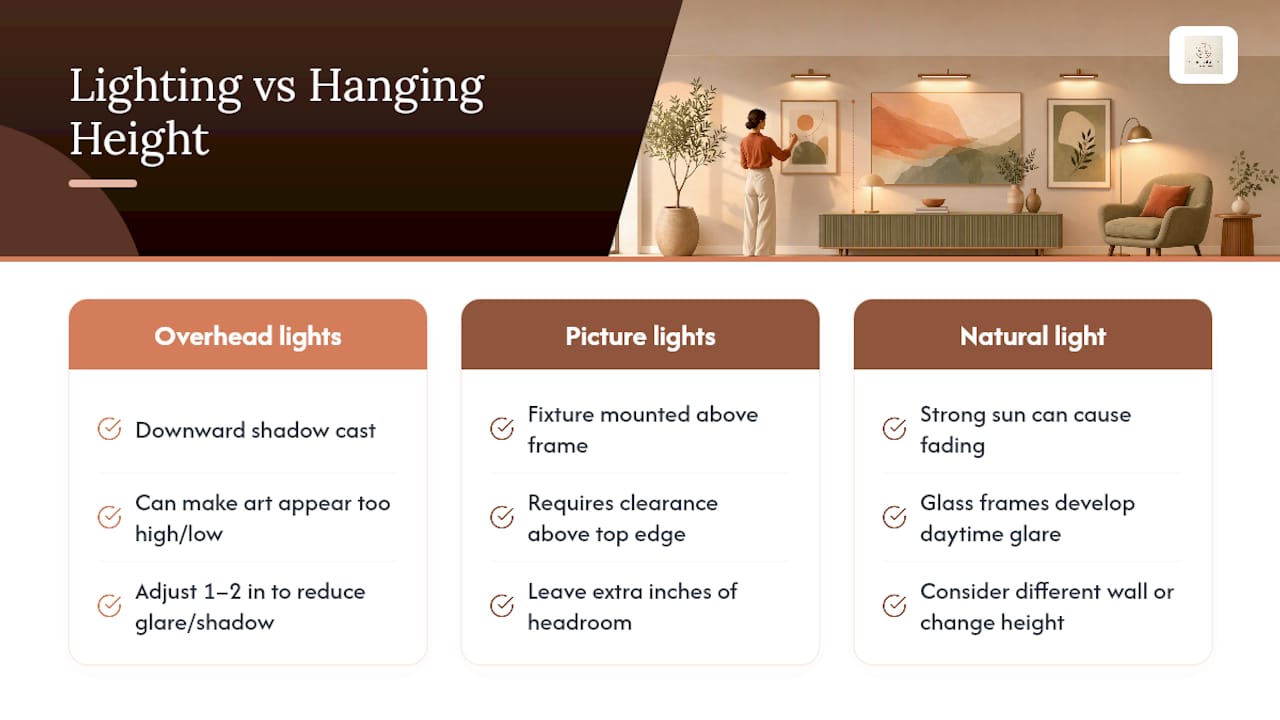
Height and lighting work together more than most people realize. A perfectly measured 57-inch center can still look wrong if the light source hits it at an odd angle or creates glare across the surface.
Overhead recessed lighting, especially when positioned close to the wall, tends to cast the frame’s shadow downward, which can make a piece hung at a technically correct height look like it’s sitting too high or too low depending on the throw of the light. If your room’s main light source sits directly above where the art will hang, consider whether a slight adjustment, sometimes just an inch or two, reduces glare on glass-covered frames or shadow lines on canvas.
Picture lights and adjustable art lamps, when used, are typically mounted above the frame rather than centered on it, which means the art’s position needs to account for enough clearance above the top edge for the fixture itself. If you plan to add a picture light later, leave a few extra inches of headroom above your calculated hook height when you first hang the piece.
Natural light matters too. Art hung directly in the path of strong afternoon sun, particularly canvases and unglazed prints, is prone to fading over time, so a wall’s lighting conditions can be a legitimate reason to choose a different wall entirely, not just adjust the height on the one you had planned. Glass-covered frames near windows can also develop distracting glare depending on hanging height and the sun’s angle through the day, worth checking at different times before committing to a permanent hook.
Adjusting for Different Ceiling Heights
The 57-inch standard was built around typical residential proportions, but a room’s ceiling height changes how that number actually reads on the wall.
In standard rooms with 8 to 9-foot ceilings, 57 inches works without adjustment. It sits comfortably in the middle of the wall’s visual field and matches average eye level.
In rooms with taller ceilings, 10 feet and up, a strict 57-inch hang can start to look low relative to the amount of empty wall space above it. Rather than simply raising the center height significantly, which pushes art above comfortable eye level, the better fix is usually to increase the scale of the artwork itself or stack two pieces vertically to fill the taller wall. A modest increase to 60 inches is reasonable; hanging much higher just to “fill the wall” tends to make the piece harder to actually see and appreciate.
In rooms with lower ceilings, under 8 feet, which shows up in some basements, older homes, or converted spaces, 57 inches can feel like it crowds the ceiling line. Dropping the center slightly, along with choosing a smaller-scale piece, usually reads more comfortably than trying to force standard proportions into a shorter wall.
Open-concept spaces with varying ceiling heights across one continuous wall present a specific challenge: pick one consistent height for the entire sightline rather than adjusting per section, since the eye catches inconsistency across a single wall far more easily than it does across separate rooms.
Securing Heavy or Valuable Art Beyond a Basic Hook
A single nail and a basic hook are fine for a lightweight print. They are not sufficient for a large framed canvas, anything behind glass, or a piece with genuine monetary or sentimental value.
For heavier pieces, the French cleat system distributes weight across a wider section of the wall rather than concentrating it on a single point, which meaningfully reduces the risk of hardware pulling out over time. This matters especially for anything mounted into drywall rather than a stud.
Always calculate hardware needs based on the piece’s true total weight, frame, glass, backing, and matting combined, not just an estimate of the canvas or print alone. Glass-fronted frames in particular are heavier than they look, and undersized hardware is a common cause of pieces coming loose months after installation.
For genuinely valuable or fragile pieces, two anchor points instead of one adds real security, and it also keeps the piece from swinging or shifting when a door closes nearby or the house settles. Museum putty or wall bumpers behind the bottom corners of the frame add another layer of stability, keeping the piece flush and reducing wall damage from movement over time.
If a piece is irreplaceable, an heirloom, a valuable original, or simply something you’d hate to lose, it’s worth confirming the wall itself can support the intended hardware before drilling. A stud finder confirms solid backing; for anything unusually heavy, anchoring directly into a stud rather than relying on a drywall anchor alone is the safer call.
Where the 57-Inch Rule Falls Short
The 57-inch standard earns its status because it works as a default, not because it’s a strict formula. Most articles on this topic present it as close to gospel, and that’s where the advice starts to mislead people.
The real skill isn’t memorizing 57. It’s recognizing when the room is telling you to deviate. A dining room built around a table where everyone sits, a stairwell with a moving floor line, a wall with 12-foot ceilings and one small print, none of these situations are served well by rigid adherence to a single number. The furniture-gap rules matter more than the floor measurement in the majority of real rooms, since most art in most homes hangs above something.
What gets underestimated is wire slack. It’s a thirty-second measurement that people skip constantly, and it’s the reason so many technically well-planned hangs still look off by an inch or two. If you take one thing from a measurement-heavy topic like this, take that step, not the headline number.
Prioritize scale and furniture relationship first, exact height second. A well-scaled piece hung an inch off standard still looks intentional. A perfectly measured piece that’s too small for the wall behind it never will.
— Stephane
Noble Abode Pieces for Every Placement
Once you know your target height, the next decision is which piece actually fits the wall and the furniture beneath it. Noble Abode’s collection is sized and curated with these exact placement rules in mind, so matching a piece to a scenario doesn’t require extra guesswork.
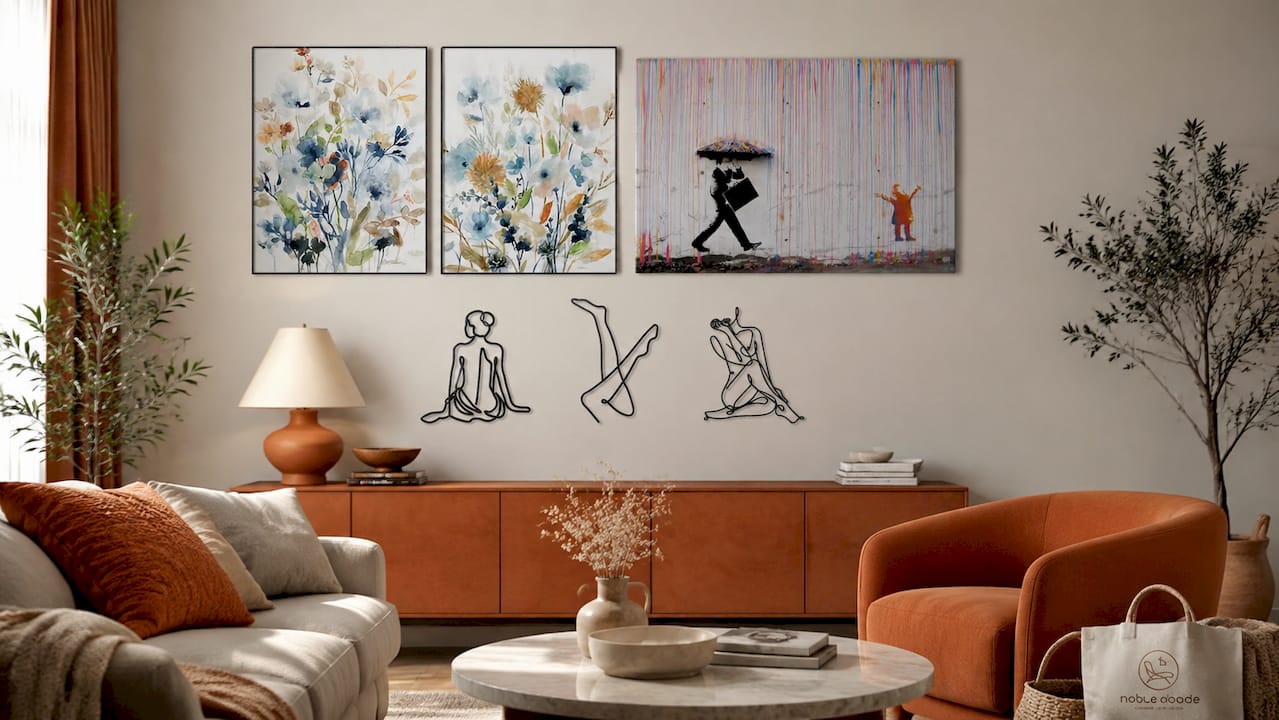
For a sofa wall, the Banksy-inspired 36x24 canvas is sized to land near the two-thirds-width guideline for a standard-to-large sofa, and it arrives ready to hang. For a console, credenza, or smaller wall, the floral leaf canvas duo offers a mid-size statement without overwhelming the surface below it. For gallery-style clusters in bedrooms, hallways, or bathrooms, the three-piece metal line art set is designed as a grouped set, which simplifies spacing since the pieces are made to hang together.
When sizing any piece, use the two-thirds rule for single canvases and consider a matched set when a single frame won’t fill the wall’s width comfortably. Pairing a Noble Abode piece with complementary room accents, like those in Henna For Fun’s room decor collection, rounds out the styling once your art is hung. Browse the full wall art collection to find the size and finish that fits your wall.
Sources
- What’s The Best Way to Hang a Picture? Our Expert Guide to Displaying Art in Your Home | Architectural Digest
- How High to Hang Art: The 57-Inch Rule and Every Exception | Austin Gallery
- How to Hang Art — Height Rules, Hardware & Gallery Walls | FindArtInfo
- What is the “right” height to hang a frame? | Framebridge
FAQ
What Is the 2/3 Rule for Hanging Pictures?
The 2/3 rule says your artwork’s width should equal roughly two-thirds to three-quarters of the furniture width beneath it, keeping a sofa or console from overwhelming a piece that’s too small.
Should Art Be Hung at 57 or 60 Inches?
Fifty-seven inches is the standard museum reference point for most rooms, while 60 inches often looks more balanced in rooms with taller ceilings or larger-scale furniture.
How High Should Art Be Hung With 12-Foot Ceilings?
Keep the center near 57 to 60 inches rather than raising it significantly, and fill the extra wall height with larger-scale art or a stacked composition instead.
What Is the 60-Inch Rule for Hanging Pictures?
It’s a variation of the standard center-height guideline, used instead of 57 inches when a room’s proportions, ceiling height, or furniture scale call for a slightly higher visual center.
How Do I Hang Art Above a Bed Without a Headboard?
Center the piece over the mattress width rather than any furniture, and keep the bottom edge roughly 4 to 8 inches above where a headboard would typically sit.